Treasure Trove of Sri Bhagavan’s Grace
In this chapter
Prabhulinga Leelai
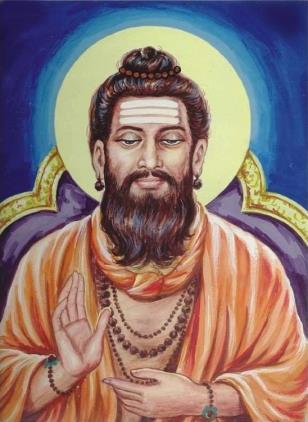
Allama Prabhu
“Prabhulinga Leelai” is a 15th century Vira saiva work, written in Kannada and comprising 1,111 verses. It was originally composed when a Vira saiva scholar, Camarasa, was challenged to produce a work that was greater than either the Mahabharata or the Ramayana. Shortly afterwards Camarasa had a dream in which Virabhadra, the son of Lord Siva, asked him to write a long poem. Camarasa subsequently composed “Prabhulinga Leelai” in eleven days, after which he presented it at the Court of his King, where it was approved by both the Monarch and the scholars who had challenged him.
This Kannada work was translated into Tamil verse by Sivaprakasa Swamigal, an accomplished Vira saiva poet and scholar, in the seventeenth century. The Tamil version was read by Sri Bhagavan, who referred to it in His conversations with visitors on a number of occasions.
* * *
Then in the course of conversation he related that a ray of light has been found which, when projected, does not reveal the operator but enables him to witness the scene. So it is with siddhas. They are only pure light and can see others, whereas, they cannot be seen by others. For example Prabhulinga, while touring in the North, came across Goraknath. The latter displayed his yogic powers e.g., when his arm was cut by a sword, the sword was blunted without inflicting injury on him. This is making the body proof against injury (kayasiddhi). Prabhulinga offered himself to be cut. When the sword was thrust, it passed through and through his body as if it was air and there was no injury on the body. Gorak was astonished and offered himself as the disciple of Prabhulinga.
Again, there was a dialogue between Siva and Parvati in Kailas. Siva said that Allama was one who would not be affected by Her blandishments. Parvati wanted to try it and so sent Her tamasic quality to incarnate as a king’s daughter on the Earth in order that she might entice Allama. She grew up as a highly accomplished girl. She used to sing in the temple. Allama used to go there and play on the drum. She lost herself in the play of the drum. She fell in love with him. They met in her bedroom. When she embraced him he became intangible. She grew lovesick. But a celestial damsel was sent to remind her of her purpose on the Earth. She resolved to overthrow Allama but did not succeed. Finally she went up to Kailas. Then Parvati sent Her satvic quality who was born as a Brahman sanyasini. When she surrendered to Allama she realised his true greatness.
— from “Talks With Sri Ramana Maharshi” No.334
Akka Mahadevi – The Genuine Mystic
Born as the ‘Satva’ aspect commanded by Goddess Parvati, the baby named as Mahadevi, brought up by pious parents, grows up into an young maiden. Lord Siva also commands his Bhoota-ganas to appear in the World performing austerities and offering worship to Him at many places.
Keen spiritual longing shift the emphasis from the wonder of the outside universe to the significance of the self within. She instinctively felt that man can never be fully and wholly fulfilled through self-discipline and knowledge, though self-discipline is arduous and knowledge superior. A more human approach to God lies through pure and unselfish love which withdraws most of the obstacles that the ego interposes between the Divine and the devotee.
The Divinity already inherent in her began to manifest all its radiance while she was yet in her teens, i.e., at the age of eight she was initiated into the secrets of Linga. At the age of 16 this concept ripened into full resolve and she could state with firm conviction:
“Listen Oh! mother, I love him He is the one, the only one He knows no birth and death He is uncabined by caste or clime He is boundless, changeless, formless He is beautiful beyond comparison All other fade away and die at last I will have none of them My Lord shall forever be The One Channamallikarjuna.”
A turning point, however occurred in the life of Mahadevi when she, along with many others, had come to see the procession of the king, of that place. The king saw Mahadevi among the crowd and was smitten with love for her. With a desire to marry her, the King started negotiations with her parents. But Mahadevi refused to marry the King. She summarily rejected his pleadings, cravings and ravings. The King brought pressure to bear. For the sake of her parents, she enters into a conditional marriage. When the King breaks the condition, she quits the palace. All of a sudden a psychic conversion took place in her and she left her home and her parents. She left even the clothes she was wearing. Being guided by an inner urge she began to wend her way towards Kalyana, which was then a place of pilgrimage. Her parents and even some friends tried to dissuade her by picturing the difficulties she might have to encounter on the way. To them her answer was poignant, yet to the point:
“I am no helpless woman I utter no futile threats I am nothing daunted I shall dare hunger and pain I shall steal out of withered leaves A wholesome meal And on pointed sword Shall make my bed. I am ready for your sake To dare the worst To die this instant The readiness is all Oh! my Channamallikarjuna”.
With unflinching faith in God she marched on passing through hills and dales, through shrubs and thickets, through woods and planes and reached Kalyana where she was accosted by Basaveshwara, the founder of Anubhava Mantap. But Allama Prabhu, the President of Anubhava Mantap, put her many questions which she answered in a singularly charming manner. She wanted to participate in the proceedings of the Anubhava Mantap.
Here is an interesting dialogue between Allama Prabhu and Akka Mahadevi:
Allama Prabhu: Where from didst thou come, Madam? Tell us who thy Lord is, otherwise our saints forbid thee.
Akka Mahadevi: God Channamallikarjuna is my Lord. I am not at all related to any mortal human of this world.
Allama Prabhu: Thy profuse hair have hidden the body as a garment. God Guheshwara regards this garment as improper.
Akka Mahadevi: Of what use is it if the body turns dull and dark, if it appears blithe and bright? When the heart is rendered pure by the grace of Channamallikarjuna, the complexion of body is of no consequence.
Allama Prabhu: If thy heart is pure, why dost thou hide thy body with the hair? That may be due to inward bashfulness which expresses itself outwardly. This our God Guheshwara does not like.
Akka Mahadevi: I hide it so that your saints may not be enticed.
When Mahadevi came to Kalyana she found herself in the midst of the saints who were near and dear to God. Communion with the saints brought a great change in her life. The subtle but irresistible influence of the saints enabled Mahadevi to scale the heights of spiritual life. She speaks in eloquent terms of the benefits she derived from the company of the saints.
“I sing, dance, hear, walk and speak in happy fellowship with thy saints, Oh! Lord…. Through conversation with the blessed ones, I have gained respite from my grief. Oh! Lord, I cannot bear parting from the blessed ones who know Thee. … When a soul rubs another and divine experience is born, the traits of the body are all burnt. …. the infirmity of my body is no more; the tremor of my senses is now stilled; the mind perplexed is now calm and serene… all this I gained through the company of the saints. Basavanna’s devotion, Channabasvanna’s enlightenment, Madivala’s firm faith, Prabhudeva’s fearless and carefree state, Ajaganna’s clarity of perception, Nijaguna’s purity of conception, Siddharama’s trance state; the mellowing grace all these saints showered upon me, Oh! Lord.”
The communion with the saints brings wisdom to the simple, and sudden calm to those who are tormented by doubts. It floods the personality with new light and the passage from one spiritual state to another is achieved. At the moment of indecision it gives birth to authoritative commands which quell the sufferings of the self. By the communion with the saints even spiritual conversion is attained.
Akka Mahadevi proceeded to Shrishaila, the place of her last destination where she saw face to face God Channamallikarjuna and was absorbed by him in the plantain grove.
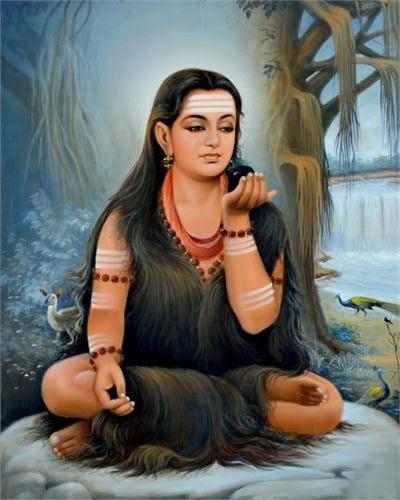
Akka Mahadevi
Life of Sri Siddharama
During one of his visits, Allama Prabhu arrived at the city where the workers of Siddharama were engaged in digging a huge pond. He went near the workers (Oddas) and asked them “in what belief does ‘Odda’ Raman engage you in this wasteful job?”. On hearing this, the workers are angered and there is war of words between Allama Prabhu and the workers. He then says “Go, tell your ‘learned fool’ whatever I have said. This enrages the workers even more. They start hurling stones at Allama. But to their wonder none of the stones hurt Allama, but were heaped like a small hill. Seeing him unhurt and standing upon the heap of stones, the workers begin to wonder as to “who is this man., may be a magician”. When they come near him planning to beat him to death, he appears at different places. Not knowing which person to kill and dazed at the happening, the workers rush to inform the news to their chief. When Siddharama arrives at the spot in a great rage thinking “who could be the person, daring to insult me? I would cut his tongue”.
Allama devar uses explicit and implicit derogatory words at Siddharama. Siddharama is Swollen with pride, as the possessor of the third eye; besides, has he not established numerous Lingas? Siddharama threatens to open his third eye, Prabhu, not the least ruffled, asks him if he could be a yogi in his violence. At these words, Siddharama opens his fiery eye; but the flame issuing from it is meekly absorbed in the soles of Prabhu’s feet. The fire then worships Allama devar’s feet and begins to burn the city. Many objects are burnt; The citizens are sorry; Allama devar taking pity on the plight of the citizens stops the fire spreading; the city now dazzles more than before. Siddharama's pride is destroyed; Good sense prevail on him; At this, Siddharama, realises his folly, instantly falls at Prabhu’s feet, and asks to pardon himself, for his mistake and set him on the right path.
Allama devar is very gracious on the surrendered Siddharama. Allama explains the Truth about the Self and effects of uncontrolled senses and transforms him from a yogi into a SivaYogi. Siddharama having realised that salvation cannot be attained through philanthropic acts and worship of Lingas at Temples, falls at the feet of Allama and exclaims, there is no one who could be so much blessed as himself.
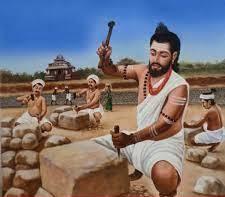
Siddharama
Life of Sri Marula Shankaradeva
This deals with an event of an adept, who apparently a simpleton, is well-versed in the supreme knowledge and light. The adept’s name is Marula Shankaradeva, precious little is known about his background.
He sat in the dust bin in front of Basava’s home. Though Basava caught glimpses of him, but failed to notice and recognize him and his accomplishments. He did not even say hello to Shankaradeva. Since Basava failed to recognize the greatness and accomplishments of Shankaradeva, Prabhu reveals the identity of Shankaradeva to Siddharama, and says it is hard for others to recognize the greatness of the realised. They may tread the world hiding their real identity. Basava regrets his oversight and indifference towards Shankaradeva.
The throng of the Saints assembled at the house of Basava, consequent upon the arrival of Prabhu, offer their meed and homage to Shankaradeva, who in turn pays homage to them all and feels himself blessed at the sight of Prabhu. Shankaradeva had for a long time been longing to see Prabhu. He was waiting for Prabhu to show up at the residence of Basava, for his intuition has suggested that Prabhu would sooner or later be showing up at Basava’s home. So Shankaradeva announces the end to his quest of meeting Prabhu and feels overjoyed at the sight of liberated one.
But the end of Shankaradeva is surcharged with electricity! It is unique and unprecedented. There are no parallel instances to compare. In the presence of Prabhu and other Saints, Shankaradeva vanishes into thin air without leaving a trace! At this turn of event all those who witnessed this transformation were somewhat shaken. They marvelled at his demonstration of the total identity of matter and radiation and the defiance of the physical laws of nature.
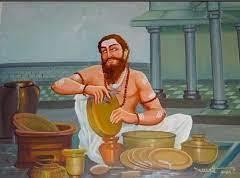
Marula Shankaradeva
Uppukootan
‘Uppukootan’ was born to ‘Parayi’ (untouchable) when the couple were in a place called `Ponnaani’ in Kerala.
He never had a name for himself, and people in general called him both by the names `Uppukootan’ and `Uppukotan’. `Uppu’ in Malayalam means salt. He made a living out of selling salt. He was also known for doing some tricks with salt. The name `Uppukotan’ is believed to have come because he used to extract salt from the sea in Ponnani. `Kottu’ means food. Since he made salt for his food (livelihood), people used to call him as `Uppukotan’. However, a more commonly accepted name is `Uppukootan’. ‘Kootan’ means one who is huge. People might have called him Uppukootan for his large and strong stature. Like how Vararuchi had told Parayi while asking her to put the baby there and come with him, the God who has given the baby a mouth will also provide for it! True to this, despite being an orphan, Uppukootan was very strong and well built.
Uppukootan is believed to have been brought up by a Christian / Muslim. He had a long and rough beard, and was always seen travelling through forests and mountains, across rivers and towns, clad in a dirty rag and carrying a cloth bag. There was something very obscure about his business. He would bring salt from Palghat to Ponnaani and sell there (where salt is abundantly available), and collect cotton balls from Ponnani and sell in Palghat, where it was already available in plenty.
Like the rest of the siblings, Uppukootan also was a divinely gifted being. He had special affection towards children. Though many used to ask him why he always carried salt, he never bothered to reply. Once he was walking by a river, and was contemplating on his own life. The river and his life had a lot of similarities, he thought. The river is full of whirlpools, and underwater currents unseen to the common eyes, so too was his life. Like the river that had to move away from its origin at a very young age, he too was separated from his mother. And like the river finding solace in finally merging into the Ocean that is salty by nature, he too, found solace with the salt bags!
Isn’t there a Biblical saying, `Ye are the salt of the Earth!’.
Uppukootan converts salt to rice cakes!
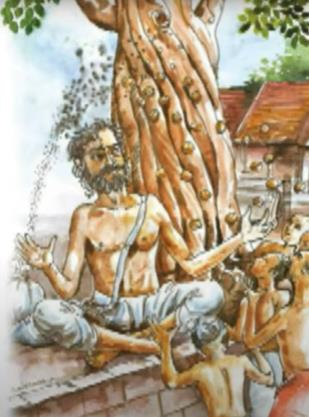
Once while returning from a long journey, he was eagerly surrounded by a bunch of little children. He sang, danced and played with them for a long time. The children now felt hungry and started searching his bag, and found nothing. Uppukootan put his hands inside a salt bag, threw up a handful of salt, and to the wonder of the children around, the salt particles came down as rice cakes (Aappam). Everyone was wonderstruck. When the children asked how he could do it, he replied, “This is control over the hand and the mind, if you practise, you can do it too!”
Uppukootan saves the children from local thugs
This story happened in the market place of Naathaapuram. The children there were eagerly awaiting him there. Uppukootan would come there carrying a huge sack of salt, which even a horse could not carry. The children would lovingly call him as `Uppaappa’ and search inside his bags for some goodies. Their Uppaappa arrived, and children heartily took the sweetmeats that Uppukootan had got while in his travel. Amidst the merry time, a set of local thugs came there. The children fearfully clung on to their Uppaappa, saying that the thugs will kidnap them and make them as slaves. Assuring them of their safety, he took a toy whistle from one of the boys and started blowing it. Many snakes sprang up from inside the whistle and landed on a tree top. The snakes then fell down one by one on the thugs. Fearing for their lives, they fled away.
Uppukootan meets Agnihotri
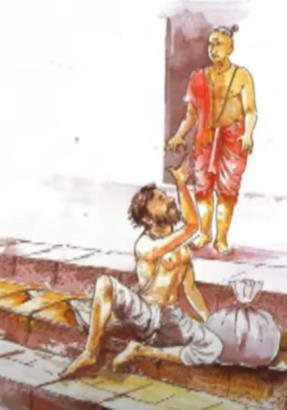
Once, while selling salt, Uppukootan ended up at the house of Agnihotri (Brahmin Priest). They were unaware of the fact that they were siblings. The tired Uppukootan called out asking if the house needed salt. When Agnihotri came out of the house, Uppukootan was captivated by the charisma of Agnihotri. Deep inside his heart, he felt a sense of great respect for this pious looking Brahmin. Sitting on the chair in the veranda, Agnihotri enquired, “What is your name?”, to which Uppukootan replied, “People call me Uppukootan”. “Oho, so it’s the people who have given you that name. Don’t you have a name of your own?” enquired Agnihotri. “What’s there in a name Sir, isn’t it just an indication?” Agnihotri said, “But I have a name of my own, and it is Agnihotri. So, do you mean that this also has no significance?”. “Of course! Yes Sir. This name indicates the greatness of your personality and acts. It commands great respect indeed” replied Uppukootan, with an unblemished smile. Agnihotri looked carefully at Uppukootan, and said, “You seem to have the smile of Naranathu and the voice of Paakkanaar. Do you know them?” asked Agnihotri, to which Uppukootan replied. “Yes, I know them. I also noticed that you have the voice of Naranathu and the smile of Paakkanaar”. What followed was a stretch of deep silence.
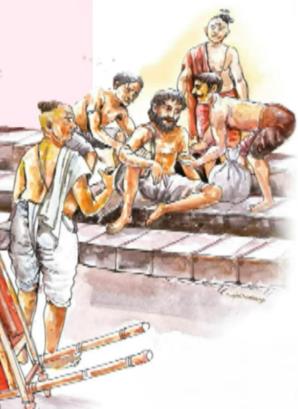
Breaking this spell of time came in Agnihotri’s father-in-law, in an aristocratic palanquin. Agnihotri got up in reverence to receive him. Uppukootan was sitting in the veranda stairs, and did not bother to get up. When reprimanded by Agnihotri’s father-in-law, Uppukootan replied so – “When there is ample space for five people to pass by, why should I get up?” Agnihotri’s father-in-law instructed the men carrying his palanquin to move him away. Like Bheemasena who could not move the old monkey (Hanuman) while on his way to get Paarijaata, the men failed terribly in their task. Forget moving him, they could not even move his salt sack by an inch. Realizing that this is not a common man, they withdrew from their action. Thus scorning at the Brahmin’s false pride, Uppukootan then got up and walked away, carrying his sack of salt.
Uppukootan thus condemned the stigma associated with caste differences!