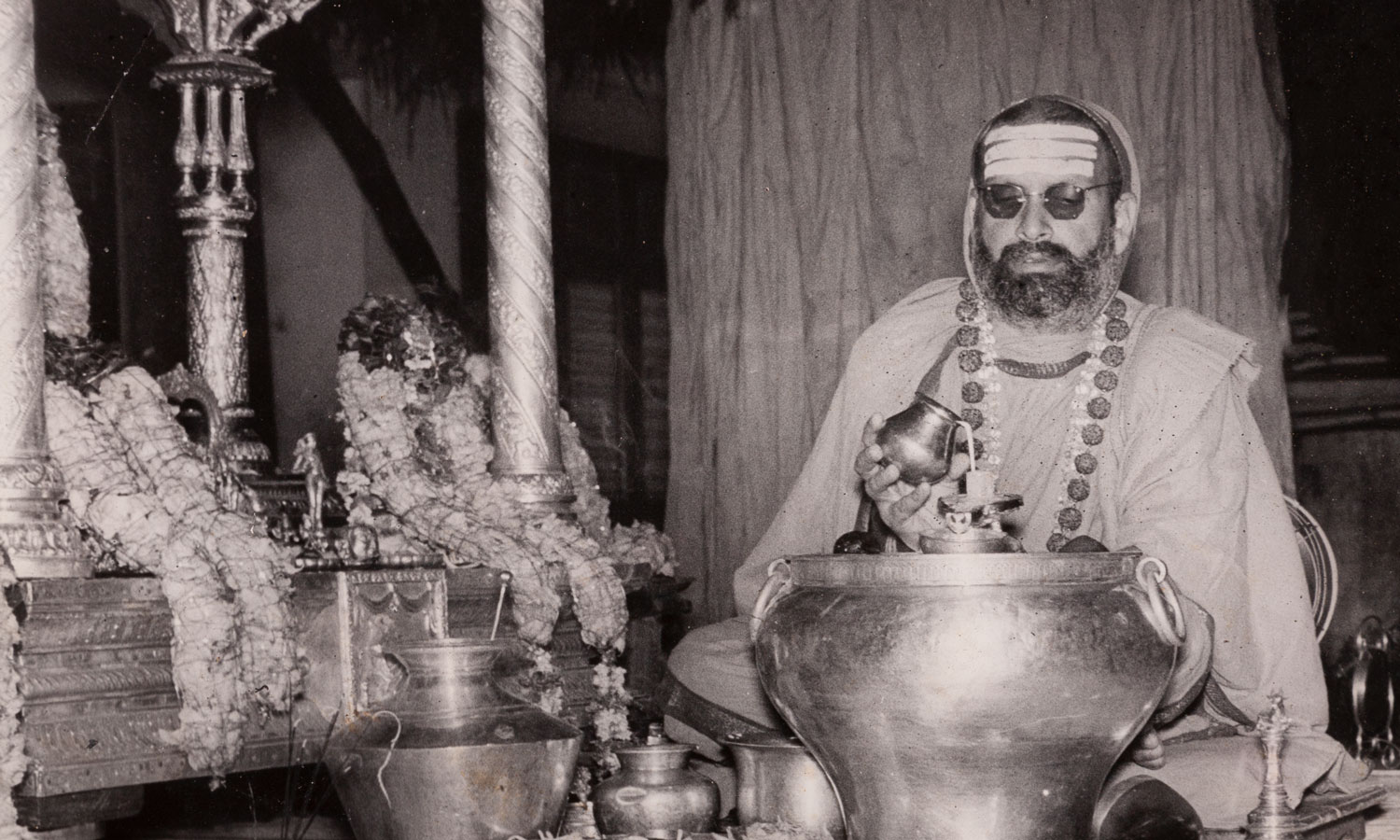
Born to Venkatalakshmi Ammal and Rama Sastry, a primary school teacher, on November 13, 1917, the day of Deepavali at Bangalore,He was named Srinivasa. Even as a child, Srinivasa was ardently pious. At school, Srinivasa was an obedient and conscientious student. Several were the instances of His boyhood days when He displayed exceptional qualities of wisdom and farsightedness. From a very young age, He began expressing to His friends a desire to renounce the world and attempt to see God.
Srinivasa’s Upanayana(sacred thread ceremony) was performed at the Math’s expense at the Sharadamba temple in Sringeri. Ordained by the Gayatri Upadesha, Srinivasa stepped into the stage of brahmacharya, following which He sought to stay back and learn the holy scriptures at the Math.
Chosen successor
Srinivasa was unquestionably the most brilliant of the students at the Math and came up with thought-provoking interpretations of the Sanskrit verses that He was taught. He slowly caught the eye of the Jagadguru, the great Jivan Mukta, Sri Chandrasekhara Bharati Mahaswamigal.
When the Jagadguru decided to choose His successor, the choice fell rightly on Srinivasa. Necessary arrangements were made. On May 22, 1931, Srinivasa was initiated into the holy order of Sanyasa, even before He had attained the age of 14. The Guru named him as Abhinava Vidyatirtha and taught the sacred Mahavakyas that signify the identity of the individual soul with the ultimate reality. The Guru named His holy successor designate Abhinava Vidyatirtha, perhaps because He foresaw that His illustrious disciple would equal the great Yogi, the 10th Pontiff of the Peetham, Sri Vidya Shankara Tirtha, in Yoga.
Sensing the capability of His disciple, the Jagadguru who was least interested in administrative affairs, wished to be relieved of the responsibilities of pontifical duties. He handed over the running of the Mutt to His disciple and entrusted the performance of the Chandramoulishwara Puja.
Ever since He was initiated into Sanyasa, Sri Abhinava Vidyatirtha was extremely keen on being an ideal ascetic. Mere reading of the scriptural texts could never satisfy His need for perfection. The Acharya was temperamentally inclined to the royal path of Yoga. Maharshi Patanjali lists eight steps leading to the acme of Yoga. He aphorises : Yama (restraint), Niyama (Observance of rules), Asana (posture), Pranayama (regulation of breath), Pratyahara (abstraction), Dharana (concentration), Dhyana (contemplation) and Samadhi (trance) are the eight limbs of Yoga. Sri Jagadguru Chandrasekhara Bharati Mahaswamigal initiated the Acharya into the process of meditative contemplation when He was just 15 years of age. By the time Acharya attained 16 years of age, the deep contemplation of the Self became natural. A few hints from the Guru regarding meditation were sufficient for the Acharya, who practised meditation and soon began to attain Savikalpa Samadhi. He went on to perfect Nirvikalpa Samadhi (attained by concentration on the attributeless Supreme). He was a Jivan Mukta before He was 20.
Strange as it may seem, His formal lessons in Vedanta commenced much after he had attained perfection in yoga. His guru expounded the Bhagavad Gita Bhashyam, Brahma Sutra Bhashyam and Bhashyam on Isa, Kena, Katha and Taittiriya Upanishads. To the Acharya, these lessons merely served to confirm what He had already learnt through His personal experiences earlier in life.
On September 26, 1954, Sri Chandrasekhara Bharati ended His mortal life in the waters of the Tunga. About 20 days later, on October 16, 1954, Sri Abhinava Vidyatirtha formally took over as the 35th Jagadguru Shankaracharya of the Sringeri Sharada Peetham.
Able Administrator
Many were the tasks that lay ahead of the new Jagadguru. As his guru had often remained secluded, he had not toured much. Naturally devotees all over the country were eagerly awaiting the visit of the Acharya to their cities. There were other administrative problems of the Math that needed to be sorted out immediately by the new Jagadguru.
He started improving the affairs of the Math, built a new guest house to stay for the pilgrims coming to Sringeri to receive the blessings of Goddess Sharadamba and the Jagadguru, renovated the Ambal and Ganapati shrines, converted a huge bamboo forest into cultivable land, laid roads of access in Sringeri and introduced irrigation facilities.
He was also an able administrator. Though in 1959 the government handed back the administration of the Math to the Acharya, it was stripped of all the Jahagirs earlier in its possession. This was a big blow to the income of the Math. The Math had to be content with an annual compensation of a couple of lakhs of rupees. When the news was sorrowfully told to the Acharya, he was unperturbed and replied, “The Jahagirs were non-existent in the Bhagavatpada’s time. The Math had been functioning quite well even before the lands were granted. Likewise, it shall carry on now without them. There is nothing to worry about.”
He was equally adept in the art of management. Power in the Math was initially concentrated in the hands of a few in the administrative cadre. This provided scope for bottlenecks. The Acharya effectively implemented the well-known management principle of decentralisation. It is common knowledge that favouritism is always detrimental to effective administration. The Acharya gave no room for partiality and the relatives of His former days were no exception.
He established branch Math’s at various places and consecrated many temples.
The Acharya was also blessed with incredible memory. When questioned about the accuracy of His recollections relating to numerous details He said: “I used to remember details of the construction work that was carried out in my presence. In fact, I could even recall the exact number of nails used for a particular task as also the number of strokes with which each nail was driven in, provided the task was carried out in my presence.”
In April 1964, the Acharya started from Sringeri on his first all-India tour during which he met the Shankaracharya of Dwaraka. The meeting of the two Jagadgurus was a great event and was hailed by the press and the public alike.
Fifteen years later, during the Jayanti of Shankara Bhagavatpada in May 1979, the Acharya organised a historic summit meeting at Sringeri with the Jagadguru Shankaracharyas of the three other Mutts of Dwaraka, Badri and Puri, established by Adi Shankara, thus showing the unity of spiritual strength of the religious leaders.