Sri Chandrasekhara Bharati III
34.1912 - 1954Dakshinamnaya Sri Sharada Peetham, Sringeri
3 chapters
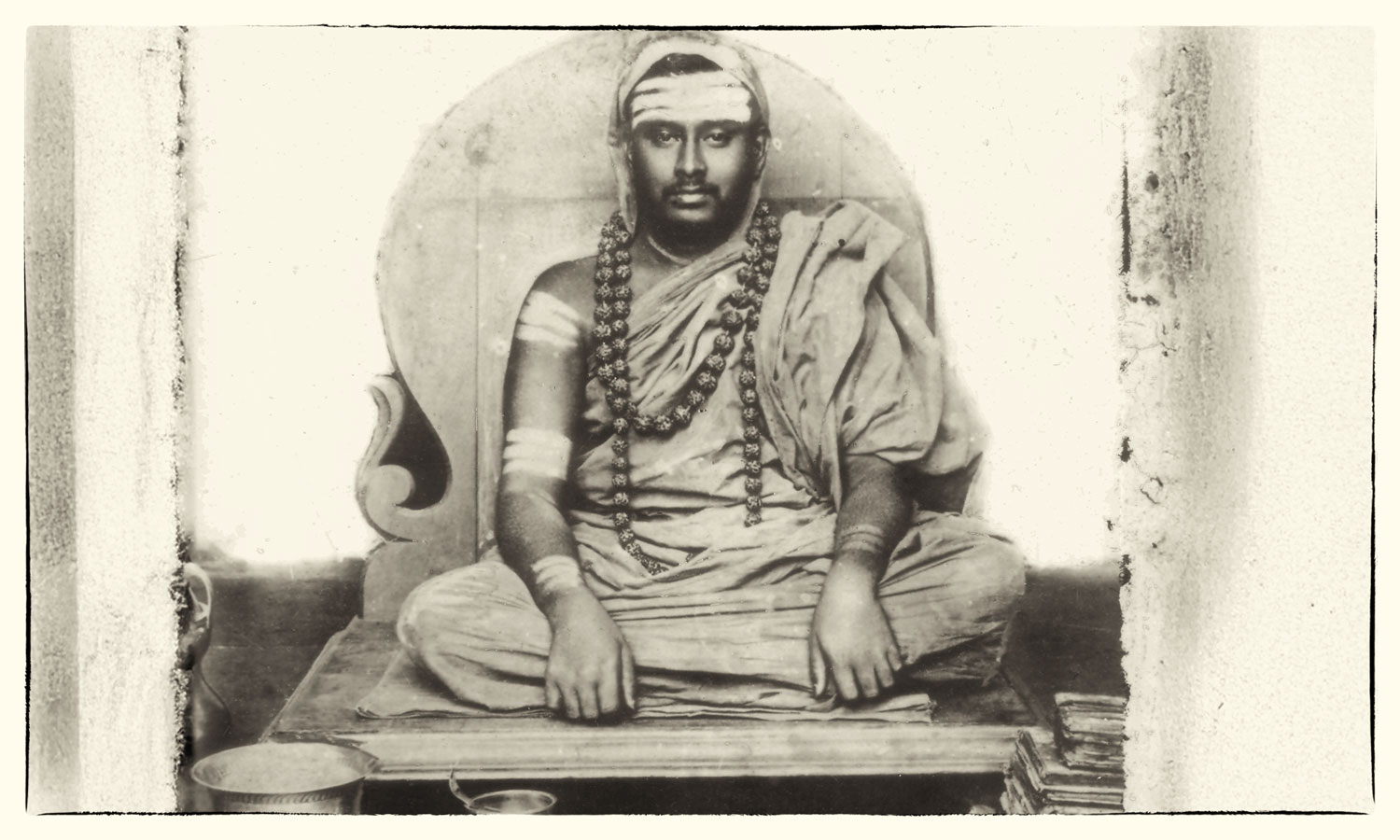
Sri Chandrashekhara Bharati Mahaswamiji
सदात्मध्याननिरतं विषयेभ्यः पराङ्मुखम् ।
नौमि शास्त्रेषु निष्णातं चन्द्रशेखरभारतीम् ॥
Jagadguru Sri Chandrasekhara Bharati MahaswamiJi as the 34th Acharya of Sringeri Sharada Peetham was both a scholar and saint of outstanding eminence. From His boyhood days, His enthusiasm for dharma and good conduct and His devotion to guru and God were boundless. When I think of His benevolent qualities, I am reminded of a sloka in Vidyaranya’s Sankara Vijaya.
द्युवनान्त इवामरद्रुमा अमरद्रुष्विव पुष्पसञुयाः ।
भ्रमरा इव पुष्प सञुयेषु अतिसंख्याः किल शङ्करे गुणः ॥
Countless are the trees in the garden of Kalpa Vrikshas and equally so are the flowers on
those trees and the bumble bees on those flowers. Similarly, the good qualities of Sankara
are also beyond any count.
From his early years, Sri Chandrasekhara Bharati came under the influence of his guru Sri Sachchidananda Sivabhinava Narasimha Bharati, who took a personal interest in his education. He studied at the pathasalas of Sringeri and Bangalore, and attained exraordinary proficiency in Sastras.
At the age of 20, he became the head of the Sringeri Sharada Peetham and was very efficient in the conduct of its affairs. He was a great saint in the real sense, as he led a simple life without any worldly desires inspite of his exalted position at the prestigious Sringeri Samsthanam.
He had the rare power to transform, by a mere glance, even the non-believers of God into believers. He was able to explain, with great ease and humility, any subject that his sishyas brought to him. Although he was a very learned man, he did not have the least ego. In the later years he did not take much interest in the affairs of the mutt, but he had an ingenious capacity to set right even the slightest mistake that occurred.
Sri Chandrasekhara Bharati attained a high dispassion in life and wanted to provide more time for his own tapas. At the age of 40, he nominated his successor. It should be said that he incarnated in this world primarily to guide people in dharma.
His method of worshipping the Lord served for all as an example to follow. He was indeed so devoted as to extend, for example, the hours of puja on Narasimha Jayanti day from noon to dusk, which was the time Narasimha avatara actually took place.
सन्तु नमांसि सहस्रं श्रीमद्भ्यश्चन्द्रशेखरगुरुभ्यः ।
येषां हृदये वदने नामनि पूते च भारती लसति ॥
Thousand prostrations to the great saint, Sri Chandrasekhara Bharati, who not only bears the
name of Bharati (Sharada), but also bears her in his heart as well as his speech.
H.H. Sri Chandrasekhara Bharati Mahaswamigal adorned the Vyakhyarta Simhasana, Throne Of Transcendental Wisdom from 1912-1954.
(Excerpts from the English translation of Jagadguru Bharati Tirtha Mahaswamiji)
Biography of Sri Chandrashekhara Bharati Mahaswamiji
सदात्मध्याननिरतं विषयेभ्यः पराङ्मुखम् ।
नौमि शास्त्रेषु निष्णातं चन्द्रशेखरभारतीम् ॥
Unattached to objects of the senses, Immersed in the Self day and night,
Skilful in sacred lore, which He does live; My salutations to Chandrasekhara Bharati!
A Jivan Mukta is rare. Some time, in some country a great soul takes birth. One must be fortunate even to get a glimpse of such a being, for it ennobles his life. To this parampara of jivanmuktas belonged Sri Chandrasekhara Bharati, the 34th Acharya of Sringeri Sharada Peetham.
Laureate among the scholars who were patronised by Sri Nrisimha Bharati VIII was Ishwari Subba Shastri. Later in life he retired to the Himalayas as a recluse. His only son Gopala Shastri inherited his father’s flair for learning and outshone him in his detachment. His spouse Lakshamma bore him eleven children and each of them died in their infancy. The couple sought the blessings of Sri Sacchidananda Shivabhinava Nrisimha Bharati Swamiji whom they looked up to for everything. When they met the Acharya, due to his spiritual insight, he could see the happy events in store not only to their family but also for the Peetham. It is said that the Acharya, while assuring them of the success of their pilgrimage, added that it would be in the best interest of their to-be-born son to be dedicated to Goddess Sharadamba.
On their pilgrimage to Gokarna on a Shivaratri day, Lord Mahabaleshwara appeared in the dreams of Gopala Shastri and Lakshamma, and assured them that they would be blessed with an illustrious son. Their hearts were filled with ecstasy. Soon the happy tidings came, Lakshamma had conceived her twelfth child. On Sunday, October 16, 1892, a son was born to this pious couple. It was the auspicious day of Ashwayuja Bahula Ekadasi (the eleventh day of the dark fortnight) in the lunar year Nandana. On the eleventh day the rituals of jatakarma and namakarana were done. The son was named “Sri Narasimha’. There is little doubt that Narasimha was an exceptional luminary who was born to teach, born to redeem. Even from his boyhood days he was introverted, had no attraction for the objects of the world.
He had his board and lodging in the house of Srikanta Shastri, the Agent of the Mutt. He was very fond of chanting the hymn Mookapanchasati. Once, while on way to the market, he was so immersed in the composition that he proceeded far beyond the limits of the Sringeri township. It was only when the recitation ended that Narasimha realised he had come far out.
Narasimha’s memory was prodigious, his intelligence was sparkling and his conduct was humble and simple. He was admitted to the local Anglo-vernacular school run by the Government. Narasimha used to study Sanskrit at home and English at school. The Brahmopadesa of Narasimha was performed when he was eight. He was regular in the performance of sandhyavandana three times each day and agnikarya, worship of fire god, twice daily.
Narasimha excelled in his class. In his twelfth year, Narasimha took the lower secondary examination and topped the list in the first division. However, Narasimha was just not made for a worldly career. He was the child of God born to adorn the Sharada Peetham. Narasimha changed over to Sadvidya Sanjeevini Patashala of the Peetham, according to the express wishes of Sri Sacchidananda Shivabhinava Nrisimha Bharati Swamigal.
During his tours, the Acharya established in 1910 an institution of higher Vedantic training, ‘Bharatiya Girvana Praudha Vidya Abhivardhani Pathasala.’ His automatic choice for the course was his special student, Narasimha for higher studies in Mimamsa and Vedanta. He prayed that His disciple and successor should embody in His person all the great traditions of knowledge and spirituality that the Peetham had stood for, and true to His samkalpa all of them found their abode and fulfillment in the disciple who ascended the Vyakhyana Simhasana under the name of Sri Chandrasekhara Bharati on April 7, 1912.
As a Peethadhipati
The new Jagadguru gathered round Him veteran scholars, one of them Virupaksha Sastri who later became head of the Kudli Mutt. Virupaksha Sastri often proclaimed that the Jagadguru’s profound scholarship was the result of divine grace rather than any effort on His part. Within three years, the Jagadguru mastered all the recondite works on Vedanta, not to speak of the other Shastras.
The renovation of the temple of Sri Sharada was completed, and a beautiful shrine was erected over the Samadhi of the late guru in Narasimhavana. In 1916, the Acharya had the Kumbabhishekam of both the shrines performed at which the Maharaja of Mysore was present, as also representatives of the Maharaja Gaekwad of Baroda and several other rulers. Thousands of disciples came to Sringeri to participate in the functions and receive the blessings of their own guru. The Jagadguru then set His heart upon tapasya, and placing complete faith in Sri Sharada and his guru, He withdrew into solitude, occasionally coming out to teach the bhashyas to deserving disciples.
Four years busy touring was followed by a long period of practical seclusion from the outside world, and the Jagadguru gave Himself up to intense tapasya oblivious of his surroundings. But the affairs of the Mutt required attention. Under inspiration from Sri Sharada, the Jagadguru designated Sri Srinivasan, a youth of remarkable intelligence and potentiality for spiritual eminence, His successor, and gave Him Sanyasa with the name of Sri Abhinava Vidya Tirtha Swami on May 22, 1931. The Junior Acharya soon became highly proficient in learning and took over the spiritual and secular affairs of the Mutt, giving considerable relief to the senior Acharya.
At the request of the Jagadguru, the Mysore Government appointed a senior officer of their administrative service, who under the designation ‘officer-in-charge’, took charge of the revenue administration of the Samsthanam.
Seldom did the Jagadguru receive disciples while in retirement and on the few occasions that He did, for which hundreds would be waiting, a smile or a significant nod proved more efficacious and illuminating than a sermon, and would fill their souls with blessedness. By dint of introspection and tapasya, His body lost all suggestions of being material and appeared sublimated into spirit radiating a halo all around.
Videha Mukti
A few years later the Jagadguru of His own volition decided to free from the fetters of His mortal body. On Sunday, September 26, 1954, He got up very early in the morning and walked towards Tunga; a servant followed at a slight distance. He stepped into the water without heeding the servant’s warning about the depth of water at that spot, and advancing further into the current had a dip. Then he did Pranayama, and dipped again. The servant saw the Acharya’s body floating down the current. In consternation the servant plunged into the river, caught hold of the Acharya, but in the effort lost his consciousness. A gentleman who happened to hear the shouts of the servant, brought the two ashore. The servant was soon restored to life but ‘nothing could be done in the other case’.
It was reported that His Holinesses body was in an erect sitting posture with legs crossed as at the time of contemplation and was straightened out only in an attempt to restore respiration and that there was no sign of drowning or of suffocation or of any struggles for life. His Holiness had ever been in the best of health, and His passing away naturally baffled all doctors, just as He was baffling them even when He was alive. In life as in death he was equally an enigma to all who sought physical explanation for spiritual experiences. The Jagadguru’s mortal remains found their resting place in a samadhi just by the side of that of his great guru in Narasimhavanam. The anniversary of the day will ever fall on the Mahalaya New Moon day, the day of the annual abhiseka of Sri Sharada preparatory to the Navaratri celebrations. His birth, upanayanam, sanyasa and videha mukti were all on Sundays.
Vijaya Yatras of Sri Chandrashekhara Bharati Mahaswamiji
First Tour
Invited by the Maharaja of Mysore, the Jagadguru started in January 1924 on a tour of South India. At Mysore the Maharaja received His Holiness with all tokens of devotion. Jagadguru then entered the plains of Satyamangalam. His further itinerary was on the lines of His predecessor’s, Gobichettipalayam, the agraharas along the course of the Cauvery upto Jambukeshwaram, Srirangam and Tiruchirapalli, and then through Pudukottai State of Chettinad, halting, at Kunnakudi for the Chaturmasya vows.
After visiting Ramanathapuram, Rameshwaram and Madurai, He visited the towns and villages on the banks of the Tamaraparani including Papanasam and Banatirtha falls and Tiruchendur, He worshipped the Goddess Kanyakumari and proceeded to Trivandrum where the Maharaja received him in a manner worthy of the eminence of the Acharya and the traditions of his state.
The Acharya celebrated Shankara Jayanthi (April 1927) at Kaladi, and inaugurated the course in Vedanta in the Patashala. The Maharaja of Cochin visited the Acharya in Kaladi. Then passing through Cochin State, He visited Palakkad and Coimbatore and at Nanjangud instituted a Patashala. He reached Sringeri towards the end of 1927.
Second Tour
In 1938, the Jagadguru yielded to the prayers of disciples to visit Bangalore and stay there for few months. Facing the shrine of Sri Shankara in the Bangalore Mutt premises, another shrine had been built for Sri Sharada which the Acharya consecrated.
From Bangalore Jagadguru went to Coimbatore and then to Kaladi, where He stayed for ten months. The Maharaja of Travancore Sri Chittirai Tirunal, and his distinguished Diwan C.P. Ramaswami Aiyar afforded all facilities during the Acharya’s sojourn.
The official text
Sri Chandrashekhara Bharati Mahaswamiji
Read the official text