Introduction
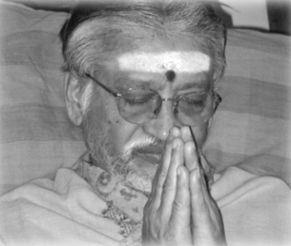
Bhagavan Sri Ramana Maharshi, it is said, had no name that he called his own. However, he did have a name and he revealed it, not once, but thrice. The first time was in his hymn Aksharamanamalai, The Marital Garland of Letters. In its very last verse, Bhagavan sings, “Place your garland around my neck and wear the garland strung by this Arunachala Ramanan.” The second time was some days later. A devotee at Virupaksha cave wanted to know who Bhagavan really was. He wrote a verse on a piece of paper, “Oh Ramana, who are you? Are you the highest God, Hari, or a rishi, or a celestial being? Who are you?” He then left the note on Bhagavan’s stone couch when Bhagavan had gone out. When Bhagavan returned and saw the note, he wrote behind it, “I am Arunachala Ramanan, dwelling in the Heart of every being, beginning with Lord Hari to the so called lowest being. If with devotion, you plunge into the cave of your Heart, your inner eye will be opened and you will see this truth as the fullness of non-dual Awareness.” The third time was when Viswanatha Swami wanted to write a verse on Muruganar, another senior devotee. Unable to compose an entire verse in Tamil, he wrote two words, “Mugavapuri Murugan.” When Bhagavan was not there, he left the paper on Bhagavan’s seat and slipped away. When Bhagavan came back, he completed the verse, “Arunachala Ramanan who resides in the Heart lotus of every being, gave Mugavapuri Murugan a look and destroyed all his tendencies. This enabled him to come out with thousands of spontaneous verses, the beauty of which is comparable with those written several centuries back by the saint Manikavachakar in Thiruvachakam.”
So, what was the purpose of Bhagavan Arunachala Ramanan’s advent on earth? In his hymn Necklace of Nine Gems, Bhagavan reveals it: “Arunachala commanded me to make known his true state of Awareness all over the world as the Self in each one’s Heart, and thereby destroy the false identity that one is the body.” Arunachala Siva , the infinite flame of jnana manifest in the form of a holy hill, incarnated as Ramana to talk to us in our language. After all, who would be able to understand a hill if it were to speak? Its language is mounam, silence.
I once shared this with Bhagavan’s old devotee, Professor N. R. Krishnamurthy Iyer, a physics professor and scientist. He exclaimed, “How wonderful! This is true! Arunachala did come as Ramana; but Ganesan, add another sentence to that.” He continued, “It is true that Bhagavan is Arunachala, but we, his devotees, are the rocks and boulders of Arunachala, part and parcel of the sacred hill.” This revelation thrilled me. Professor Iyer added, “Whenever a great being appears, he comes with his retinue. When Bhagavan incarnated on earth, we too came to serve him. Once our service is over, we will go back to the source.”
Though it was Arunachala’s command that his message be spread around the world, Bhagavan did not move an inch from Arunachala for fifty-four years. The fact is that Bhagavan did not need to move - the world came to him. Frank Humphreys was the first westerner to visit him. Many like Kavyakantha Ganapati Muni, Muruganar and Arthur Osborne followed. Their only purpose was to record the message of the master. Great masters like the Buddha and Christ would have remained as just names but for the retinue that came with them. Their devotees gathered and preserved their teachings as well as their answers to seekers’ questions - questions that can occur to any spiritual seeker. Consequently, future generations continue to reap the benefits of their teachings. It is to fulfill this noble purpose that the great masters come with their retinue.
Another example of a great master who came with his retinue of devotees is Sri Ramakrishna Paramahamsa. When no disciple had yet come to him, at times intoxicated with divine bliss, he would stand on the bank of the river Ganges and shout, “Mother, where are the children you said you are sending? They have not yet arrived!” The divine Mother eventually sent eighteen great disciples. Later, when he had cancer and was to drop the body, he announced, “I will be born once more. I am going to be born as a beggar in my next life to alleviate the suffering of the people.” To this, his wife the Holy Mother Sarada Devi said, “I might not be coming.” Ramakrishna Paramahamsa replied, “You have no choice. When I come, all my retinue will be born too.” He gave the example of a weed in a pond. It comes out with all the weeds around it when pulled out by its roots.
Bhagavan had many devotees. Some of them are well known and some are not. The human and sacred relationship of these devotees with Bhagavan was never formally recorded in one book. The reminiscences in books like Talks with Ramana Maharshi, Letters from Ramanasramam and Day by Day with Bhagavan mainly contain answers given by Bhagavan. However, there were precious few records of Ramana Maharshi’s life from the devotees’ point of view. I longed to record the intimate nuances of their satsang with the master. From 1956 onwards, I constantly questioned the old devotees. “How did you interact with Bhagavan? How did he treat you? What was your relationship with him like?” They would humbly reply, “We are nobody. All is Bhagavan. Ask us about Bhagavan and we will tell you.”
In 1960, I moved to live in Ramanasramam. I worked hard at my ashram duties but somehow I was not completely happy. I could not put my finger on what was missing. Though I received a lot of well meaning advice from the elders at the ashram, my heart was not satisfied. My teacher, T. K. Sundaresa Iyer then told me, “If you are not satisfied with our guidance, you should go and get it from an acknowledged jnani.” He directed me to Swami Ramdas of Anandashram in Kerala who in turn sent me to his spiritual heir, Mataji Krishna Bai, a realized saint. I asked her, “How should I serve my master? What is my sadhana?” She said, “Old devotees of Bhagavan have already left the ashram. Go bring them back, attend to them and serve them till their last day. This is your sadhana. This seva to them is your sadhana.” I was taken aback. I had closely studied eastern and western philosophy. Nowhere had I heard of serving the guru’s devotees as a form of sadhana. She added, “Another important thing is that since you are related to Ramana Maharshi, everybody will tell you that you are already liberated. They will tell you that according to Hindu treatises, a realized master’s relatives are already realized beings. That, the seven generations preceding him and the seven generations succeeding him are blessed with emancipation - freedom from karma. Do not believe it. You have to earn your bread - your spiritual bread. God is absolutely impartial and if you have to attain salvation, you have to strive hard like everyone else. Practice Ramana Maharshi’s teachings, pursue Self Enquiry.” Overwhelmed by the magnitude of the task before me, I cried, “Mother, I am leaving and you will be far away!” “You have been entrusted to me by Papa. I am going to guide you,” she reassured me. “You are hundreds of miles away from me! How are you going to guide me?” I looked at her questioningly without voicing it in words. She smiled and said, “Don’t worry about that. I will be guiding you every moment.” Sure enough, her continued guidance is palpable to me even now.
When I came back to Ramanasramam, I acted on Mataji Krishna Bai’s counsel very sincerely. I started searching for old devotees, bringing them back to the ashram, serving them and putting Bhagavan’s teachings into practice. In the beginning, neither did I always succeed nor did I have a complete grasp of it. Nevertheless, I did not give up. I kept wondering why she had said that to serve the devotees was my sadhana. The answer came to me like a flash: I was being called to record the reminiscences of Bhagavan’s old devotees and their relationship with him - something that had not been done. I began working on this task with enthusiasm. Veneration goes to those old devotees who proactively started sharing their memories of Bhagavan. Most of these were recorded by me, which were published periodically as Ashram publications and regularly in the Ashram journal, The Mountain Path. I owe much to ‘boulders’ like Kunju Swami, Annamalai Swami, Ramaswami Pillai, Devaraja Mudaliar, Suri Nagamma, Major Chadwick, and others for coming forward with beautiful recollections of their meetings with the master.
For instance, whenever Ramaswami Pillai met me, he would begin narrating some incident involving Bhagavan. He once pointed to a coconut tree and said, “Once I was standing right there and plucking coconuts using a long pole with an iron clamp. Bhagavan saw me on his way up the hill and said ‘Why can’t you use a bamboo clamp? The metal clamp will hurt the tree. It is already offering its fruit to you unconditionally.’ I actually made the mistake of thinking that I was really wise - while Bhagavan could offer spiritual advice, perhaps he was not practical. After all, I had to pluck so many coconuts! If I used a bamboo clamp, it would break. Therefore, I continued using the iron clamp. When Bhagavan returned from walking on the hill, I was still at work. Suddenly, a coconut fell on my nose and it began to bleed. Bhagavan stood next to me and gently rebuked me, ‘You doubted my words. Now do you understand how your wrong actions will hurt you? Now do you understand?’”
A deluge of reminiscences came down from him and other devotees. I begged all of them to write these down. “Please share your memories of Bhagavan, your interactions with him, his interactions with the earlier devotees - everything. Whatever you say will be direct from the source.” And they graciously responded. In the thirty-seven years I was in Ramanasramam, it was my association with the old devotees of Bhagavan that gave me the greatest joy and learning. For many years, it has been my heart’s wish to share this joy and learning with fellow seekers. Each devotee had a significant role to play and this forms the basis of this book. Its purpose is to bring to light how Bhagavan Arunachala Ramana’s devotees, his ‘rocks and boulders’, came together gracefully and naturally to support the master in his work.
I am deeply grateful to the AHAM Retreat Centre, Asheboro, NC, and the AHAM ashram in Arunachala, for hosting talks on the old devotees of Bhagavan. The bulk of this book has been culled from these talks that were recorded on CDs by the editorial services of good friends. To them too, I owe a deep sense of gratitude.
My humble request is to allow the words to fall away, leaving the essence of one’s own pure understanding to bloom, blossom and flower within one’s Heart.
“Grace is always there.”
V. Ganesan
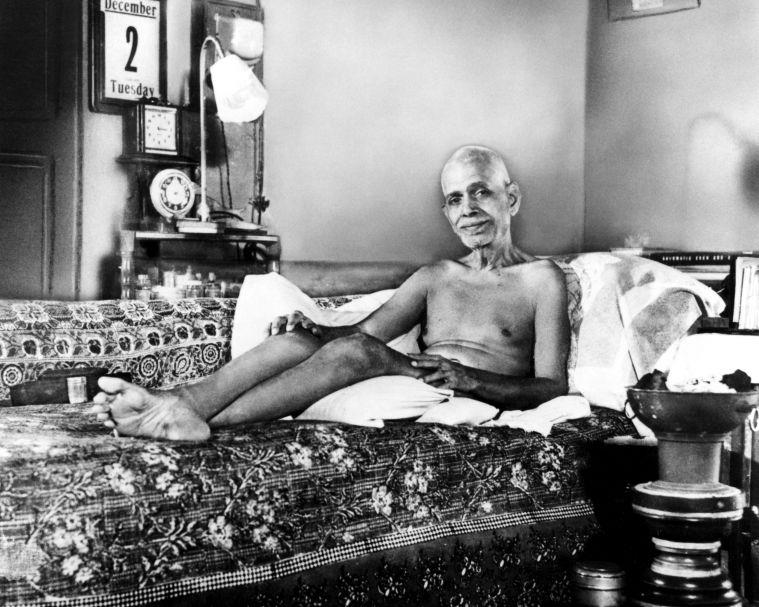
Bhagavan in the Old Hall
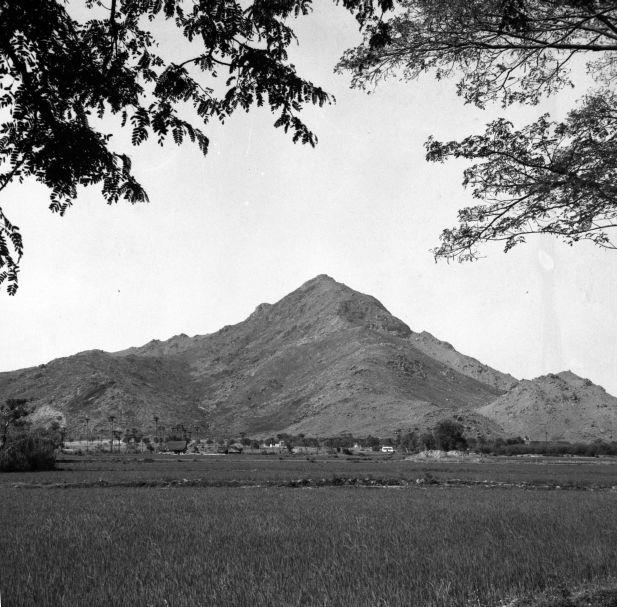
Arunachala