Sadhu Natanananda
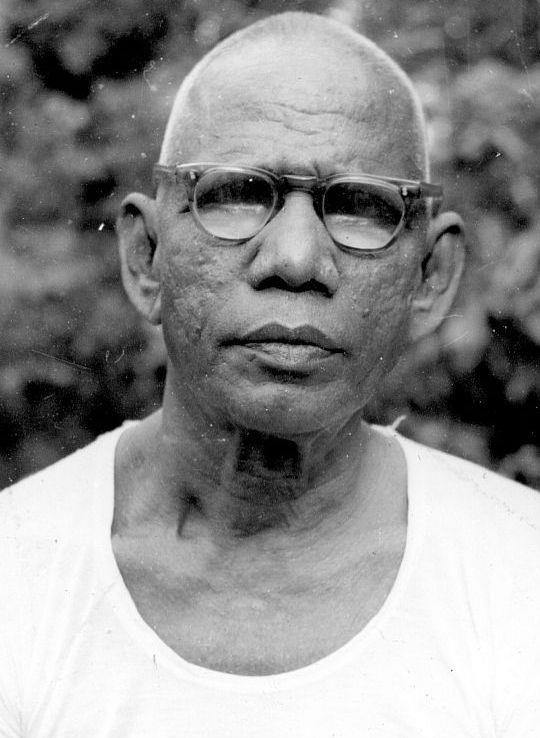
While Kavyakantha Ganapati Muni was a colossus, Sadhu Natanananda can be compared to the tortoise in the hare and tortoise story. An unlikely spiritual giant, he rose from being an ordinary, elementary school teacher, to a man of deep wisdom and realization. Sadhu Natanananda is the compiler of Spiritual Instruction, one of the most important books for spiritual seekers.
This simple teacher had studied Ramakrishna Paramahamsa, Swami Vivekananda and the scriptures. He understood that it was through a true guru’s guidance that he could know exactly what truth is. Therefore, he yearned for a guru. His friends told him of a young ascetic up on Arunachala hill who could guide him. Natesa Mudaliar, as he was known then, visited Bhagavan at Skandashram and seated himself near him. Since he was well versed in the scriptures, he thought he should talk only after the guru talked to him. However, Bhagavan very rarely spoke unless someone asked him a question. After spending hours in silence with Bhagavan, Mudaliar went home disappointed. “Perhaps, he is not a saint,” he thought, “I will go to other saints.” He visited many other saints and sages but returned disappointed. His friends reproached him, “Why did you give up? Go again to Bhagavan!” He started writing letters pleading to Bhagavan to shower his grace on him. He even sent a registered letter wherein he wrote, “If you are not going to give me grace, I will die without realization. In my next birth I will demand grace from you again and you will have to be born once more just to give me realization. You might as well give it to me now!”
Bhagavan appeared to him in a dream and said, “You are demanding grace from me. You must first worship the Lord seated on the bull.” In his small room there was a picture on the wall. It was that of Lord Siva seated on Nandi, his bull. Natanananda worshipped the image for a few days but was still not happy. He went again to Tiruvannamalai and visited Arunachaleshwara temple. “Perhaps, Bhagavan has guided me to this in the dream,” he thought. This time, some people tried to dissuade him saying, “Do not go to that silent ascetic. He will not talk to you!” However, he was a stern, serious, persevering man. So much so, that even Muruganar remarked that austerity was Natanananda’s armour.
Without giving up hope, this school teacher went to Bhagavan again and pleaded, “Bhagavan, I want to experience your gracious wisdom. Kindly fulfill my prayer!” Bhagavan looked at him for a full fifteen minutes. When a question was put to Bhagavan, he would not usually answer immediately. Instead, he would prepare the questioner with silence and only then give the answer, so that it remained with the questioner as direct experience. He was more interested in the questioner than in the question. He gazed at Natanananda and said, “Is it the body in front of me which desires to obtain grace or is it the awareness within it? If it is the awareness, is it not looking upon itself as the body and making this request? If so, let the awareness first of all recognize its nature. It will then automatically recognize God and grace. The truth of this can be realized even now and here.” Wave after wave of pure ecstasy pulsed through Natanananda and he stayed in Bhagavan’s presence for hours. He was blessed by Bhagavan’s glance of grace.
Natanananda once told me that even Bhagavan’s glance did not completely fulfill him and that there were some residual tendencies despite his leading a strictly austere life. Once, when he was in Bhagavan’s presence, Kavyakantha Ganapati Muni and other scholarly devotees were sitting with Bhagavan and speaking in Sanskrit about Hindu scriptures. Utterly dejected that he could not follow a single word about the lofty subjects that were being discussed, he sat silently with tears streaming down his cheeks. When he opened his eyes, everyone had left and only Bhagavan was there. Bhagavan looked at him compassionately and asked, “Why are you so dejected? If you were really unfit to realize the Self in this life, you could not have come to this place at all.” (This applies to all of us.) Bhagavan continued, “The power that drew you here will make you realize the Self. If not today, then at some other time it is bound to fulfill its commitment. There is no reason why you should be dejected.” This dissolved all imperfections in Sadhu Natanananda and drove out all his ignorance. With this, he too became a Self realized sage.
The day he understood his realization, he went incognito. The outward symbol of his becoming Self realized was his obscurity. He lived alone - happy to be immersed in the Self all the time. After Bhagavan’s mahasamadhi in 1950 and until 1967, many did not even know if Natanananda was still alive. Though he stayed in a cottage in Tiruvannamalai, no one knew where he was. Like most of the old devotees, I too thought that he had passed away.
I had spent seven years in the ashram when suddenly one day my friend Dorab Framji asked me, “Do you know Sadhu Natanananda is alive?” I jumped with joy because I loved his book, Spiritual Instruction. I paid him a visit. He was an austere man with nothing in his room except for a few loincloths. He blessed me and asked, “What are you doing? Are you practicing Self Enquiry?” I replied, “I am not capable of doing Self Enquiry. I only chant Arunachala Siva , Arunachala Siva .” His face was red with rage. I was taken aback because this was my very first meeting with him and I was accustomed to people indulging me whenever they met me. Not Natanananda! He was a stern and serious man. He raged, “What a fool you are! What do you think you have come to Bhagavan for? For what function has he chosen you? It is only to make you like him! Read his Forty Verses on Reality, practice Self Enquiry, be the truth. That is why you have been chosen!” I was stunned in disbelief.
He refused to come into the limelight or even stay at the ashram. Dorab Framji found a cottage next to Osborne’s house for him. Natanananda stayed there till 1981. I was very fortunate that he allowed me to visit him and talk with him whenever I liked. Once, I drew him out of his reticence by asking him to give me an article for a souvenir I was bringing out for the ashram. He obliged and handed it over to me. Unfortunately, I misplaced it. I assumed he would have a copy. I went to him and said, “Swami, I am sorry but I lost your article. Please give me your copy. I will very carefully note its contents down and then return it.” He laughed and said, “Look around you, Ganesan. My environment gives you an idea about me. Look at my room, there is nothing here - no books, no clothing, no utensils, nothing.” Puzzled, I asked, “What do you mean, Swami?” He replied, “Ganesan, you must have come to know that I have written many verses on Bhagavan. However, do you see any book here, even though they were all printed? The moment I wrote my adoration about my master either in verse or prose, I would place it at my master’s holy feet. As far as I was concerned my job was done. After Bhagavan dropped the body, a few people asked me to write for them just like you have. I complied by writing and submitting it to the management. There ended my responsibility.” However, he did oblige me by writing that article again, which one can find in the Ramana Pictorial Souvenir published in 1967.
I once took a family which was popularizing Bhagavan’s name to meet Natanananda. He was told about the work they were doing for spreading Bhagavan’s name. Natanananda became furious, “You talk such nonsense, thinking you are going to spread our master’s fame! The only way you can do it is by becoming the truth yourself. Put the teachings into practice right here right now, that is the best way you can serve the guru. Our master is the teaching. The best way to express your devotion to Bhagavan is by putting his teaching into practice.” This family got frightened and never again went to Natanananda.
In Natanananda’s last moments, Sadhu Om, Kunju Swami, a few others and I prayed before him. In every devotee’s death that I witnessed, the one common factor was that none was bothered about his or her body. Just before he dropped the body, I asked, “Swami, how do you feel?” “I am happy,” he replied. Physically, he was suffering deeply. Every doctor that I took to him, diagnosed him to be severely ill. Yet, he said he was happy. I asked, a little surprised, “What do you mean by happy?” Natanananda replied, “Look at Bhagavan’s picture and you will understand.” Those were his last words. He directed my attention to Bhagavan and then happily closed his eyes and passed away. It was a privilege for me to help build the samadhi for this jnani’s body inside the compound of Dorab Framji’s residence.
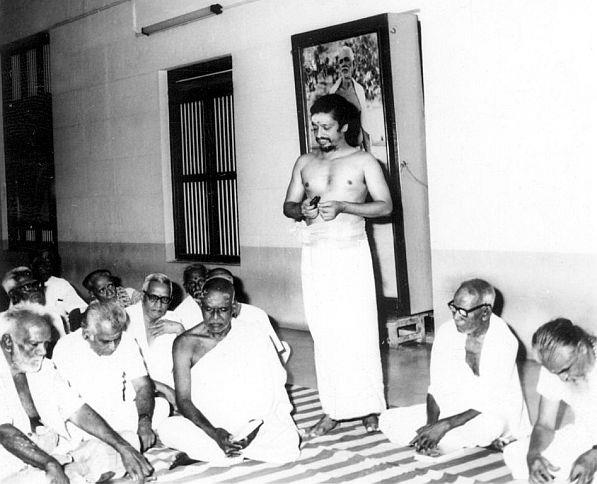
Ganesan paying tributes to Sadhu Natanananda (seated to his left)
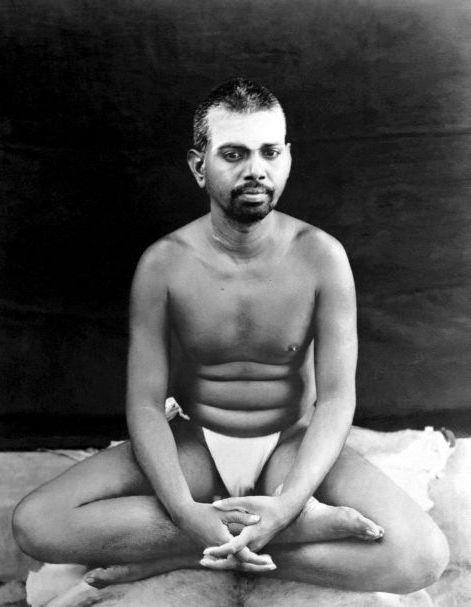
Bhagavan seated on a deer skin at Virupaksha Cave