Manavasi Ramaswami Iyer
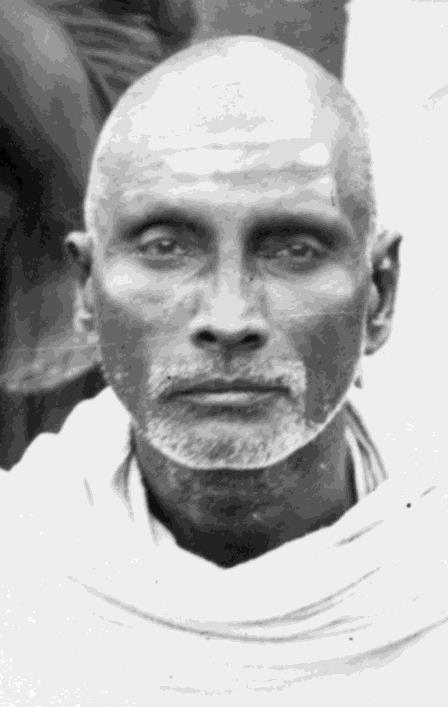
“In 1908, my father and I visited Arunachala. The town was crowded as the Karthikai Deepam festival was on. On hearing about Brahmana Swami, a saintly sadhu living in Virupaksha cave on the hill, we went there. When we reached the cave, a person at the entrance stoutly refused us permission to go in and see the swami. I challenged his authority to deny us permission. Fortunately, the swami came out just then. I was thrilled to see him. Something inside me made me appeal for relief from the physical ailments and mental anguish that were constantly troubling me. The swami replied, ‘I am neither a medical doctor nor a soothsayer,’ and started walking away. Not giving up, I followed him and retorted, ‘I came to you hearing about your great spiritual attainment. Maybe I am not destined to find relief.’ The swami suddenly stopped walking, turned to me, and looking at me with piercing eyes said, ‘Develop an attitude of accepting such challenges with inner determination. Nothing can shake you.’ Then, he raised his right hand in blessing. I felt pure rays of light emanating from it and enveloping me. This filled me with the confidence to accept challenges in the future with the attitude that the higher power will assuredly protect me.”
This remarkable devotee was Manavasi Ramaswami Iyer. Born with a challenging nature, he never accepted no as an answer ever in his life. It was this innate quality of his that Bhagavan strengthened in their very first meeting. As spiritual seekers, physical challenges in the form of illness and mental challenges in the form of doubts are sure to assail us in life. Two things are important. We must have the courage to accept every challenge squarely and boldly. Equally, we must have the faith that the higher power - call it guru or God - will guide and protect us.
That visit of Iyer was very significant for him. He had come just as a visitor. But when he got down from the hill, the four towers of the temple, the sacred mountain and the sage residing there with his unmistakable spiritual power, impressed him so much that he decided to shift his residence and stay there permanently. He started visiting Bhagavan every evening, staying with him at night. There were only one or two people with Bhagavan then and so there were no restrictions. Coming to know of Iyer’s interest in music, Bhagavan taught him the nuances of how to compose kritis, a form of lyric. It was the beginning of a different kind of puppet show! In a normal puppet show, the puppeteer pulls the strings to make the puppet dance to his tunes. In this puppet show, the master pulled the strings resulting in Iyer not dancing but composing kritis of remarkable musical value bringing out the greatness of Bhagavan and Bhagavan’s teaching.
After work one day, Iyer came as usual to Virupaksha cave and asked Bhagavan in English, “Swami, Jesus Christ, the Buddha and other sages came to the world to redeem the sinners. Is there hope for me?” Bhagavan looked at him steadily and answered, in English, “Yes, there is hope.” Visibly moved and thrilled to the core with this answer, a Tamil kriti bubbled out from Iyer: “Ramana, you are my sole refuge, I have none else to turn to.” This song is popular among Tamil devotees of Bhagavan to this day.
One night in Virupaksha cave, Bhagavan focussed his attention on Iyer for almost half an hour and he experienced a burning current entering him. His mind turned inwards and got merged in the Heart. For the first time, he understood that Bhagavan was not just an ascetic swami but a spiritual dynamo. This spiritual experience gave him implicit faith in Bhagavan. Iyer had a chronically poor digestion. When he told Bhagavan about this, Bhagavan again focused his eyes on him. Iyer immediately felt his brain cooling down. Within a few days, in celebration of some festival, Echammal brought many varieties of rich food and sweets made of ghee and sugar for Bhagavan. Bhagavan, who always shared his food with anyone around, told Echammal to call Iyer. Apprehensive because of his dyspepsia, Iyer declined and told Echammal, “Please ask Bhagavan to forgive me. I cannot eat such rich food.” But Bhagavan insisted, saying, “Come, share it with me.” Obeying Bhagavan, he ate the food without any further thought. After this, his chronic dyspepsia disappeared completely. His gratitude to Bhagavan for curing him came out in the form of his second song, “How do I express my gratitude for the cure graciously bestowed on me?” His family who stayed in the town and objected to Iyer spending every night with Bhagavan, heard about this miracle and started reposing faith in Bhagavan.
Iyer was soon transferred to Berhampur, a town in Eastern India. It was with a heavy heart that he went there. While there, his feet became covered with painful sores. Even after extensive treatment, including a surgery, there was no relief. However, despite the intense pain, he had to go on official work. He prayed fervently to Bhagavan for help. The very next morning, there was a knock on his door. When he opened it, there were two sadhus standing outside. They told him, “We are on a pilgrimage and have come from Arunachala. Before we left, Bhagavan told us to come to Berhampur and meet you.” He received them warmly. Noticing that Iyer was suffering from painful sores, the sadhus prepared an ayurvedic paste from tamarind and sambarani (a kind of common Indian incense) and applied it on Iyer’s sores. The very next day, Iyer was totally cured. His emotionally charged devotion to Bhagavan at this miracle, gushed out of him as a song called Saranagati , a perennial favourite with Bhagavan’s devotees: “I surrender to you. To whom else am I to surrender? You who are perfect in Arunachala which endows one with ultimate release, oh Ramana, rain cloud of compassion, is this not the appropriate time for granting me your glance of grace? If you delay what am I to do? My beloved, remove my sorrow and grant me bliss. I cannot bear this indifference any further. Oh, you who are Brahman itself, I surrender to you.”
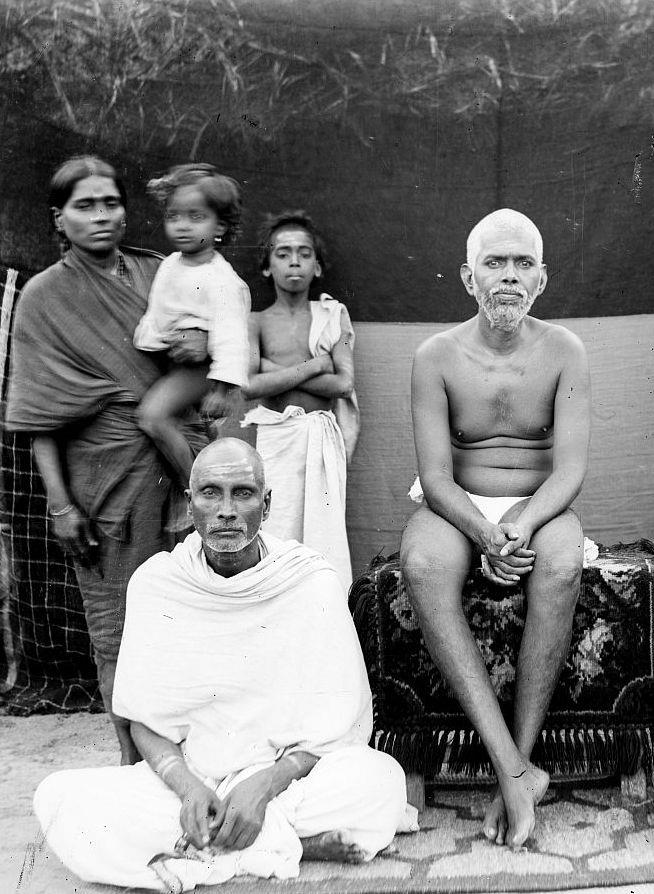
Bhagavan with Manavasi’s family
I was very close to Iyer and once he told me about this song, “See the beauty, Ganesan, it is not because of this song that the cure took place. The cure had already taken place and if at all I had to sing a song with my brain I would have only sung a song of gratitude thanking Bhagavan for curing me. Look at the song - it says, ‘Is this not the appropriate time for granting me your glance of grace? If you delay, oh, what am I to do? My beloved, remove my sorrow and grant me bliss. I cannot bear this indifference any further.’ This is after the miracle had happened.” He started quoting from sages and saints like Manikavachakar, Meera and Tukaram where they pray, “Bless this wretched dog,” when God has already blessed them. It was not the other way about. Then he quoted from Bhagavan’s eleven verses to Arunachala: “Oh Arunachala, drawing me with your cords of grace although I had not even dimly thought of you, you decided to kill me outright. How then has one as weak as I am offended you that you now leave the task unfinished? You have not killed me. You have left it half done. Why do you torture me keeping me suspended between life and death? Fulfill your task of killing me now and long survive me all alone, oh Lord!” He continued, “That has already been done to Bhagavan, but still, he writes this as prayer. Why should Manickavachagar sing, ‘I am the worst sinner, please save me’? It is not because of the prayer that the Lord came and saved him. In his Aksharamanamalai, Bhagavan says, ‘Bless me that I may die without losing hold of you, otherwise miserable is my fate Arunachala. Place your sacred hand upon my head and make me partake of your grace. Do not abandon me, Arunachala. Oh Arunachala, unite with me to destroy our separate identities as you and I and bless me with the supreme state of ever vibrant joy.’ It looks like a prayer. Many people have had this doubt and asked Bhagavan, ‘You are a jnani. So why did you write, ‘Save me, do not allow me to be condemned?’ The answer is that it had already been done. We should have prayed first to get God’s grace. But God, being great, gives his grace first and then accepts our prayer - even if we do it later!”
In 1922, Bhagavan saved Iyer from definite death. Kapali Shastri, an eye witness to that miracle, has written in his book: “Maharshi was living on the hill in Skandashram. A few of us used to accompany him during giripradakshina. On one such day before starting our giripradakshina, we got word that supervisor Ramaswami Iyer was taken ill suddenly and was lying at Virupaksha cave. The Maharshi went down the hill to the place where Iyer was lying. Iyer was having violent palpitations of the heart. Maharshi sat near him placing his hand on his head. Within five minutes, Iyer got up and looked quite normal. Maharshi kept sitting - he did not get up even after an hour. I had in my bag in Skandashram olive oil, which I went and brought and rubbed on Maharshi’s head. Then, we all went back to Skandashram. When I asked Bhagavan, he simply replied, ‘Well, Ramaswami Iyer got up and I sat down. I was conscious when the oil was rubbed, it was very pleasant.’ He did not say he performed a miracle or anything like that.”
Later, in 1942, Iyer was once again saved from certain death. One day, his wife came running to Bhagavan and prayed that her husband who was unconscious in their house be saved. At that very moment, Iyer woke up. Years later, when I heard about this, I was a little skeptical. So, I went and challenged Iyer, “How is it that all the time you fall sick and Bhagavan saves you from death?” He answered, “What to do, Ganesan, it is not only me that Bhagavan has saved. He also saved other sincere souls from the throes of death.” He then gave me a list - his own daughter, his friend Subramani Iyer’s daughter, Jagadisa Shastri, Bhagavan’s own sister’s husband and a few other names that I did not know.
Iyer had five daughters and one son. Bhagavan took keen interest in Iyer’s family and every member of his family was totally devoted to Bhagavan. When I came to ashram, I wanted to know more about them and their relationship with Bhagavan. So, I went to Mumbai where one of his daughters was staying to interview her for The Mountain Path. Her name was Lalitha Venkataraman and she was a noted musician. She shared with me the unique relationship all of them had with Bhagavan from his Virupaksha cave days. For all of them, Bhagavan was God. Every time the family had to leave Arunachala, they would stand in front of Bhagavan and sing the song Saranagati in chorus. Consequently, this song was sung repeatedly in Bhagavan’s presence for nearly two decades. Lalitha Venkataraman told me “In fact, my father was popularly known as Saranagati Ramaswami Iyer or Saranagati Thatha.” She continued, “Since my husband was employed in North India, I could come to Tiruvannamalai only on rare occasions after my marriage. Whenever I was in the ashram, I used to sing and accompany myself on the veena and Bhagavan would listen keenly with a smile. One day, when I entered the hall after a long absence from Tiruvannamalai, he remarked, ‘Look, only this morning we heard her voice on the radio and here she is now.’ I had recorded two songs on Bhagavan and one of them must have been broadcast that day.”
“As a child, I have played with Bhagavan at Virupaksha cave. However, it was my elder sister Rajam who as a child was petted by Bhagavan. He would plait her hair and they would play together with her toys. My sister was so fond of Bhagavan that whenever she got something tasty or interesting to eat at home, she would rush to Virupaksha cave and share it with him. Once, a special type of paddy was brought and hand pounded in our house. Its bran was very sweet, tasty and healthy. When the lady who was pounding it mentioned this to my sister, she took handfuls of the bran and ran to Bhagavan. Noticing Rajam’s appearance at that odd hour, Bhagavan asked her whether she had brought something for him. She gave him the bran and both ate it. Bhagavan then told her how that bran would be tastier if eaten along with certain other ingredients. My sister enjoyed great privileges with Bhagavan. But she was always aware that she was moving with God. She worshipped him every moment of her life.”
After a pause, she said, “My elder sister Rajam was a good painter. Though she never learnt painting from anyone or from any art school, her drawings and painting had a special, real life quality in them. When she grew up, she did paintings of goddesses. She would show them to Bhagavan and he appreciated them very much. Once, Rajam did a beautiful painting of Goddess Varalakshmi, an aspect of the mother goddess worshipped by married women. When she showed it to Bhagavan, he suggested that she print it and distribute it. Rajam begged and borrowed money and had it printed. In the 1940s and 50s, many pooja rooms of orthodox Brahmin families had this picture.” Lalitha Venkataraman then took me to her pooja room upstairs and showed me two lovely paintings by Rajam - one of the goddess Madurai Meenakshi and another of the saint Thyagaraja. Then I remembered the painting of Bhagavan seated on a peacock with the signature Rajammal at the bottom that was in Skandashram.
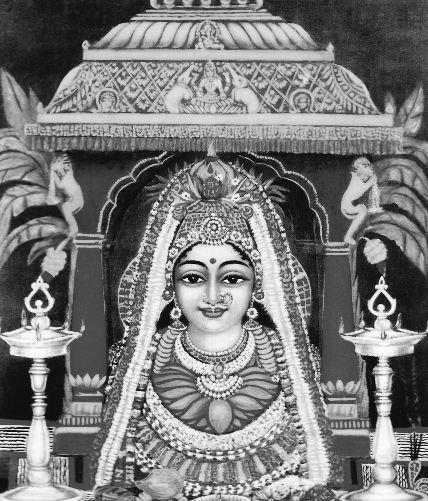
The painting of Goddess Varalakshmi
All his life, Iyer was a devout bhakta. He would start shedding tears at the very mention of the word ‘Bhagavan’. In 1922, Iyer had the rare privilege of being present when Azhagammal attained liberation in Skandashram. Iyer was chanting Lord Rama’s name when Bhagavan sat keeping his sacred hands on Azhagammal’s head and Heart to liberate her. He was a witness to Bhagavan’s act of grace. Iyer was also one of those who carried Azhagammal’s body down to where it is now interred. He was with Bhagavan all the time till the interring was completed. On the tenth day, a linga was installed over the tomb. Kavyakantha Ganapati Muni composed an extempore Sanskrit hymn in praise of Azhagammal as being even greater than the mothers of the Buddha, Jesus Christ and Adi Shankara. Seated in a corner amongst the crowd, Iyer was listening to it with rapt attention when Bhagavan called him and inspired him to compose a kriti in Tamil. Though Iyer was sorrow stricken, he obeyed. Spontaneously, a kriti came to him. He noted it down on a paper and gave it to Bhagavan. Bhagavan asked him to sing it. While singing it, Iyer was amazed to see how perfectly the kriti had turned out.
When Bhagavan attained brahmanirvana in 1950, Iyer saw the jyothi of Bhagavan move as meteor like light and merge with Arunachala. Close admirers of Iyer like the Tamil scholar Ki. Va. Jaganathan adored Iyer as a jnani. A very popular writer in Tamil Nadu during the 60s, Ki. Va. Ja. asked me to take him to Iyer’s residence. Iyer was then sick and bedridden in a house opposite the ashram. The moment he saw Iyer, he put his hands together above his head and went round and round his bed shedding tears and chanting, “Ishwara, Ishwara, Ishwara.” He then started singing extempore verses praising Iyer. It was truly a wondrous sight. I have only heard about people becoming emotionally ecstatic and shedding tears. That day, I witnessed it. On our way back Ki. Va. Jaganathan blessed me, saying, “Adore him, Ganesan! Seek Iyer’s blessings. He is a Self realized, holy man hiding behind a veil of ordinariness. Do not miss this opportunity to receive his blessings. It will take you a long way on your spiritual path.” Thanks to this advice, I was fortunate to receive Iyer’s blessings.
Iyer passed away in Chennai and his last moments were very peaceful. His palms over his chest and ecstatic tears shedding from the outer corners of his closed eyes, clearly showed that he was seeing Bhagavan in his Heart. Slowly, gently, his breathing became still. Manavasi Ramaswami Iyer was now absorbed forever, in Arunachala.
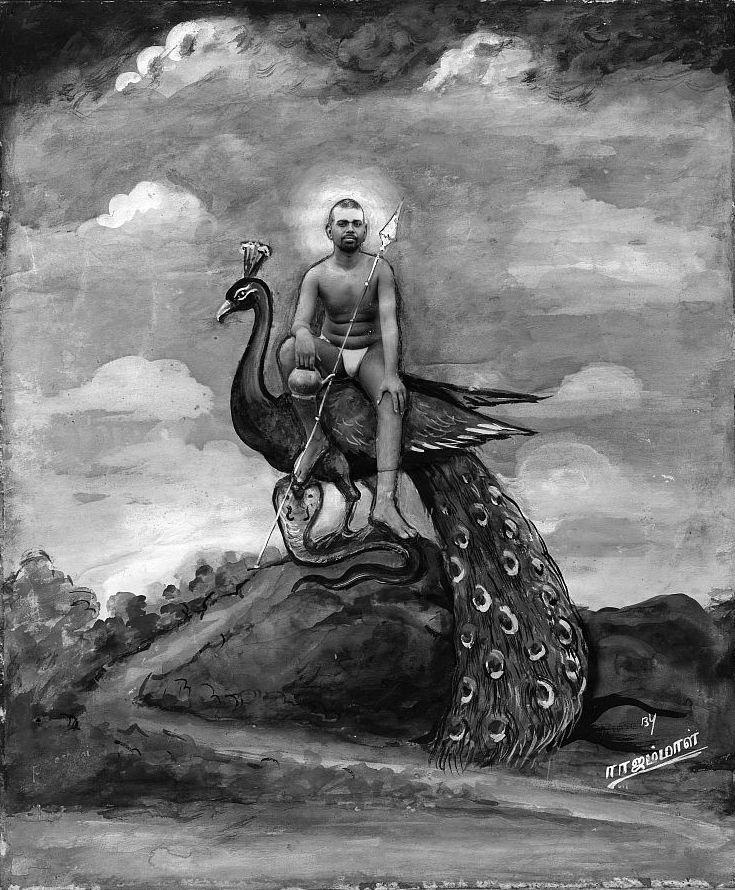
Painting by Rajam of Bhagavan seated on peacock
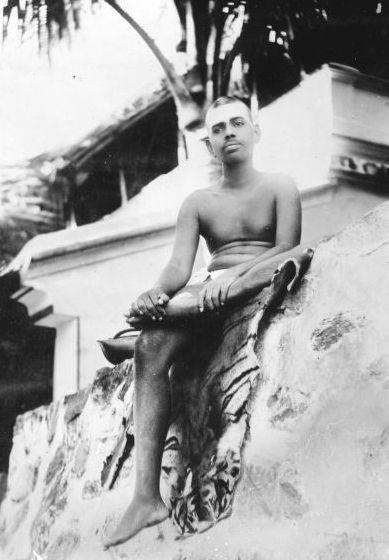
Bhagavan at Virupaksha Cave