Frank Humphreys
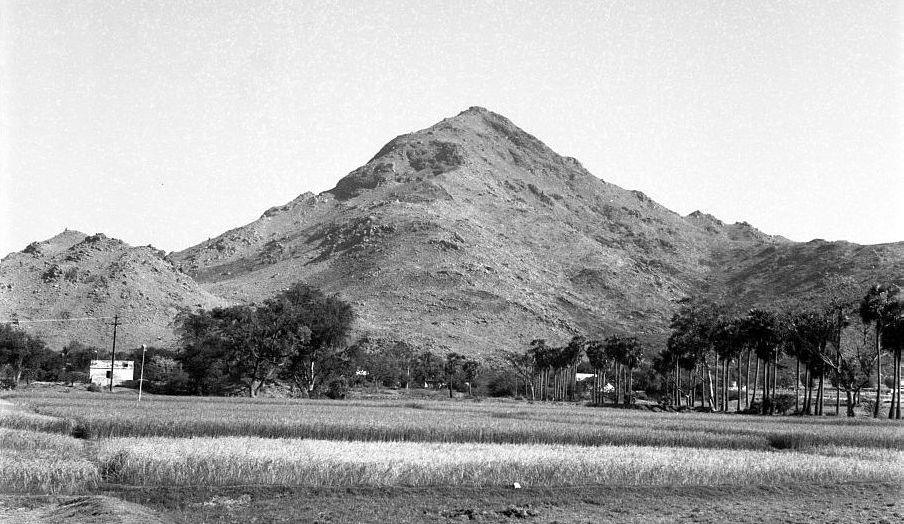
Once, a man came to see Bhagavan in Virupaksha cave. He stayed only for a week. During that time, he composed and sang four songs in praise of Bhagavan. He said his name was Venkatrama Iyer and that he was from Sathyamangalam, a small village close to Tiruvannamalai. Later he sent a fifth song, the famous hymn Ramana Satguru. When Bhagavan read the five songs he was struck by their beauty. Ever since then, many Tamil speaking devotees of Bhagavan have been singing them. Strangely, when some of the old devotees went to Sathyamangalam to meet Venkatrama Iyer, nobody in the village knew anything about him. Later on, while devotees were discussing this, Devaraja Mudaliar remarked, “While at Virupaksha cave, Bhagavan had written five hymns in praise of Arunachala.” To this, Muruganar replied, “Father Arunachala wanted to express his gratitude. So, he came in a human form as Venkatrama Iyer and sang five hymns on Bhagavan.”
One of the verses in Ramana Satguru proclaims that Bhagavan has hoisted his flag of wisdom to lead billions of beings to liberation. What is a billion? One followed by many zeroes. If you remove all the non-existent zeroes that the billions of individual egos in reality are, what remains is only the one. That one is Arunachala, that one is Ramana and that One is what every one of us really is. And not the Rams, Rahims and Ronalds we think we are.
Bhagavan came to make us remember our original, divine nature. No one was excluded from his grace - be it man, woman or beast. Until now, all his devotees were Hindus. It was time for the teaching to spread across the divide of nations and religions. And spread indeed it did, without disturbing the faith of the thousands who came seeking from all corners of the world.
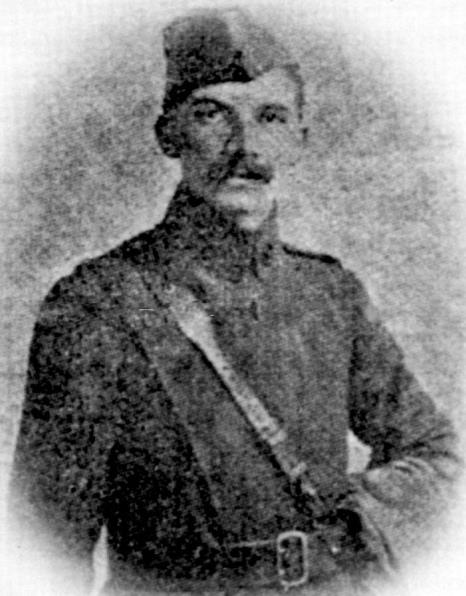
Frank Humphreys was a young British police officer and a Catholic. Transferred from England, he arrived in Bombay, now Mumbai, with a high fever and had to be admitted in a hospital.
A psychic possessing occult powers, Humphreys used these powers to get relief from the intense pain he was suffering while in the hospital. He then transported his subtle body to Vellore, a town near Tiruvannamalai where he had been posted, and saw one Narasimayya who was to teach him the local Telugu language. Later, when he arrived in Vellore, Narasimayya introduced himself, saying, “I am your Telugu tutor.” “I know,” replied the Englishman. “How do you know?” asked the puzzled tutor. “I have seen you though you have never visited Bombay. I travelled in my astral body and met you,” replied Humphreys. Narasimayya had tutored many Britishers, most of whom were spiritually disinclined. He presumed that this man was just crazy.
Humphreys then requested Narasimayya, “I would like to read a book on Hindu astrology in English. Can you help me?” Narasimayya presumed that this was yet another crazy question from him and ignored it. Seeing this, Humphreys continued, “Are there any mahatmas here?” (Mahatma means great soul). This last question startled Narasimayya. He wanted to test Humphreys. He left without giving any reply. The next day, he returned with a number of photographs of sages and saints and went to Humphreys’ room. Seeing no one there, he left them on the table and went away. When he came back, Humphreys had returned as well. Taking one photograph from the pile he asked, “Narasimayya, is this not your guru?” He was referring to a photograph of Kavyakantha Ganapati Muni. Kavyakantha was indeed Narasimayya’s guru. Thrilled, Narasimayya concluded that Humphreys was genuine, or there could not have been so many amazing coincidences. Humphreys revealed, “Last night, your guru came into my dream. He sat next to me in my bed and said something in a language that I could not understand.” This convinced Narasimayya.
Unfortunately, Humphreys soon fell sick and had to be taken to Ooty, a hill station where he stayed for a few months. When he returned, he told Narasimayya, “Last night, I had a dream. Since you might not believe my verbal description, I am going to draw what I saw.” He then drew a hill, a cave on it, a small waterfall beside it and a sadhu standing there. It was the pictorial depiction of Virupaksha cave and Ramana Maharshi. Narasimayya was speechless, “This is my master’s master!” Completely convinced now about Humphreys, he wanted to take him to Bhagavan. First, he introduced him to Kavyakantha Ganapati Muni who was then at Vellore. Kavyakantha was surprised to see this Britisher who was just twenty one years old and already a superintendent of police. There was a Theosophical Society conference in Tiruvannamalai in which Kavyakantha was to take part. The three of them left for Tiruvannamalai.
Upon reaching their destination, Humphreys became restless; he wanted to see the saint whom he had seen in his dream. They went to Virupaksha cave and seated themselves in front of Bhagavan. Bhagavan’s gaze was fixed on Humphreys for a long time. This is what Humphreys has recorded of his first encounter with Bhagavan: “At two in the afternoon, we went up the hill to see him. On reaching Virupaksha cave, we sat before him at his feet and said nothing. We sat there thus for a long time, and I felt lifted out of myself. For half an hour, I looked into the Maharshi’s eyes which never changed their expression of deep contemplation. I began to realize somewhat that the body is the temple of the Holy Ghost. I could feel that this master’s body was not the man; it was the instrument of God, merely a sitting, motionless corpse, from which God was radiating terrifically. My own feelings were indescribable. The Maharshi is a man beyond description in his expression of dignity, gentleness, self control and calm strength of conviction. You can imagine nothing more beautiful than his smile. It is strange, what a change it makes in one to have been in his presence.”
This was the young man’s first experience of Bhagavan. Later, Kavyakantha suggested that he put some questions to the master. Humphreys, being very young, enthusiastic, and wanting to serve the world, readily agreed. His very first question was, “Master, can I help the world?” Bhagavan: “Help yourself and you will help the world.” Humphreys: “I wish to help the world. Shall I not be helpful?” Bhagavan: “Yes, by helping yourself you help the world. You are in the world, you are the world. You are not different from the world. Nor is the world different from you.” Humphreys, after a pause: “Master, can I perform miracles just as Sri Krishna and Jesus Christ did?” Bhagavan: “Did any one of them, when he performed them, feel that it was he who was performing the miracle?” Humphreys: “No, master.” This was the first hint Bhagavan gave him that he should not be captivated by his occult powers and sense of doership.
He was unable to stay for too long in Vellore. He returned whenever he could, often travelling fifty miles under the hot summer sun on his motorcycle. When he reached Virupaksha cave, the first thing Bhagavan invariably asked him was, “Have you eaten? Are you not hungry?” Humphreys was usually hungry. Bhagavan would immediately arrange for food to be given to him. Bhagavan knew westerners ate with a spoon. So, he crafted a spoon made out of a coconut shell for Humphreys. This thrilled Humphreys even more. Once, Humphreys was still hungry after finishing his meal. Bhagavan remarked, “You are still feeling hungry.” He then asked somebody to give him more food. After lunch, the young Englishman was feeling very thirsty, thanks to the burning tropical heat. But, his innate British reserve prevented him from asking for anything. Knowing this, Bhagavan immediately looked at one of the other devotees and said, “Give him lemonade. He is very thirsty.” All this impressed upon him that Bhagavan’s love was not only that of a spiritual master, but also that of a nurturing mother. Many a time, he saw small children at the cave - neither talking nor playing, but just sitting peacefully. He was baffled. He had never seen children sit so silently, so peacefully, and for so long. The truth was that these children could also feel the spiritual peace of Bhagavan and responded in a like manner.
Bhagavan knew of Humphrey’s inclination to occult sciences and dissuaded him. “Pursue that which is superior to all the occult powers,” he told him, “Your aim should be higher than this. Not only higher, it should be the highest, and the highest is to recognize that you are the truth. All these occult powers will delude you. Give them up!” Bhagavan helped Humphreys get weaned off from using occult powers. Humphreys was a very strong man. Just as he had the capacity to acquire occult powers, he also had the strength to practice his master’s teachings. When he relinquished his chosen vocation, the occult sciences, Bhagavan directed him with the teachings of Self Enquiry and surrender, and taught him to go within.
His descriptions of the master, which he recorded in a letter and sent to his friend in England, were published in the International Psychic Gazette: “The phenomena we see are curious and surprising - but the most marvellous thing of all we do not realize, and that is that one and only one illimitable force that is responsible for all the phenomena we see and the act of seeing them. Do not fix your attention on all these changing things of life, death and phenomena. Do not think of even the actual act of seeing them or perceiving them, but only of that which sees all these things, that which is responsible for it all. This will seem nearly impossible at first, but by degrees the result will be felt. It takes years of study and daily practice, but that is how a master is made. Give yourself a quarter of an hour a day. Try to keep the mind unshakably fixed on that which sees. It is inside you. Do not expect to find that ‘That’ is something definite on which the mind can be fixed easily - it will not be so. Though it takes years to find that ‘That’, the results of this concentration will soon show themselves in four or five months time - in all sorts of unconscious clairvoyance, in peace of mind, in the power to deal with troubles, in the power all around, always unconscious power. I have given you these teachings in the same words that the master gives to his intimate disciples. From now on, let your whole thought in meditation be not on the act of seeing, nor on what you see, but immovably on that which sees.”
What powerful instructions! How blessed was young Humphreys to receive this teaching! Humphreys received everything after getting established in the Heart. He found it difficult to cope with his job and pursue meditation as well. He came to Bhagavan, who advised him to stay on longer. (The master can recognize when one is completely ready. Bhagavan, the master cook, needed to ‘cook’ him for sometime longer!) After a few months, he came again to Bhagavan. This time, Bhagavan said, “Now, you can go.” Humphreys has recorded, “I went back as a better and deeper Catholic.” There was no conflict in him at all.
After some time, he turned away from all worldly things, entered a monastery and became a monk. Established in the Heart, there was no Hindu, Christian or Muslim; there was no male or female, just pure being – just as Jesus would want a follower to be.
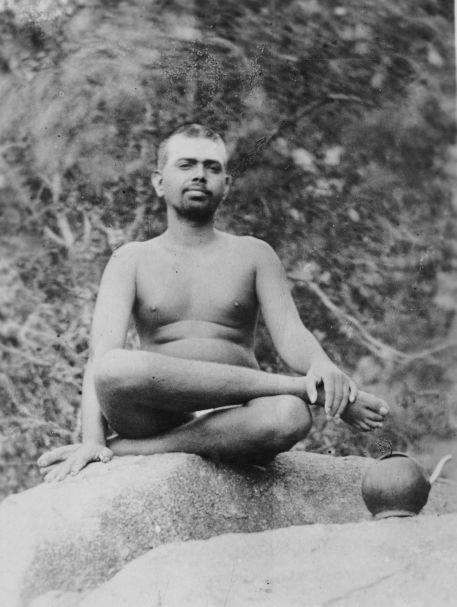
Bhagavan seated on a rock at Virupaksha Cave