Masthan Swami
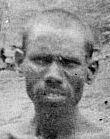
Masthan Swami was a staunch Muslim. His parents, who observed all the religious codes, rituals and disciplines rigorously, brought Masthan Swami up in the same manner. Even as a child of eight years, Masthan would enter into samadhi without knowing what it was. He had the natural ability to be detached from people and things from childhood. This remarkable devotee followed all the Islamic injunctions and was very much devoted to Allah and Prophet Mohammed. His natural inclination towards the samadhi experience coaxed him to start reading and picking up Tamil. Soon, he was studying books like Kaivalya Navaneetam and Sukar Vashistam. The simple Tamil poems of the nineteenth century Sufi mystic Gunangudi Masthan, which are vedantic in nature, were also a powerful influence. But, though Masthan Swami participated in Muslim festivals like Ramzan, Id, etc., his mind and heart were tuned to the inner Self, going into samadhi, and reading and singing Thayumanavar’s songs. (Thayumanavar’s songs were extolled by Bhagavan because they dealt purely with the truth. Other saints have brought in Siva and other gods, but Thayumanavar stuck to the teaching of going into silence, and Masthan Swami was well versed in that.)
In 1914, Masthan Swami lived in Desur, a village forty miles away from Tiruvannamalai and from where Desurammal hailed. Being two of the only people in that village who shared a similar spiritual ‘madness’, the two became friends. One day, she told him, “Masthan Swami, you must meet my guru.” She then brought him to Bhagavan in Virupaksha cave. Masthan, a staunch and devoted follower of Islam describes his first darshan of Bhagavan: “He was seated like a rock. His unswerving gaze was filled with grace, compassion and steady wisdom. I stood by his side. After giving me a look, he opened the gate of my Heart and I was also established in his state in the very first encounter. Just one look from Bhagavan and I stood like that for eight hours, absolutely without fatigue and filled with total absorption and peace. In those days, at Virupaksha cave, Bhagavan would open our Heart with a single, gracious look and we would be transformed. There was no need for any questions, since by his look he made us like himself.”
What a wonderful man Masthan was! On this very first encounter itself, he took Bhagavan as his guru. He had already read about the qualifications and marks of a guru. He could see that seated in front of him in human form was not only his guru but God as well. When he returned, Masthan Swami experienced some conflict within himself. Until then, his master had been Prophet Mohammed. Though Allah was God, and Prophet Mohammed was his guru, here was a living guru, Ramana Maharshi. “Am I disloyal to my other guru, Prophet Mohammed?” he wondered. He was filled with Bhagavan’s presence, but as he was brought up in the Islamic tradition he had this feeling, “Am I brushing aside my master Mohammed because he is no more in the body?”
Fortunately, he was bold enough to go to Bhagavan and confess, “Bhagavan, this is my problem. Please help me.” Bhagavan looked at him for sometime: Bhagavan was never interested in the question. Instead, Bhagavan was always interested in the questioner. He looked at Masthan Swami and showering all his grace, replied, “Do you take this body to be Bhagavan? Do you think the Prophet is dead? Then, is the Buddha dead? Is Jesus Christ dead? Are they not guiding hundreds of thousands of people even today? Are they not living in the Heart? A living guru means the one living in one’s Heart as a guru. A living guru does not mean somebody living in a body at a given historical time and in a given geographical space. The guru lives eternally in your Heart. Heart is Allah, Heart is Jesus Christ, Heart is Buddha and Heart is Bhagavan. Live in the Heart as the Heart by diving into the Heart.”
These words were recounted to me by Viswanatha Swami. I could not grasp them immediately, so I requested him, “Please explain it so that I can understand.” He said, “The guru is always timeless. To talk of the guru in time, you bring in death, birth, living, all this. There is only the guru principle which is the Heart of every one of us.” I said, “Swami, how do you say this?” He replied, “A devotee once came from Lahore. Tiruvannamalai and Lahore are more than one thousand miles apart. In the 1930s and 40s, travel was almost impossible in India. He could only stay for a month or so. When he was to leave, he wept before Bhagavan, ‘How can I leave you and go Bhagavan?’ Bhagavan said, ‘Where are you going? Can you go away from Bhagavan? Bhagavan is always with you, Bhagavan is in you. In fact, you yourself are Bhagavan.’ See the beauty of the answer. When Bhagavan says you yourself are Bhagavan, how can a Ganesan or a Viswanathan be Bhagavan? It is the ‘I AM’ in Viswanathan and Ganesan that is Bhagavan; the living master is always in the Heart as awareness. This awareness that is in you, in me and in every one of us, is Arunachala Ramanan, God, Self, Heart, Allah, Jesus, Buddha… We can give it any name.”
Masthan Swami was a multi-faceted personality. He was a weaver. It was said of him that he was the Kabir of Bhagavan. He was totally devoted to the master just as Kabir was devoted to his. He began coming regularly to Bhagavan. He relinquished weaving as a profession and wove only to make loin cloth and towels for Bhagavan. Being a total ascetic, he never married. He begged in the streets of his own village. When he came to Tiruvannamalai, he would often come with Desurammal. Desurammal had money and brought lots of food because she wanted to feed Bhagavan. Masthan Swami would carry the rice and dal on his head and walk the long distance from Desur happily. It was not a burden for him because he was going to meet his master. At Arunachala too, he would beg for alms.
Masthan had many conversations with Bhagavan. Of one such conversation, Masthan Swami recounts, “Once, while I was on my way to see Bhagavan, I prayed for his grace. On arrival at Virupaksha cave, he asked me, “Do you like saguna upasana - worship on God with form - or do you prefer nirguna upasana - worship of the formless God?’ I replied, ‘I choose nirguna upasana.’ Bhagavan then gave me this beautiful instruction, ‘Fix the mind in your Heart. If you keep your attention on the source from where all thoughts arise, the mind will subside there at the source and reality will shine forth.’ Though I have come across similar teachings in other books, these words of wisdom coming in the holy voice of my guru penetrated my Heart and implanted themselves as the way for me. After this meeting with Bhagavan, I had no further doubts about this. In fact, no doubts arose at all after this.” Bhagavan thus guided him to be established in the Heart.
Many a time Masthan Swami went around the hill with Bhagavan. Once, when he was divinely intoxicated, Bhagavan asked him to sing songs of the Sufi saint, Gunangudi Masthan. Bhagavan loved those songs. Masthan says, “I sang in the highest voice because it was my master who had made the request.” Another interesting incident Masthan relates is about Bhagavan and a large, golden coloured mongoose. That it was golden coloured was very unusual, considering that these shy creatures are normally grey in color. It was the Karthikai Deepam festival time. Hundreds of people were climbing up the hill. Running through the crowds, this mongoose went into Virupaksha cave. It began searching every nook and corner of the cave. At that time, Palani Swami was not there as he was taking a bath in a stream nearby. Not finding Bhagavan inside, the mongoose went outside and licked Palani Swami’s feet. Then, it started climbing up further to Skandashram where Bhagavan was. On reaching Skandashram, the mongoose fearlessly jumped onto Bhagavan’s lap and sat gazing at him. Bhagavan caressed it and looked at it, pouring his grace. The ashram was crowded and the only attendant present was Masthan Swami. He took care that the creature didn’t get hurt and didn’t hurt the peacocks there. Wherever the mongoose went, he followed it. After a while, it disappeared. When the ashram manager Perumal Swami returned, Masthan related what had happened. Perumal Swami said, “You should have caught that mongoose and kept it tied down here!” Bhagavan smiled at them, “Can you catch him? Can you tie him down? He is a siddha purusha. Arunachala is home to many siddha purushas. One of them wanted to come and spend some time here. So, he came here.”
During Bhagavan’s lifetime some of the serious seekers were living in Palaakothu, a grove of jack fruit trees near the ashram. Sometimes, they would decide to go to other towns to beg and sing praises of Bhagavan. Whenever they went to Bhagavan to get his permission for doing so, Bhagavan would enquire, “Where are you going? Where will you stay?” They would reply, “Bhagavan, we are not concerned about that. We are going to lead the lives of parivrajakas, begging for food and staying without shelter.” Bhagavan would not be very happy about this until they said, “We shall inform Masthan Swami about where we plan to go.” This was because Masthan Swami would then go after them, give them food, or beg for them and make them take rest. They would go to Polur, Desur, Chengam or Gingee, all within a radius of thirty to forty miles. Masthan Swami would follow them or go ahead, wait on them and serve them, saying, “I am the devotee of devotees,” in the most genuine way. They would ask him, “Masthan Swami, you serve us so well. What can we do for you?”
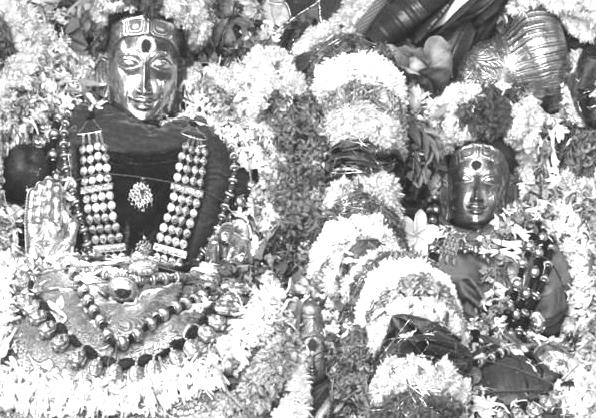
Lord Arunachaleswara and Mother Apeethakuchambal
“You can do one thing for me.” he would reply, “Narrate to me without omitting a single word, whatever our master spoke in my absence.” That was the only reward this devotee wanted. Masthan Swami was very humble. Bhagavan himself said that except for Kunju Swami and Viswanatha Swami, no other devotee knew who Masthan Swami was. He preferred to remain unobserved. The words ‘humble, devoted and pious’ aptly describe him.
Once, a robbery took place in the Old Hall at Ramanasramam while Bhagavan, Masthan Swami and some others were present. There was no reaction from Masthan Swami though one sadhu actually took a crowbar to hit the robbers. Bhagavan stopped him and said, “We are all sadhus, our duty is to keep quiet; the robbers’ duty is to rob. Let us follow our dharma. Let them follow theirs.”
When Masthan Swami became ill, he moved from his village to another village because he did not want to give anyone trouble. Rarely did Bhagavan go out of his way for anybody, but in this case Bhagavan called Desurammal and said, “Wherever Masthan Swami goes, be with him and look after him.” I have rarely heard of Bhagavan giving this kind of instruction for the sake of any other devotee. Masthan Swami’s last days were very beautiful. After he dropped his body, Desurammal came to Bhagavan and narrated, “Bhagavan, in his last days we thought he was in delirium. He was saying, ‘Nandi has descended and Siva’s celestial devotees, the bhutaganas, are dancing, saying, ‘Masthan! Come, come, come to us.’” She continued, “Perhaps, he was blabbering in his delirium. But Bhagavan, in his last moment he stood up. It was absolutely impossible for him to stand up in that state. He stood up and then with tears in his eyes said, ‘Apeethakuchambal has come to receive me, I am going Desurammal,’ and he dropped dead.”
On hearing this, Bhagavan commented, “Maybe the Universal Mother personally came to take him. All his descriptions tally with the world of Siva described in the Puranas. Masthan Swami was an unassuming devotee. He had a wealth of hidden spiritual experiences.” Not only did he extol Masthan Swami, the master thanked Desurammal as well, “It is a matter of gratification that he passed away in your care, under your supervision.” He did not stop there. After this, Bhagavan picked up a copy of the two thousand five hundred year old Tamil book, Tirumandiram. In it, are instructions on how a realized being’s dead body should be buried. Bhagavan marked those passages and sketched out how the tomb had to be built and the body entombed with sacred ash, camphor and other ingredients. Following these clear instructions, the samadhi was built.
The whole village turned out that day despite a pouring rain. The local temple, even though it was a simple one, gave the temple chariot in which God’s image was carried to carry the corpse of a Muslim. Most Hindus can feel the profundity of this. On that day, the rain was so heavy that the water was up to hip level. Amidst chanting, the body was carried into the samadhi built according to Bhagavan’s instructions. It is said that whoever goes there and offers prayers at the samadhi has his wishes granted. Let us offer our salutations to one of the most beautiful devotees of Bhagavan. Masthan Swami was the simplest soul one could meet, but Bhagavan paid the highest tribute to him. He said that, of all the people who came to him, Masthan was the ripest. One look and the fruit fell!
Masthan Swami had a disciple named Sambhandam, from whose notebook these details were gathered. Sambhandam has written a song about his master, Masthan Swami: “Oh Masthan, the liberated sage who lives in Desur, you are ever a good and pure renunciate, who remained forever like a child, who roamed like a ghost, and who lived without a trace of worldly desires. Precious gem, who obtained the sacred grace of satguru Ramana adored by all, praise to your fullness and salutations at your holy feet.”
From Masthan Swami, we learn the definition of a living guru. We observed that Masthan had almost three explosions of enlightenment. Thrice his Heart opened up with some feelings of doubt. In this process that he underwent, lies a lesson for us too - never get discouraged. Self effort and Self realization are nouns. Self realizing is a verb because it is always happening. Masthan was an example of this. His third process of enlightenment occurred when Bhagavan asked him if he would like to follow the form or formless way of worship. Masthan Swami chose nirguna - formless worship. Bhagavan already knew that Apitakuchalambal would come to take him. He asked him to choose worship in form or formlessness and Masthan Swami chose the latter. Yet, his ultimate liberation came from form, which means only one thing: God alone decides. We have the liberty only to make effort, the result is always in the hands of God and it is always for our good.
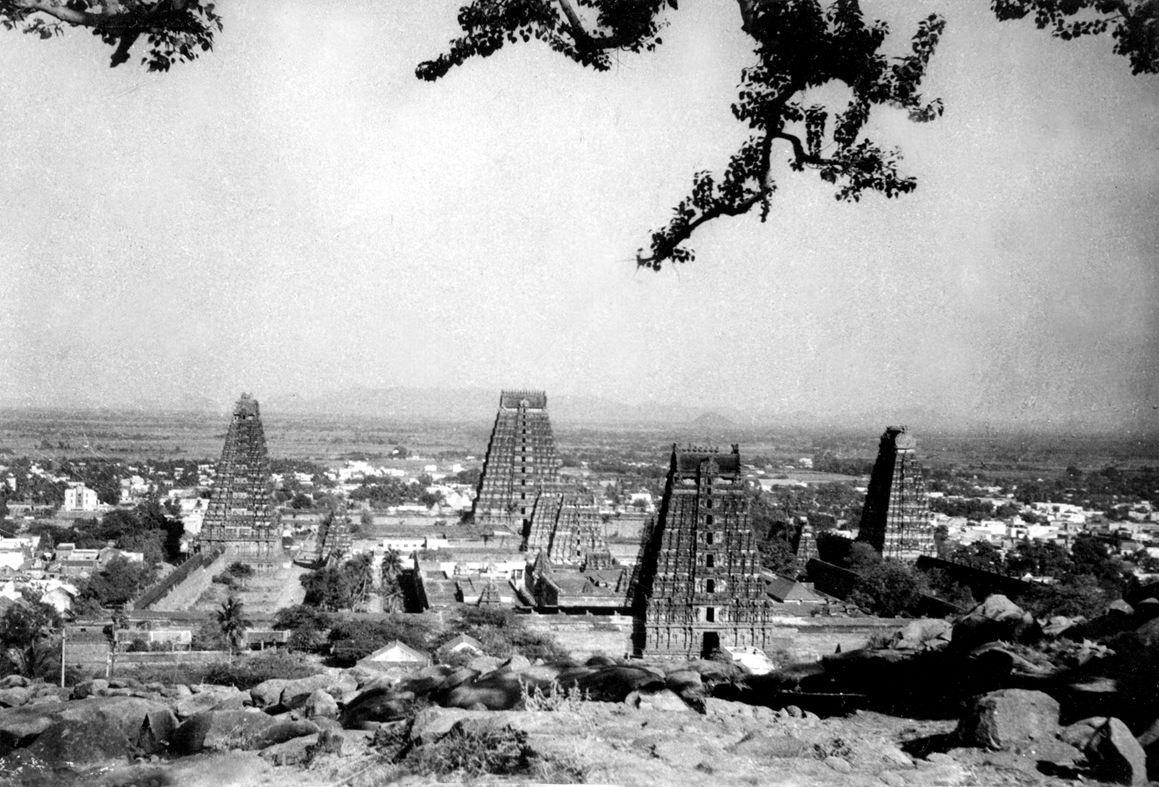
Arunachaleswara Temple viewed from the Hill
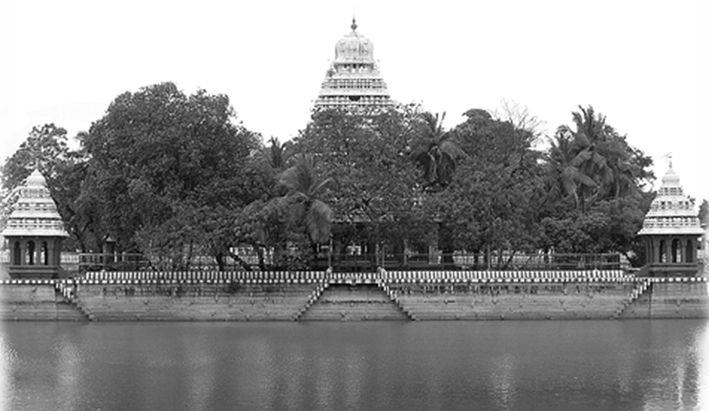
Madurai Mariamman temple tank