Raja Iyer
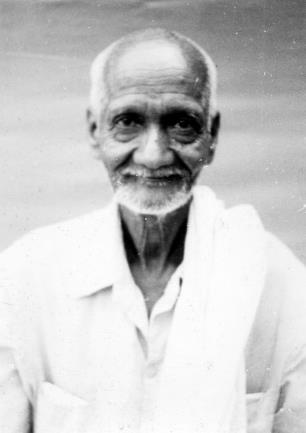
Raja Iyer was known as the Post Master. He was a simple and deeply religious man, devoted to singing bhajans and other devotional songs. He came to Bhagavan in 1911 when Bhagavan was in Virupaksha cave. By nature, he was a wanderer who went wherever his feet took him. He stayed with Bhagavan whenever he came to see him and his own aunt who lived in Tiruvannamalai. Even as early as 1911, this woman discerned Bhagavan’s greatness. It was her custom to make sweets and offer them to Bhagavan at Virupaksha cave. Whenever Raja Iyer was there, he would tell her, “I will take it to Bhagavan,” and so she would send the sweets through him. When Raja Iyer first met Bhagavan and gave these sweets as offerings, he could not comprehend anything of the spiritual teaching of Bhagavan; however, he did appreciate the experience. He said, “I liked the harmony of the evening hours at Virupaksha cave; the aromatic breeze of the holy hill and the stillness emanating from Bhagavan were indescribable. I enjoyed drenching myself in all that natural beauty. Added to this, whatever was brought to Bhagavan was shared equally with the others.” Since Raja Iyer was a nomad, there were times when he could not get enough food. Therefore, Bhagavan would keep some food items for Raja Iyer knowing that he enjoyed eating. Any time he went to Virupaksha cave or Skandashram, he always got something to eat. Raja Iyer commented, “I am not at all ashamed to confess that I went to Bhagavan only to eat sweets!”
One day, when Raja Iyer was going to Skandashram, he met Echammal carrying food to Bhagavan. At the same time, a group of devotees were coming down from Skandashram looking terribly disappointed. Echammal looked at the expression on their faces and asked, “What happened?” The group replied, “We went to see Ramana Maharshi but we could not find him.” Echammal exclaimed, “What? You could not find him?” They replied, “No, we couldn’t.” She then asked them, “Was nobody there?” The group said, “There was only one person. He was arranging some stones and patching up a wall. Other than him, there was nobody.” Echammal said, “Did you ask him where Bhagavan was?” They replied, “Yes, he said Bhagavan had gone up the hill.” Perplexed, Echammal and Raja Iyer enquired, “What did the person look like?” The group answered, “He was wearing a loin cloth and had a cloth wrapped around his head.” To this, Echammal and Raja Iyer asked, “What about his complexion?” They replied, “He was very fair.” Both Echammal and Raja Iyer understood that the person was none other than Bhagavan. Echammal and Raja Iyer told the group, “Come, we will take you to Bhagavan.” By the time they reached Skandashram, Bhagavan had completed whatever work he had been doing and had returned to his usual place. He was sitting so serenely that when the group entered and saw him, they immediately said, “This is not the man, it was somebody else.” At this, Bhagavan laughed. Echammal then confronted Bhagavan in the presence of Raja Iyer, “Bhagavan, why did you say that Bhagavan had gone up the hill? These people were so disappointed!” Bhagavan asked Echammal, “Do you want me to put a placard on my forehead saying that I am Bhagavan?” The point is that Bhagavan admitted that he was Bhagavan when he asked whether he should place a placard on his forehead indicating that he was indeed Bhagavan! When Raja Iyer narrated this incident to me, it was both amusing and revealing.
In 1927, during one of his wanderings, Raja Iyer came to a small city called Reddipalayam. By this time, Bhagavan had already come down the hill to the spot which later became Sri Ramanasramam. Since there was no electricity in those days, a devotee of Bhagavan arranged for a punkah or an improvised fan. This consisted of a long cloth attached to a light board suspended from the ceiling. By pulling a long rope attached to the fan, the cloth would circulate cool air. One night, Bhagavan appeared in Raja Iyer’s dream. Bhagavan was seated in the hall under the punkah. When Raja Iyer entered into the hall, Bhagavan said, “Come and pull this punkah.” So, in his dream, he pulled the punkah and Bhagavan enjoyed the cool breeze. A few days later, Raja Iyer went to Tiruvannamalai. When he entered Bhagavan’s Old Hall, he saw exactly the same punkah that he had seen in his dream! He prostrated before Bhagavan, and Bhagavan said, “Raja, go and pull the punkah.” Raja Iyer did what he was told. Five minutes later, Bhagavan called out to him and said, “Raja, that is enough!” Raja Iyer felt a great sense of responsibility and understood that Bhagavan wanted him to serve. Bhagavan had never before asked anyone to either pull the punkah or stop it. Since Bhagavan seldom actually told anyone to do anything, Raja Iyer took this as a sign that Bhagavan wanted him to serve him. He came to Ramanasramam permanently.
When Raja Iyer started staying in the present Ramanasramam, he was very often invited to sing bhajans in the town. There are different kinds of bhajans sung about different deities. For example, on the birthdays of Lord Rama and Lord Krishna, bhajans are sung throughout the night. Sometimes, an oil lamp is lit and placed in the middle of the room. People go round the lamp as the bhajans are sung. Raja Iyer was once invited to participate in a bhajan ceremony on the occasion of Lord Rama’s birthday - Sri Rama Navami. He communicated this to Bhagavan, “Bhagavan, they have invited me and I will have to go there.” Usually, Bhagavan would nod his head to indicate his approval, but on that day he didn’t. Just then, Chinna Swami the sarvadhikari came into the hall and said, “Somebody has sent money with the specific request that Sri Rama’s birthday be celebrated in Ramanasramam in the same manner in which it is celebrated in his village.” Bhagavan looked at Raja Iyer and said, “See, you will stay and do the bhajans here.” So, on that day, Raja Iyer performed the bhajans at the ashram. The bhajans went on for six or seven hours into the night. Raja Iyer often became ecstatic when singing the bhajans. Bhagavan too enjoyed the bhajans in his own way. Bhagavan did not participate physically in the bhajans by singing and dancing; but he would comment in Tamil, “Paithyam, they are all mad!” And then he would add very significantly, “How I wish everyone was mad like that!” I too have had the luck of seeing Raja Iyer sing and dance - it was wonderful!
One day Chinna Swami told him, “You can neither stay inside the ashram nor eat here unless you do some kind of service.” Raja Iyer went to Bhagavan and said, “Bhagavan, listen to what Chinna Swami is saying.” Bhagavan suggested, “Raja, why don’t you make idlis in the morning?” Idlis, or rice cakes, were made in the ashram every morning as it is to this day. Raja Iyer said, “Bhagavan, I do not know how to make idlis.” Bhagavan said, “I will teach you.” Making idlis was not easy because it involved a lot of work. Rice and lentils had to be ground the previous evening and it had to be done manually since there was no machinery. That evening Bhagavan said, “Raja, come,” and taught him. (In fact, Bhagavan himself ground the rice and lentils for many days with Raja Iyer to teach him.) The next morning, Raja Iyer told Bhagavan nervously, “Bhagavan, I do not know how to steam the idlis.” Bhagavan volunteered, “I will come and help you, Raja.” Bhagavan showed him how to cook the idlis. But, the next day, to Raja Iyer’s dismay, he found that all the idlis he had made had crumbled. He dashed to the hall desperately and reported, “Bhagavan, all the idlis have crumbled and I do not know what to do. I am very nervous.” Bhagavan asked him, “Before making these idlis, I told you that you should make an offering to the fire. Did you make a pledge that you will offer the first set of idlis to the fire?” Raja Iyer admitted, “Bhagavan, I forgot to do it.” Bhagavan said, “Go and do that. Tell the fire that the first set of idlis will be offered to it.” Raja Iyer told me he continued to make this offering even after Bhagavan passed away. He continued making idlis till the late seventies and the first offering was always to the fire.
This was the same Raja Iyer who visited Bhagavan at Skandashram and Virupaksha cave because he was fond of eating. He was still so fond of food that he would go into the kitchen and eat anything, whether cooked or raw. One day, a devotee complained to Bhagavan saying, “Bhagavan, what is all this? The man is uncontrollable; he eats whatever he wants!” Bhagavan smilingly said, “You are complaining about Raja.” The devotee said, “Yes, Bhagavan. It is not according to the rules of the ashram.” Bhagavan questioned, “Are you sure that it is a mistake on the part of Raja Iyer?” The devotee said, “Yes, Bhagavan.” Bhagavan continued, “Can you be clearer? Why do you also not go into the kitchen and eat like that?” The devotee answered, “No, Bhagavan, I cannot do that; I just cannot.” Bhagavan told the devotee, “It is not his constant eating that is bothering you but the fact that you are not able to go inside and eat as often.” In this manner, Bhagavan taught the devotee that there are no others. Our opinion about others is based upon our own shortcomings. The devotee was unable to eat as much as he wanted because he was afraid of Chinna Swami and therefore he was complaining. But Raja Iyer was not afraid of Chinna Swami. Raja Iyer told me years later that he had received many a berating from Chinna Swami, but this did not deter him from going into the kitchen and eating! Bhagavan then advised the devotee, “There are no others; whatever you see outside is your own reflection. Your mind is creating all this.”
In 1937, the Ramanasramam post office was started and Raja Iyer was made its first Post Master. The post office was near the cow shed. On the first day of its operation, Raja Iyer asked Bhagavan to come to the post office. When Bhagavan came, Raja Iyer gave him the seal and requested him to put the seal on all the letters received. He requested Bhagavan to come again in the evening so that all the letters that were being dispatched could also receive the seal from Bhagavan. So, on the first day in Ramanasramam post office, all the letters were blessed by Bhagavan since he put the seal on all of them.
There is a famous temple in Tiruvannamalai called Pachaiamman that the villagers frequented. In his early days, Bhagavan too had stayed there. Raja Iyer was so devoted to Bhagavan that when Bhagavan had sarcoma, he felt that the vermillion powder from this shrine could cure Bhagavan. This was the intense belief of all the villagers and of Raja Iyer. So Raja Iyer performed a pooja in the temple in the name of Bhagavan and took the prasad to him. But the doctors had given strict instructions that no one be allowed inside Bhagavan’s room. Bhagavan was inside the room with the doctors and a few other people. Raja Iyer lamented to himself, “I am unable to give this to my Bhagavan! If only he takes this prasad, he will be cured!” A few days later, someone suddenly called Raja Iyer and said, “Bhagavan is calling you.” Raja Iyer, who was constantly carrying the prasad in his pocket, was surprised. When he went to see Bhagavan, Bhagavan looked at him and enquired, “Raja, do you have anything to give me?” Raja Iyer remembered the prasad and said, “Bhagavan, this is the prasad from Pachaiamman temple. I prayed that you get cured, Bhagavan. Please take this prasad.” Bhagavan smeared some of the prasad on his forehead and said, “Give it to all!” He also added, “This Pachaiamman is very powerful and this prasad has real power.” Raja Iyer told me that Bhagavan knew that every devotee could feel the love which Bhagavan had for him and Bhagavan knew how to communicate this love unfailingly.
Raja Iyer used to look after the westerners who visited the ashram. Bhagavan appreciated the way Raja Iyer performed this duty. When I came to Ramanasramam in 1960, until 1972 or so, it was Raja Iyer who instructed me on how to conduct myself in the presence of westerners and how to take care of them. Hugo Maier and I thought that since Raja Iyer was so passionate about food, he would suffer a lot in his last days. We thought that he would constantly demand something to eat. But an extraordinary thing happened; one week before he passed away, he suddenly stopped eating. Two days before his end, he said, “I will drink only water.” It is not that he had any kind of disease; he just died of old age without any disease. In my own experience, I have only seen two people die of old age, where the body simply shrinks. The other person was Sama Thatha.
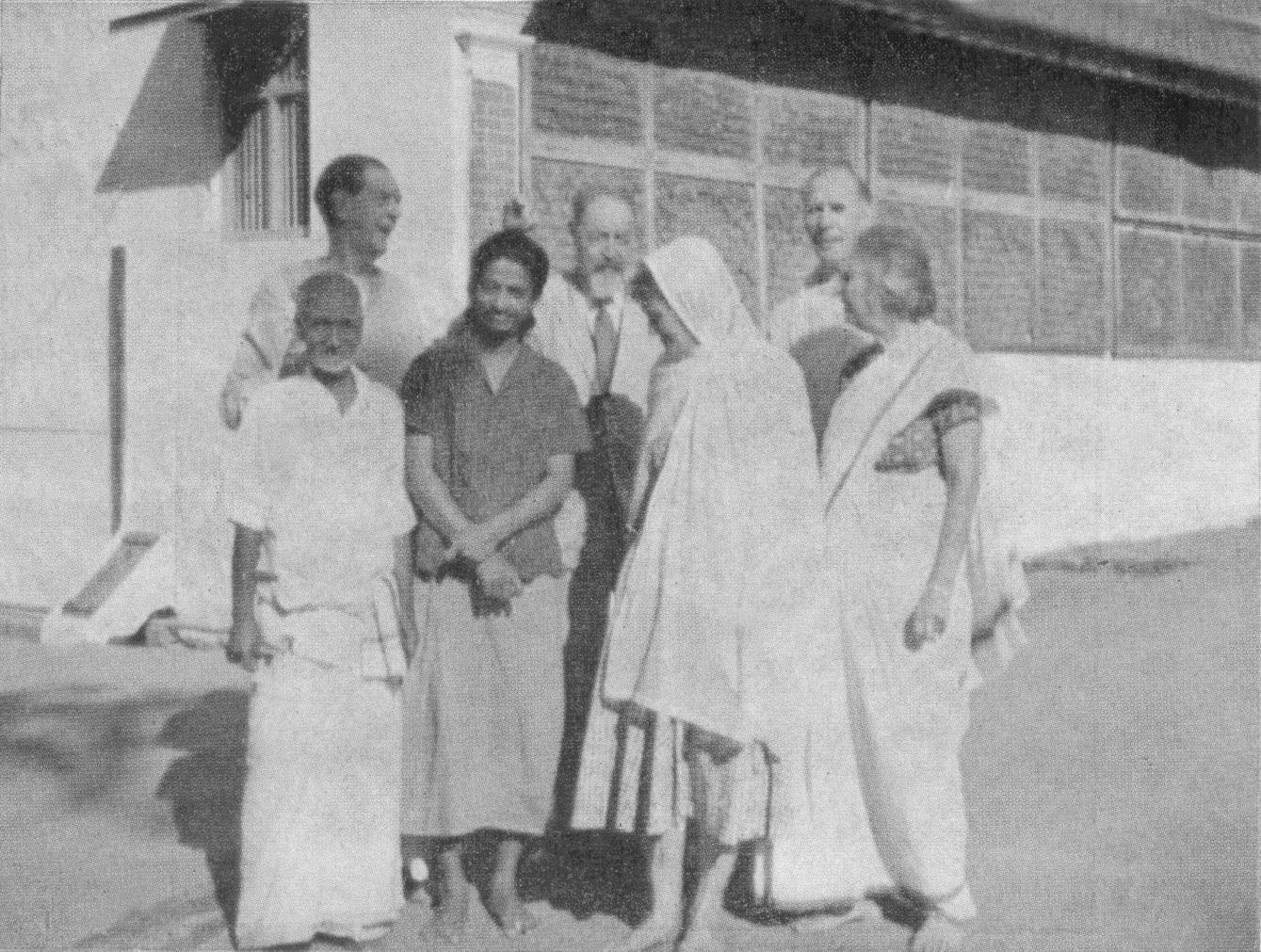
(front row) Raja Iyer, Ganesan, Mrs. Osborne and Miss Ethel Merston (back row) Major Chadwick, Terence Gray (Wei Wu Wei) and Arthur Osborne
(Sama Thatha was the fortunate one to bring food off and on to Bhagavan in Virupaksha cave and Skandashram occasionally. Later, he resigned his job and started assisting Bhagavan’s mother in cooking. He made breakfast in the present Ramanasramam till his physical strength failed him. When he was asked to leave the ashram because he was too old to continue working there, he went and sat in the hall immersed in sadness. An attendant drew Bhagavan’s attention to the plight of Sama Thatha. In the hall, there was a government officer to whom Bhagavan turned and asked, “Is there not a system called pension for one who has served for twenty five years in a government office?” Taking the cue, the attendant ran to the office and reported it to Chinna Swami. Chinna Swami came to the hall and requested Sama Thatha not to leave the ashram and added that he need not do any work. Instead, Chinna Swami pleaded that he stay and remain happily and quietly in the presence of Bhagavan all the time. In the 1960’s, when Sama Thatha was on his death bed, I attended on him and felt privileged to do so. There was no disease - he was merely melting away due to ripe old age! On the last day, since he wanted me to cremate him, he called me and taught me how to cremate sadhus who die at the ashram. My initiation in this service started with this blessed man who secured ‘pension’ from Bhagavan so that he could stay and drop his body in Bhagavan’s abode!)
On the day Raja Iyer passed away, I went and touched his feet. I also said, “Raja Iyer, please bless me.” He replied, “No, that is Bhagavan’s duty.” He continued, “Bhagavan is here. Take his blessing.” However, I insisted, “I will take Bhagavan’s blessing, but you must bless me too.” I then told him, “Raja Iyer, you know me very well. I will always do my best. If you have any wishes, please tell me. I will fulfill them. You know that I will do so.” Raja Iyer replied, “Ganesan, I have no desire. I have no thought at all. No thought comes to me. Look! Bhagavan is here! Bhagavan is here!” He kept repeating it over and over again. Finally he said, “I am in bliss, absolute bliss. See! Bhagavan is here.” His final words were, “Bhagavan is calling me!” I always tell my friends that Bhagavan took Raja Iyer not by ordinary but express post!
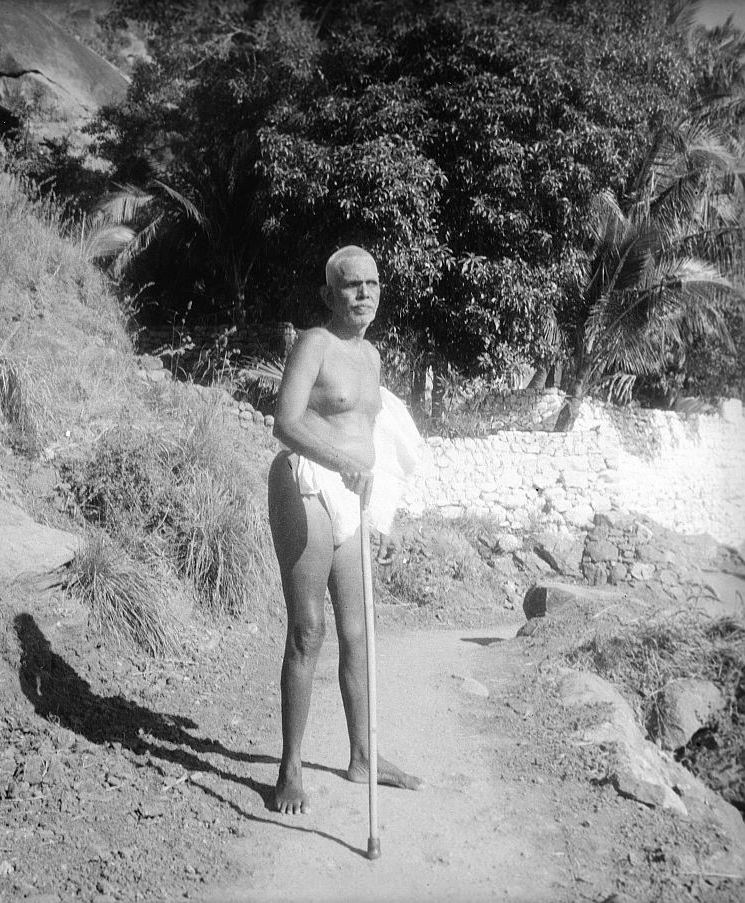
Bhagavan in front of Skandashram