G. Ramaswami Pillai
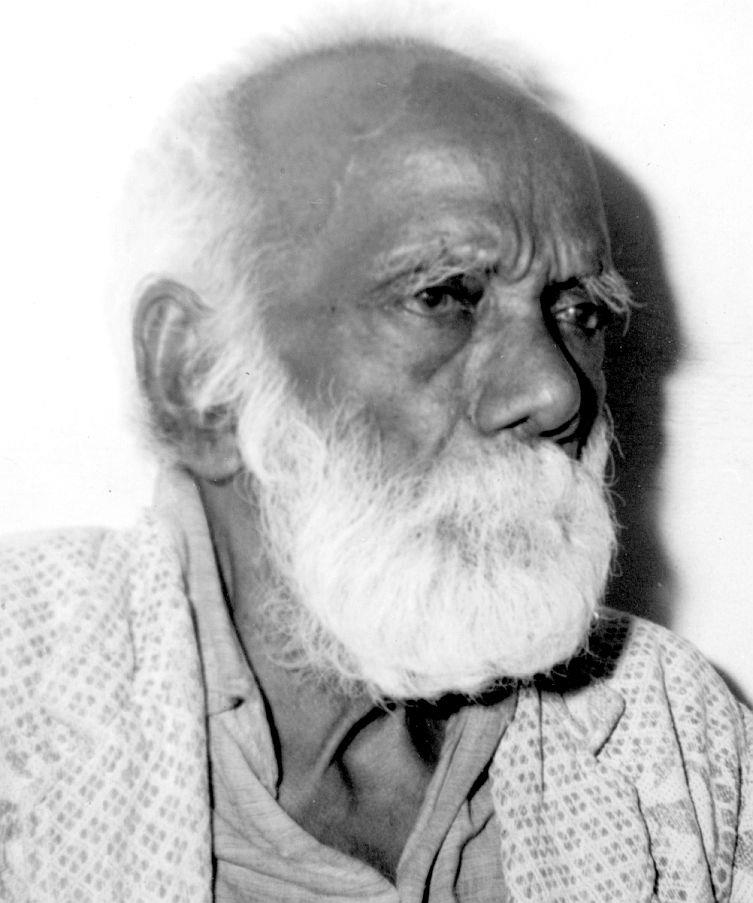
There are certain old devotees who may not seem that well known, important or significant - only because they chose to remain in the background. But in their relationship with Bhagavan and in their understanding and practice of his teachings, they are deeply significant. Although some of them were not very popular, and alas, to some extent even disliked by others, their relationship with Bhagavan was as wonderful as those of other better known devotees.
Ramaswami Pillai came from a family of non-vegetarians. However, even as a child he could not bring himself to eat meat and so he became a vegetarian. Seeing this, the rest of his family too became vegetarians. He studied the Bible thoroughly and read the Buddha’s teachings. He once told me, “I have been to the mosque many times and offered prayers just like Muslims do. When they said, ‘Allah,’ I could feel God.” He never looked upon it as something alien or different. Such was his background.
Ramaswami Pillai studied in Chidambaram, ninety miles away from Tiruvannamalai. One day, his teacher showed the class a picture of Bhagavan and said, “This is the picture of a great sage living in Arunachala.” Of the forty students in the class, Ramaswami Pillai was the only one to be so magnetized by the picture that after class he went to his teacher and asked “Sir, may I have a picture of that saint?” The teacher was only too glad to give him the picture. Recollecting this, Ramaswami Pillai told me, “Before I went to Bhagavan, Bhagavan came to my room.” Many people who have had a similar experience have told me, “Before I could go to my master, my master came to me.” After receiving this picture of Bhagavan, Ramaswami Pillai had a strong urge to meet Bhagavan. He soon made his way to Tiruvannamalai where he found Bhagavan seated on a rock in Virupaksha cave. Ramaswami Pillai said his very first darshan made him think, “Here sits the single, sovereign monarch of the universe, a maharaja, a chakravarty.” This feeling did not come to him on the first darshan alone. He said, “Every time I looked at Bhagavan, no matter how many times a day, all those years until he passed away, I felt that here is the single sovereign monarch of the universe.”
By then, Bhagavan had already composed Aksharamanamalai, a hymn with one hundred and eight verses. It took the young Ramaswami Pillai just a little more than an hour to learn the verses by heart. From then on, even though just a schoolboy, he chanted the verses constantly. Ramaswami Pillai’s second visit was when he was in college. Bhagavan had by then moved to Skandashram. That day, when he visited the master along with his friend, Bhagavan was going around the hill. He was taking the inner forest route that winds around the base of the hill. As he and his friend followed Bhagavan through the thick woods, he felt that Bhagavan was like a monarch marching ahead with his army following him.
The giripradakshina had such an impact on him that the very next day he wanted to do it again, but this time alone. But on the forest path he lost his way and did not know what to do. When he turned around, he found the ashram dog Kamala behind him. Kamala, realizing that he was lost, started walking in front leading him through the forest. Wherever he rested, she too lay down. Whenever he stood up, she resumed walking; she did not leave his side for a minute. In this manner she led him until he reached the town and then disappeared. When he returned to Skandashram, Kamala was already there! While the dog was leading him, his feeling was that this was not just a mere dog; it was Bhagavan himself who had come in this form. When he returned to Skandashram he looked at Bhagavan and Bhagavan gave him a very beautiful smile. “At that moment,” Ramaswami Pillai said, “I was more than convinced that Bhagavan would guide me through the unknown paths of life.” That was his first real experience in the presence of Bhagavan.
He started visiting Bhagavan often. On one such visit, he yearned to witness a miracle performed by Bhagavan. One evening when he went into town, somebody gave him a coconut and some broken rice. He brought these things to Bhagavan. Bhagavan said, “We can make a very nice porridge out of this. Find out if we have some sugar candy or sugar.” He was thrilled that Bhagavan - who usually never asked for anything - had asked for sugar candy. During the time Bhagavan was in Skandashram, there were only a few earthen pots used for storage. Finding all the pots empty, Ramaswami Pillai was distressed that he could not offer sugar candy to Bhagavan. He felt like running to the town for sugar candy, but it was dark and raining torrentially; the rocks were sure to be slippery. Not wanting to tell Bhagavan that there was no sugar candy, he quietly went to the entrance and waited for the rain to stop so that he could run to the town and buy some. Suddenly, he heard a knock on the door. It was a young man looking thoroughly drenched. He came inside and took out some sugar candy and a bunch of bananas from a cloth bag. Ramaswami Pillai recounted, “I already knew something extraordinary was happening. I was excited and was bold enough to go to Bhagavan. Bhagavan looking at me, said, ‘See! The sugar candy has come. We will make some porridge. As for the side dish, we now have bananas as well. Come! Let us have a feast today.’ Bhagavan was a pure jnani, always in a state of pure awareness. There was no need for me to crave for a miracle. Miracles happened in his presence. Bhagavan’s presence was magnetic. Just as iron filings are automatically attracted to a magnet, so too miracles were always happening in his presence without him even noticing it.” He asked Bhagavan, “I longed for a miracle and this happened. How did it happen?” Bhagavan replied, “This happened because of sannidhi vishesham - the power of presence, of awareness. There is no interlude of thought or desire involved in this sannidhi vishesham.” Then, Bhagavan added, “This is the first time in one year that I have had a second meal in a day.” Narrating this to me, Ramaswami Pillai’s eyes moistened as he concluded, “Never can I forget that day. Bhagavan had it indelibly imprinted on my mind.”
When Bhagavan’s mother passed away, Ramaswami Pillai helped in not only bringing down the body from the mountain but also in the burial. He was a hard worker and gave up everything else in life to stay with Bhagavan right from the Skandashram days. He painstakingly planted all the big coconut trees that we see today in Ramanasramam. Bhagavan had already given Ramaswami Pillai the teaching of ‘Who am I?’ But he still continued chanting ‘Arunachala Siva’ while engaged in gardening or cleaning the ashram premises. It was Ramaswami Pillai who established the custom of cleanliness in the ashram grounds that you see today. He used to work for almost eighteen hours a day, engaged either in gardening, sweeping or digging pits. There was only one bicycle in the ashram. When the office staff needed certain things to be got from town, Ramaswami Pillai was the only one who would offer to go on the errand. Thus, he came to be known more as ‘Cycle Swami’ than Ramaswami Pillai.
One day I asked him, “You were always away from Bhagavan’s presence; you were always working in the garden. How did you like it?” He replied, “Why Ganesan, from a distance I could see Bhagavan’s form and I was always chanting his name. Bhagavan was always in my heart. Bhagavan was perfection itself and because of his perfection, when we looked at him or chanted his name, the perfection came to us. As he was always in a state of bliss, we too were in a state of bliss.” In support of his statement, he quoted from tradition saying, “Ganesan, understand that in our scriptures this is called guru turiya. Turiya is the samadhi state - the fourth state transcending the three states of waking, dreaming and sleeping. When you are working very hard and looking at the master or chanting his name, he transports you to this state, which is not to your credit; it is because of his grace on you; hence it is called guru turiya. The samadhi state that we get established in is because of his blessings.”
Though others seldom saw Ramaswami Pillai, Bhagavan and he were working together telepathically almost all the time. Bhagavan was continuously blessing him with his presence and Ramaswami Pillai was always chanting Bhagavan’s name while doing his work. One day however, he had misgivings about his progress. He wondered if it was a mistake not to actively participate in any of the other activities of the ashram, such as chanting, pooja and festivities. So he asked, “Bhagavan, am I doing the right thing?” Bhagavan replied, “Do Self Enquiry - it embraces all other activities.” Even while he was working in the garden or going to town by cycle, he was consciously doing Self Enquiry. (Whenever I met him in the ashram after 1960, he would advise me very fervently, “Do not get involved in any of these poojas and other activities. They will not take you anywhere. Do only Self Enquiry.”)
Once, on losing his keys, he went to Bhagavan saying, “My keys are lost, Bhagavan.” Bhagavan smiled and said, “The keys are not lost; they are where they are. You have forgotten where you left them.” Then as he often did, Bhagavan supplemented what he said with his teaching: “It is just like the Self. It is always where it is. We forget it and take so many paths searching for it, saying, ‘I am not able to find the Self; I don’t know what the Self is or where it lies. We are searching for it even though it is always here. The Self is not lost, it is only forgotten.’” With the help of such anecdotes, Ramaswami Pillai used to give me Bhagavan’s teachings.
Those who have been to Ramanasramam and Skandashram must have seen the well levelled, rock paved path connecting the two. It was laid single handedly by Ramaswami Pillai. In an English version of Bhagavan’s biography, there is a mention of this path: “A path paved with smooth rocks was laid from Ramanasramam to Skandashram single handedly by a devotee.” Later, it was (mis)translated in a French edition: “It was laid by a man who had only one hand.” Ramaswami Pillai would say, “See! I have two hands but this French book says I have only one hand and yet I laid the path with it!”
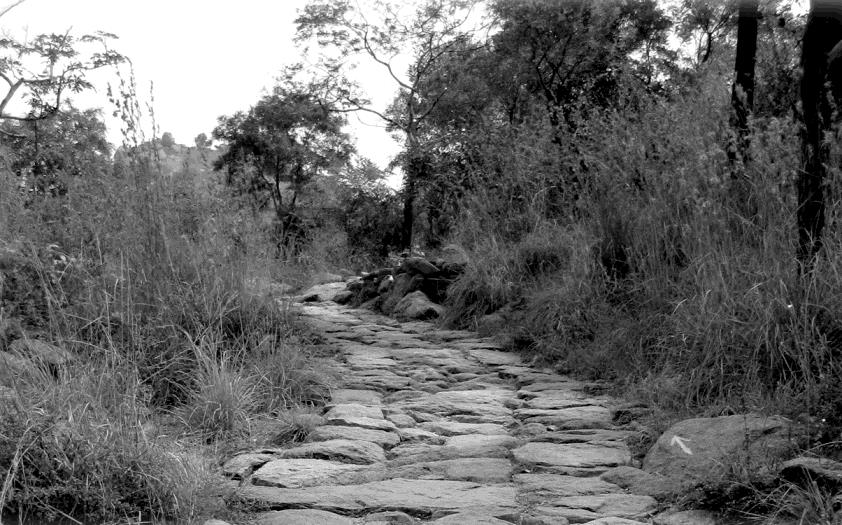
The rock paved path leading towards Skandashram
Wherever Bhagavan walked, Ramaswami Pillai would silently spread sand evenly like velvet. Every day, even under the hot noon sun, he would go and even out the paths Bhagavan regularly walked on. He was so unassuming that many people neither recognized him nor knew anything about him. One day while Bhagavan was going up the hill from Ramanasramam, he scratched his foot on a rock. Bhagavan was unmindful of it, but one of the attendants noticed it and told Ramaswami Pillai. From the next day on, Ramaswami Pillai started taking still greater care to even out a soft path for Bhagavan.
Rarely did he go into the hall where Bhagavan sat. He would normally prostrate before Bhagavan early in the morning and leave for his long, gruelling day of work. He had a unique sense of humour. One day when he came into the hall, he found two groups of traditional Hindus having an animated discussion. One group affirmed that according to the scriptures, Siva , the male God, reigns supreme. The other group asserted that Siva’s wife, Shakti, is supreme. (Shakti means power. As a matter of fact, one section of the scriptures says that even Siva gets his power from Shakti.) The two groups kept arguing in Bhagavan’s presence while Bhagavan looked on uninvolved. Bhagavan’s interest was aroused when he saw Ramaswami Pillai because he was a humourous and frank devotee. When Ramaswami Pillai learned what the argument was about, he said, “Oh! This is very simple. The female group is strongest because,” he said, quoting in English, “HE is contained in SHE. So SHE is the most powerful. What is the problem?” The entire Shakti group clapped and exclaimed, “Ah! We have won!” But, Ramaswami Pillai continued, “Wait! Wait! Wait! HE can remain independently as HE. But SHE cannot remain independently as SHE. HE has to be there; otherwise SHE can’t exist.” The Siva propagators applauded and exclaimed, “Oh! We have won!” Bhagavan laughed uproariously, admiring Ramaswami Pillai’s sense of humour. Whenever he came into the hall, Bhagavan would take great interest. Bhagavan liked unpretentiousness and this was Ramaswami Pillai’s greatest quality.
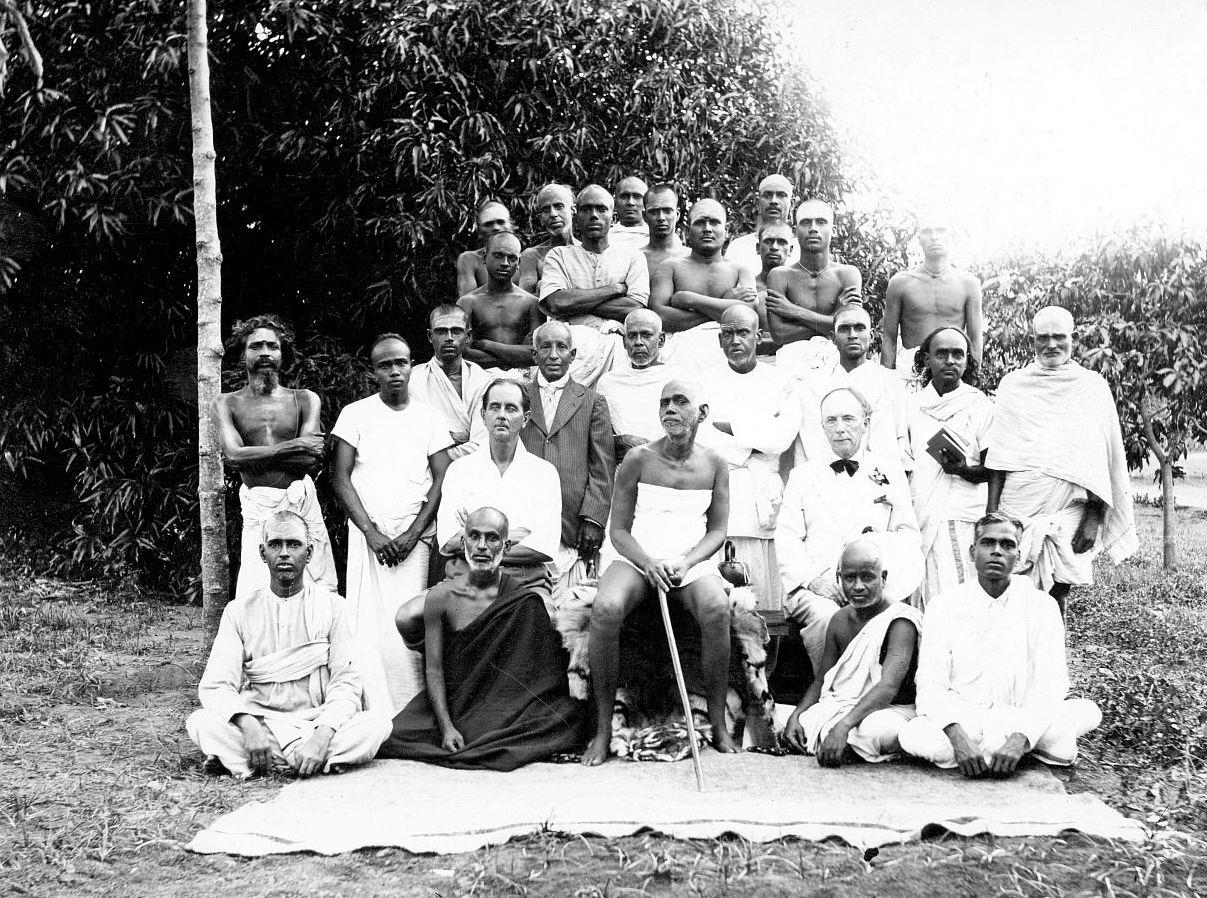
An early group photograph taken at the ashram garden
With all his humour, he used to din into my ears, “You must do Self Enquiry. In the presence of Bhagavan, we could feel that the mind was only a shadow, a shadow of the Self. The ego, the mind, is only a shadow of the Self - an unwanted accretion, a state of ignorance.” Then he would say humourously, “Nothing will be lost by its destruction. This falseness has to be and can certainly be dissolved by steady enquiry into one’s Self. Such enquiry itself is the grace of the satguru. All other efforts are definitely a waste of time.”
As we saw earlier, from the very first day he met Bhagavan he had started memorizing Bhagavan’s written works and verses. As the days went by, Bhagavan wrote many more verses. All the verses were mainly four line verses. In the evenings, parayana or chanting was done by two groups. One group would chant the first two lines and the other group would sing the next two. The parayana was set to a particular raga or tune and everyone was expected to follow it. But Ramaswami Pillai was a very excitable man. He would suddenly take off on a tangent and then start shouting the parayana in a totally different tune. This created a problem for the people in his parayana group. They approached Bhagavan and complained, “Bhagavan, Ramaswami Pillai does not follow the group. He goes off on a tangent. Please solve this problem.” Bhagavan replied, “What is the problem? He has got such a stentorian voice. Let him sing alone on one side while all of you sing on the other side as one group.” Ramaswami Pillai continued to shout out his own tune while the rest stuck to the tune of the parayana!
During his last days he could not eat the ashram food as he had lost all his teeth. He would eat only Mumbai halwa, a sweet made out of wheat and sugar. Since it was soft like jelly, he could easily swallow it. The halwa was his only source of nourishment. I used to provide him with it. He was staying inside the ashram and I had assigned him a room with an attached bathroom; I also appointed an attendant to look after his needs. On one occasion, the yoga guru T.K.V. Desikachar came from Chennai along with his group of teachers. He was a yoga teacher of repute and had taught me yoga and pranayama. I had invited him to Ramanasramam. My friend Anuradha and I took the group round the ashram and also to Skandashram. On the way, I was telling Desikachar that the path we were walking on was laid by a sturdy man who was now more than one hundred years old. Desikachar’s father, Sri Krishnamachari, was a great yogi who lived for hundred and one years. On coming back from Skandashram, Desikachar asked us, “Could I meet the hundred year old man?” I took him to Ramaswami Pillai’s room. As always, he was excited when he saw me. “Ganesan,” he said, “Come! Why have you come alone? Bring your father, brothers Sundaram and Mani; also, bring everyone in the ashram and in Ramana Nagar! I want to see them all!” I was quite surprised as he was not a friendly or social person.
It was time for him to have his halwa. When I put out my hand, he gave it a pat and said, “You are my child; you are asking me by holding out your hand! Come here.” Saying this, he started feeding me halwa as if I was a child. This happened in 1995, more than fifteen years ago - when I was nearing sixty years. I was not a child, but he was feeding me! He then distributed the halwa with his own hands. Desikachar enjoyed the scene and then said, “You used to say that he does parayana and has a beautiful voice. Could we hear him sing some songs?” I said, “Ramaswami Pillai, they want to hear you sing. Please sing some song of Bhagavan.” At this he got very angry and declared, “What do you mean by some song of Bhagavan? For me there is only one song and that is Bhagavan’s Aksharmanamalai.” He sang in his powerful voice. When he came to the tenth verse, he started panting. I immediately embraced him affectionately and pleaded, “Ramaswami Pillai! Please stop! That is enough.” “Oh! You want me to stop? Yes, I will stop,” he responded. It was three thirty in the afternoon when we took leave of him. As soon as we left the scene, he started singing Aksharamanamalai from where he had stopped. His attendant later said that he sang until five in the evening. Then he told the attendant, “Sit me up on my bed.” He continued singing with full consciousness until he dropped the body. I was not present at that time. But the next day, we laid him to rest within the ashram premises, singing Aksharamanamalai as wanted by him. All the residents of Ramanasramam and Ramana Nagar were there. I made the arrangements and interred him. Ramaswami Pillai, a very sturdy rock, had merged with Arunachala. I love him because Bhagavan loved him and he loved Bhagavan. He served not only the ashram but also every devotee of Bhagavan. The path to Skandashram will remain for hundreds and hundreds of years and every rock will talk about Ramaswami Pillai. Whether we human beings are grateful to him or not for the service done by him, every coconut tree in Ramanasramam will remain grateful to him.
After Ramaswami Pillai’s samadhi was completed, the ashram President asked me to surrender the keys of the room that I was occupying. Mother Krishna Bai whispered in my ears, “Bhagavan is giving you pension. Surrender the keys and be free.” After thirty seven years of service, that was the day that I walked away from karma yoga and the ashram. I pay homage to Ramaswami Pillai.
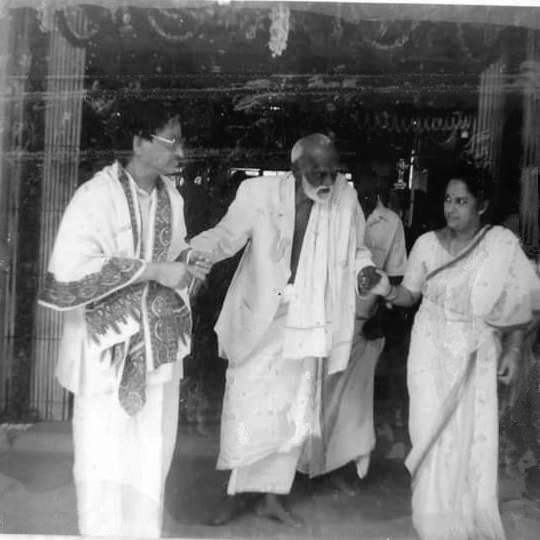
Sri Ramaswami Pillai is being brought from his room to the Sacred Shrine of SRI BHAGAVAN on SRI BHAGAVAN's JAYANTHI day -- by Anuradha and Ganesan, supporting Sri Pillai by holding his hands. He had already completed and crossed over 100 years of age ! When he reached the Shrine, he sat ( exhausted ) on the steps of the Shrine (which except for the priests no one is permitted ) . The priests were chanting. Sri Pillai majestically turned back to the Linga and in his stentorian voice prayed aloud : " Varumbadi Solilai Vandhu Yen Padi Ala " = " Did You not Command me to come ? NOW, take me ENTIRELY into Your fold ! " Very soon, Sri Pillai consciously died, after asking the servant make him sit on his bed cross-legged and loudly chanting SRI BHAGAVAN's " Marital Garland of Letters " ! What a powerful prayer by the devout disciple and how the Great GURU -- RAMANA -- fully responded to it by absorbing him into HIS FOLD !
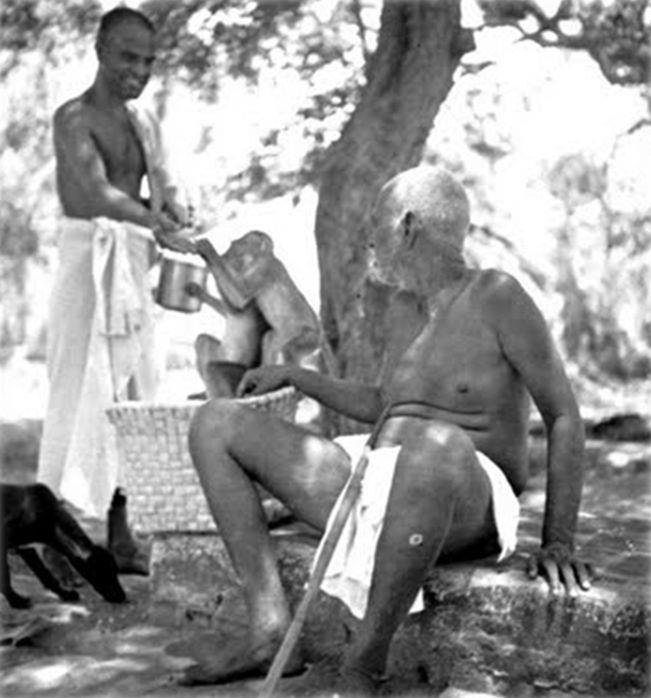
Sri Bhagavan and Kunju Swami feeding the monkeys