Niranjanananda Swami (Chinna Swami)
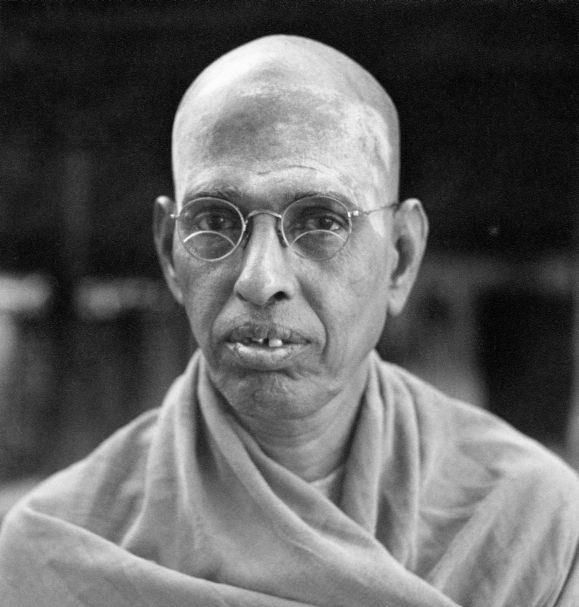
A great saint called Tiruchi Swami once blessed and guided me: “For spiritual fulfillment, one should possess a heart that is soft as a rose petal and as hard and impenetrable as a piece of iron. The seeker should use the ‘iron heart’ while dealing with the world. Worldly activities should be performed with non-attachment and with the clear determination that any work one undertakes - either on a daily or long term basis - should be completed irrespective of any problem that may arise. For this, what is most needed is perseverance. On the other hand, the spiritual seeker should use the ‘rose petal heart’ for total, selfless surrender and service to the guru. In addition, such a seeker should melt with devotion to attain the truth and also help others to grasp the essence of the master’s teaching. Patience is most needed for this.” He added, “Keep both sides of the coin within you - perseverance and patience.” Niranjanananda Swami’s total dedication and devotion to Bhagavan was the expression of his ‘rose petal heart’. While the boldness with which he bore the burden of managing the ashram, despite all problems and opposition, showed his ‘iron heart’.
In the Hindu scriptures, whenever God came to earth as an avatar like Rama or Krishna, he came with his brothers. In Rama and Krishna’s case, it was Lakshmana and Balarama respectively. Even saints like Jnaneshwar Maharaj and Ramakrishna Paramahamsa had brothers. These brothers, perhaps, might not have been perfect beings, yet the avatars and saints accepted them and corrected their flaws along the way. Their brothers were important in their mission of spreading virtue and goodness in the world, and therefore played an important role in the divine drama. Likewise, Bhagavan kept his brother Niranjanananda Swami unconditionally by his side. It is important that when we look at the brothers of great saints, we see them with an unbiased mind. This is because, while they might have committed mistakes, they were significant in the larger divine plan.
Bhagavan had two brothers and one sister: an elder brother Nagaswami, a younger brother Nagasundaram and a younger sister Alamelu. When their father Sundaram Iyer passed away, the family was split up. Nagaswami and Venkataraman came to Madurai while Mother Azhagammal took Nagasundaram and Alamelu to her brother-in-law’s house in another town, Manamadurai. At the age of sixteen, Bhagavan had the death experience and moved to Arunachala. In 1902, the family traced Bhagavan to Arunachala. Nagasundaram came to see his elder brother. Bhagavan was then known as Brahmana Swami and was living in Sadguru Swami cave below Virupaksha cave. When Nagasundaram saw his elder brother in ascetic attire and in total silence, he embraced him and wept. He observed that his elder brother was not subject to emotions any more. Bhagavan remained in silence and Nagasundaram felt that he should stay with him and help. But, Bhagavan knew that Nagasundaram had many worldly commitments and so, even though he offered to stay, Bhagavan did not reply. A disappointed Nagasundaram came back home.
We do not have too many details about Nagasundaram’s boyhood or later years. We know that he got married and got a job as a clerk. Then a series of unfortunate incidents started taking place in his life. His eldest brother Nagaswami died suddenly when he was only twenty years old. Within a short span, their ancestral property was auctioned off and they lost everything. Nagasundaram also lost his wife suddenly, leaving behind a little boy (my father, T. N. Venkataraman). Nagasundaram’s only source of comfort was his mother Azhagammal, but she too had gone away to Arunachala to stay with Bhagavan. These incidents shocked him and drove him to a state of surrender, submission and service. He gave up whatever he had left, including his son who he left with his sister. At that time like an oasis of hope, his mother sent word for him to come and live with her and Bhagavan. Thus, he left for Arunachala and Bhagavan accepted him, perhaps, due to his mother’s influence. Mother Azhagammal told her ascetic son, “My third son Nagasundaram is not very intelligent. He is a little rough and tough and it is very hard for him to live in the world. You have to take care of him.” Bhagavan obeyed her and only later revealed the purpose of supporting his brother all through. T. P. Ramachandra Iyer told me that once there was an altercation in the management and Niranjanananda Swami was involved in it. That day, while going up the hill, Bhagavan repeatedly muttered under his breath, “What can I do? I have given my word.” Ramachandra Iyer could not understand and asked, “Bhagavan, what are you saying?” Bhagavan replied, “When my brother came here, my mother took an assurance from me that I will not leave him and that I will protect him and keep him here with me. What can I do?”
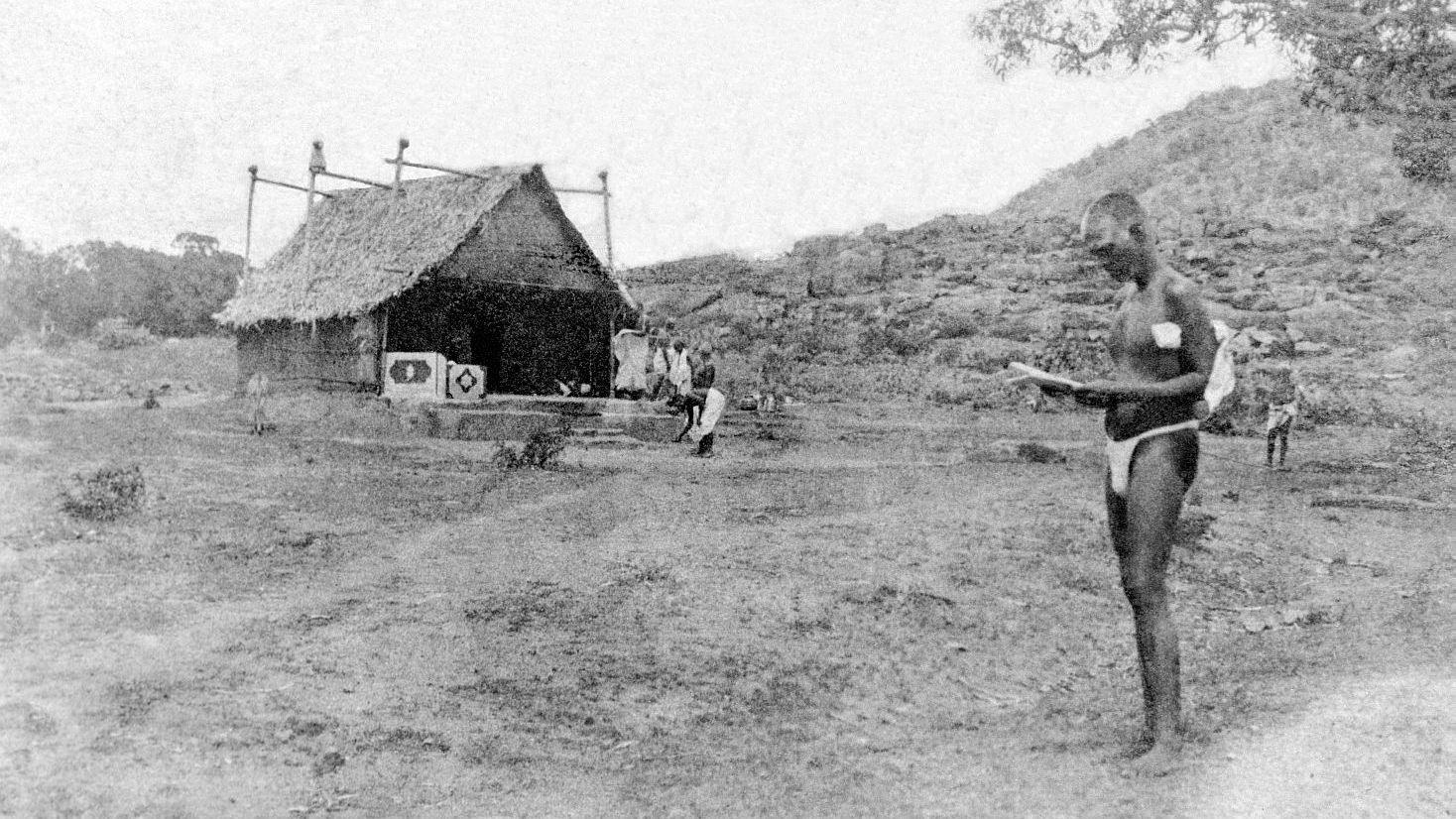
Earliest known photograph of Ramanasramam. Bhagavan seen reading a letter.
When Nagasundaram came to Skandashram, having been beaten by life’s trials, he too became an ascetic. He took to austere living and begged in the streets of Tiruvannamalai for food. By that time, Ramana Maharshi had written Who am I? and Five Hymns on Arunachala. These were the popular texts on which most devotees meditated or sang from. Nagasundaram contemplated, studied, and lived a reclusive life. Kavyakantha Ganapati Muni had already named and glorified Brahmana Swami as Bhagavan Sri Ramana Maharshi. When he met Nagasundaram, he could see that Bhagavan was paying attention to him. He too, therefore wanted to assist in saving him. “Why don’t you take the traditional step of taking sannyas and donning the ochre robe?” he suggested. Nayana also gave Nagasundaram the name Niranjanananda Swami, meaning ‘an immaculate person’. Given the complicated name, everybody started calling him Chinna Swami, meaning junior swami, as Bhagavan, his elder brother, was the senior swami.
When Azhagammal passed away, Chinna Swami was among those who carried her body down the hill and brought it to the thorny, bushy place which is now Ramanasramam. With help from the others, he buried her body in the samadhi. Kavyakantha insisted that Chinna Swami perform pooja for it. As was customary, a lingam was placed over her body. But, while this is usually taken off after some time, they let it remain there. Kavyakantha said, “You must perform pooja with all rituals because this is not just a tomb. It is a temple since Bhagavan has liberated your mother and she is no more an ordinary person; she is God.” Kavyakantha named the temple Matrubhuteswara, meaning God in the form of the mother. In this way, Chinna Swami was influenced to stay there and do pooja every day while Bhagavan stayed on in Skandashram. One day, Chinna Swami sent word to Bhagavan that he was going to make dosas the next day. It was considered a delicacy and he said he would bring it to Skandashram. Early the next morning, Chinna Swami heard a sweet voice, asking, “Is there any food for an athithi?” Athithi means a wayfarer or a guest. It was none other than Bhagavan, identifying himself as a guest.
`
Gradual growth of ‘Sri Ramanasramam’ under Chinna Swami’s management -1
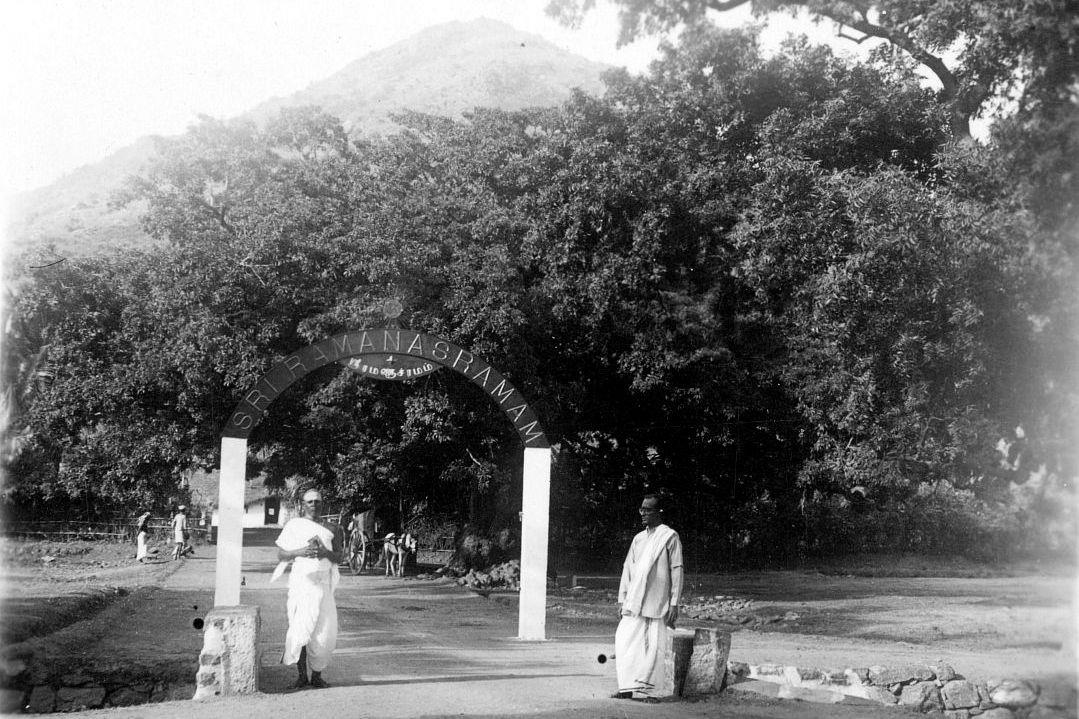
Entrance to Ashram
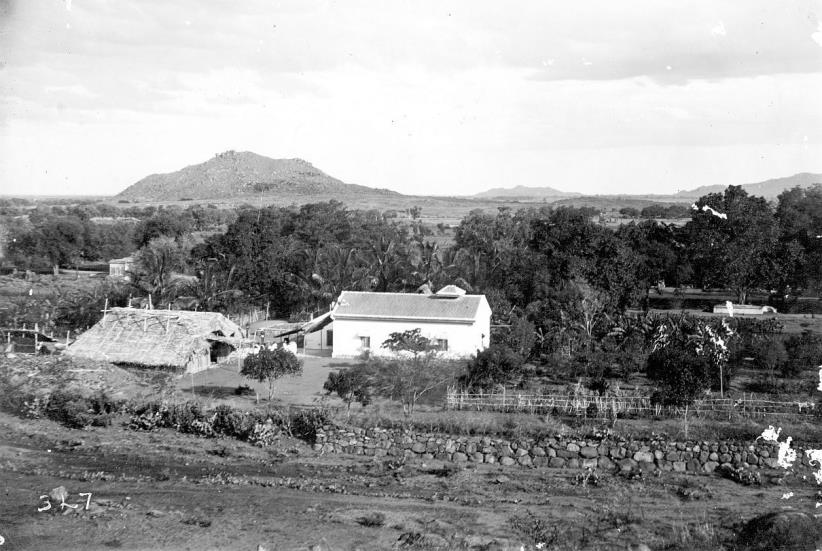
Bhagavan’s ‘Old Hall’ (1926)
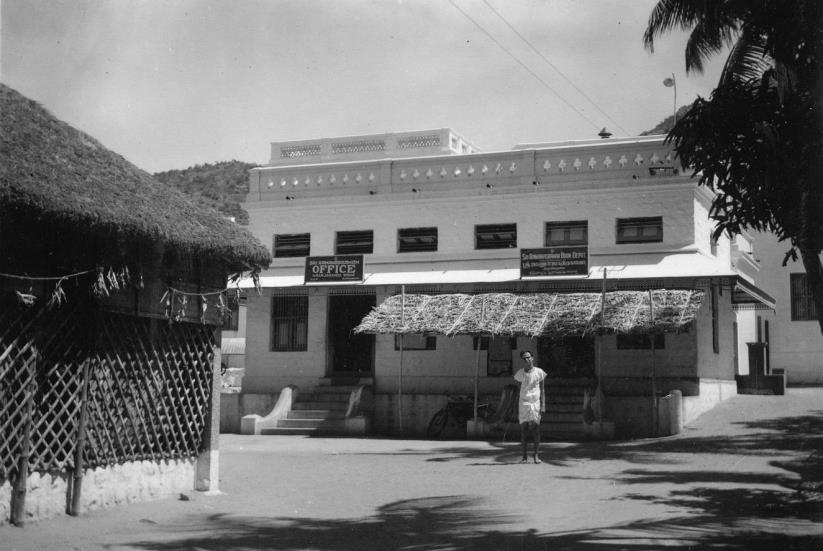
Ashram Office and Book Depot
Gradual growth of ‘Sri Ramanasramam’ under Chinna Swami’s management -2
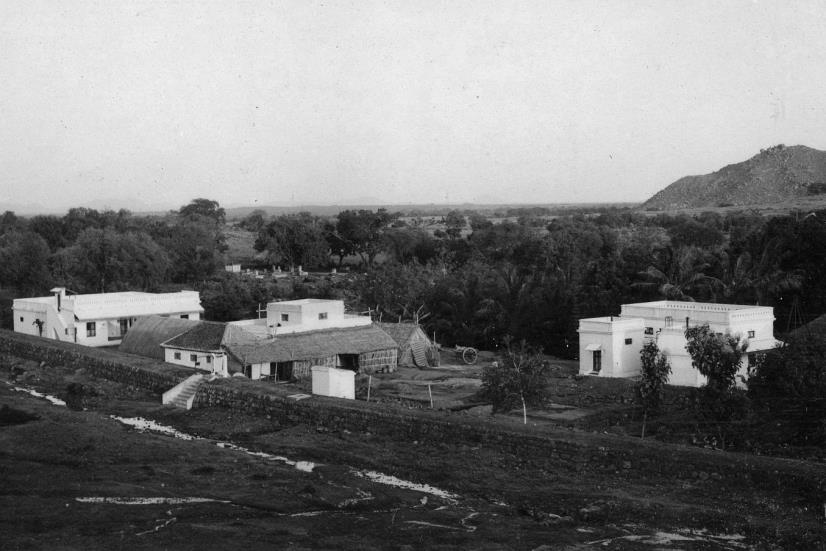
Goshala, Dining Hall and Dispensary
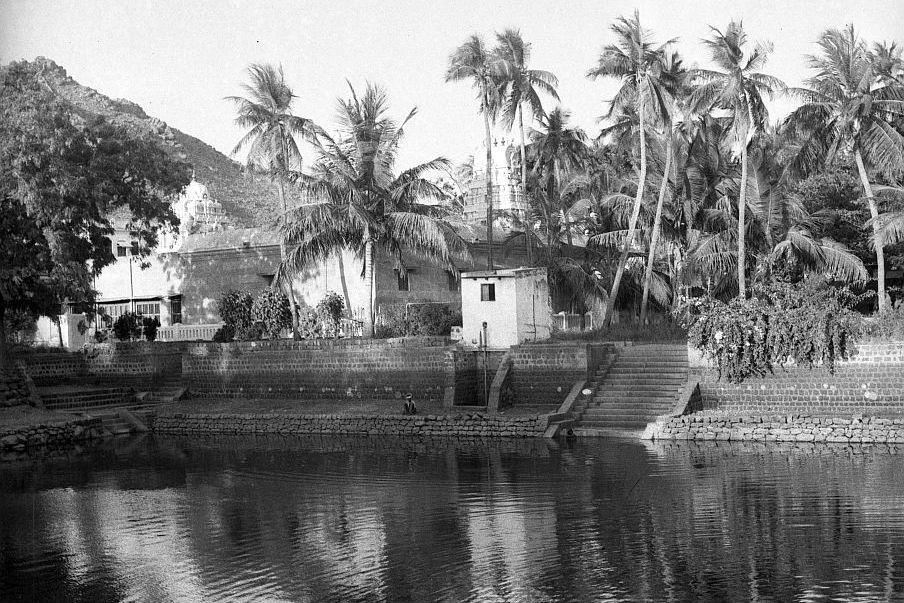
Matrubhuteswara Temple
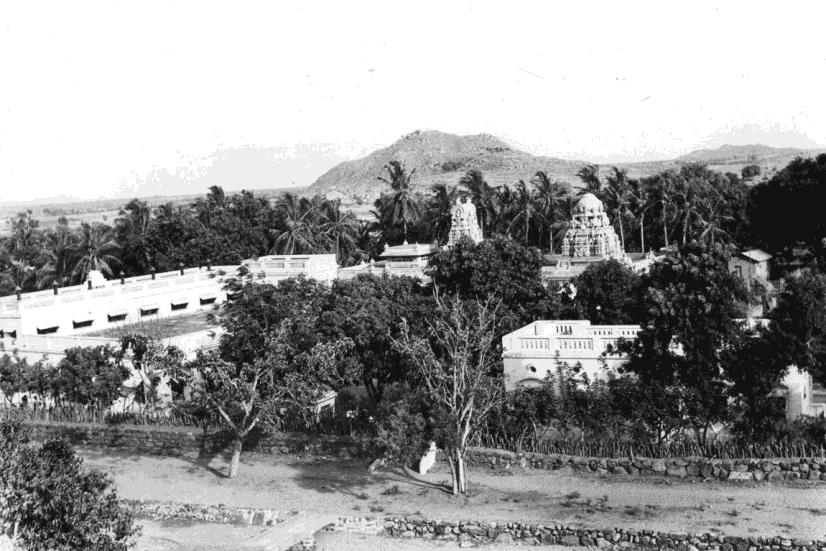
Sri Ramanasramam (1948)
The Mother’s shrine was the nucleus for the present Ramanasramam and Bhagavan stayed there, never as the owner, but as a guest until his last day. It was always someone else who managed the ashram. In 1929, after Sheshadri Swami passed away, some lawyers told Bhagavan that there were a lot of litigations that had to be managed. They advised that someone should be officially appointed as the sole manager of Ramanasramam. Everyone wanted Nayana to don this mantle. But Bhagavan turned to Nayana and said, “It seems Pichai (Chinna Swami’s childhood pet name) wants to do this. Let him become the manager and take the burden on himself.” Many devotees thought Nayana would have been an ideal manager as he himself was a spiritual giant. But time proved Bhagavan’s perfect selection. Niranjanananda Swami, being a person without any spiritual opinion, showed his strong will in the ashram’s management. But he was an unobtrusive prism for Bhagavan’s teachings.
Kavyakantha told all his devotees, “It is Bhagavan’s injunction and we should support it.” From that day on, Nayana’s disciples always supported Chinna Swami in his role as manager. In 1930, Bhagavan was asked to execute a will which stated that the family of Niranjanananda Swami would manage the material aspects of the ashram and that it would not have any spiritual successor to Bhagavan.
Chinna Swami was very austere, disciplined and strict. It is this strictness which earned him a bad name. However, he never cared about that. He was so austere that he never spent a single penny from the ashram funds for his personal use. He had two friends (devotees of Bhagavan, of course) who provided for his little needs like toothpowder, hair oil, betel leaves, betel nut and an umbrella. At that time he was the sole manager, the sarvadhikari, managing all the funds with no board or trust to verify the accounts. Yet, he never compromised on his honesty. The old devotees said he was so austere that when his clothes tore, he mended them himself and wore them again. He could have bought new clothes, but he would wait for months until some wealthy man came and distributed clothes to the residents of the ashram. Even then, he would take only one cloth for his personal use. Long before anyone was employed, he was the sole cook at the ashram and attended to all the ashram needs. (These are all facts reported by those who had earlier complained against him.)
Once, Jackie, Bhagavan’s favourite dog, was gravely injured while fighting a pig. Its intestines were exposed and it lay in immense pain. It was Chinna Swami who carried Jackie in a basket on his head to the veterinary hospital and had it attended to. Jackie recovered and lived many more years. By 1938, Chinna Swami needed assistance in the ashram. So he sent word to his son - my father - and the whole family to join him. I was two years old when my father brought me to Ramanasramam. Chinna Swami was just as strict with his son. He never favoured him; so much so, my father was always disappointed and disgruntled with him. When gifts like cycles were given to the ashram, my father would ask for one - only to be refused by Chinna Swami. If my father pulled a long face, he would tell him, “Venkatoo, we are commanded by Bhagavan to manage this ashram. We are his slaves and have to do this, generation after generation. But we do not have any special rights over this place. We should dedicate ourselves to do service with the attitude of a dog guarding a haystack. The dog will not eat the hay and it will not allow the stray cattle to eat the hay either.” My father, T. N. Venakataraman, followed this instruction meticulously and so did my two brothers and I. The third generation now manages the ashram and it is Chinna Swami’s blessing that generation after generation looks after the ashram, not like dictators or sole managers, but like dogs guarding a haystack!
Chinna Swami rubbed many people the wrong way with his blunt manner, but, as many devotees say, those stories must be looked at impartially. It is important that we see both sides of the story. Chinna Swami’s problem was a practical one: If all the residents preferred to sit with Bhagavan in the hall, how could the daily routine activities of the ashram - cooking, gardening, managing the store, letter correspondence, receiving visitors, cash transactions, printing of books, and general upkeep of safety measures to protect the property, buildings and residents - be carried out? So he stipulated the strict condition that one should assist the ashram management in some form if one wanted to stay inside the ashram. People who refused to comply with this condition were asked to leave the ashram. It is to be noted that those who were hurt by Chinna Swami’s disciplinary action spoke only about his harsh treatment but not about this reasonable stipulation put by him.
Muruganar, Ramaswami Pillai, Chadwick, Viswanatha Swami, Annamalai Swami, Kunju Swami, Devaraja Mudaliar, Suri Nagamma and Munagala Venkataramiah were a few of the old devotees in the long list of Chinna Swami’s victims.
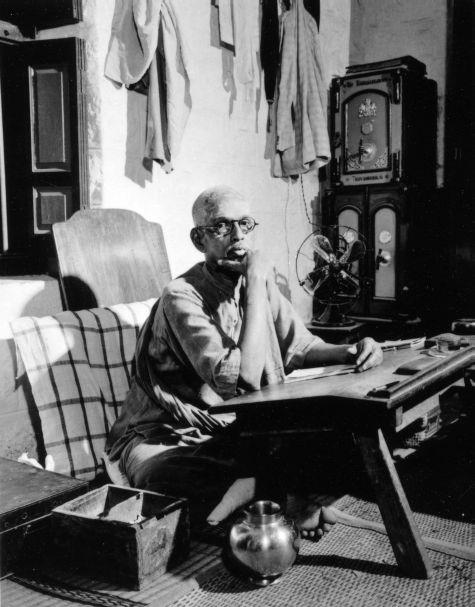
Chinna Swami as ‘Sarvadhikari’ in his office
When I referred to this unpleasant matter, they unanimously agreed, “Chinna Swami’s harshness did affect us and at that moment we were obviously hurt. There is no doubt about it. However, in later years we understood that unless he had treated us like that we would have continued to be immersed in management activities and would not have pursued our spiritual practices. In hindsight, we could see that even Chinna Swami’s harshness was only Bhagavan’s grace.”
Muruganar told me, “Chinna Swami repeatedly slighted me and even refused me food at the ashram. I had to go out on the streets and beg for food. The reason for Chinna Swami’s refusal was that he wanted me to continue performing pooja in the Mother’s shrine and also assist him with the correspondence in the office. I did not do that, so I had to leave. But Ganesan, I assure you, my going away gave me two great spiritual boons. I tell you honestly, but for Chinna Swami’s harshness I might have still been doing pooja in Ramanasramam and assisting in writing letters.” “What are those two boons?” I asked him. “I could get the proximity and presence of Bhagavan any time, day or night. Had I been committed to management work, I could not have had that. The second boon was that I was so ecstatic that I only wanted to write poems. I wrote nearly forty thousand verses on Bhagavan and Bhagavan’s teaching. These were written in silence and seclusion. With external activity, this could not have happened. Chinna Swami was a vital instrument in my gaining these two boons.”
One of the kitchen assistants Subbalakshmiammal told me that Chinna Swami was used by Bhagavan like a washerman’s stone to clear the devotees’ ‘dirt’, their vasanas, and make them devote all their attention to spiritual sadhana. To fulfill this role, Chinna Swami perpetually earned a bad name. Balarama Reddiar told me, “Though there were defects in Chinna Swami’s management, it is a fact witnessed by me repeatedly that Bhagavan always supported him. When I once complained to Bhagavan about Chinna Swami, he instantly corrected me and I steadily stood by that correction all my life in the ashram. Bhagavan curtly asked me, ‘Have you come all the way to sort out lapses in the ashram management? Attend to the business for which you have come. Find out who from within raises these complaints. Leave the rest to the higher power. Be still.’”
In 1973, Viswanatha Swami was the editor of The Mountain Path, the ashram journal, and I was assisting him as its managing editor. I spoke to him about the iron side of Chinna Swami with great feeling. Viswanatha Swami, on the other hand, quickly turned my attention to the soft, ‘rose-petal’ side of Chinna Swami by pointing out, “It is easy to stand in judgment of others, but who judges whom? A mind judges the play of another mind.” (This awoke in me, a great reverence for Chinna Swami and for everyone in the world, because when you look at people as ‘I AM’, there is no question of praise or blame.) Viswanatha Swami continued, “Ganesan, Chinna Swami was one of the biggest boulders that rolled down from the holy hill to give support to our satguru, Bhagavan. It is entirely due to his hard work and diligence that our dear Bhagavan was physically made available to us at a fixed place, twenty four hours a day. Undisturbed, we all got hridaya vidya - the truth of the Heart - in Bhagavan’s presence and straight from Bhagavan himself. In the Old Hall we experienced Bhagavan showering on us the truth, the wisdom of the Heart, day and night. How could it have been possible without a strong base, a material center and an institution like the ashram? Naturally, running an institution needed a strong, iron willed man like Chinna Swami to manage it all twenty four hours. Because of this, Bhagavan could sit silently, permitting both the horizontal and vertical expansion to take place simultaneously. Horizontal expansion includes establishment of the ashram as an institution, its daily management, printing books, serving food to the visiting devotees who flocked to be with Bhagavan, and other outward activities. At the same time, the much more important step of emphasizing vertical expansion, the need for one’s own inner spiritual growth had to be imparted too. This includes imbibing the guru’s grace in his presence: Self Enquiry, self attention, meditation, ascetic and reclusive living. The horizontal aspect includes multitudes of people and multifarious activities. The vertical aspect emphasizes only the individual, the inward experience of the truth in oneself. Bhagavan created an atmosphere for both the horizontal and vertical expansion to take deep roots in the ashram that was painstakingly raised by Chinna Swami.” He added, “In this divine play of Arunachala, Chinna Swami played a very vital role. Hence, Bhagavan gave him continued support in the affairs of the management. At the same time, Bhagavan guided each of us in our inward spiritual sadhana - whether we lived in Palaakothu or inside the ashram.”
This gave me the clarity that as seekers, we should remain in the awareness that we are all in the reverential presence of the truth - not just for one hour in the morning and evening, but every moment of the day. Call it Bhagavan or Arunachala - it does not matter by which name you call it. And we must also feel grateful to those who made this truth available to us. Not only Chinna Swami, but devotees like Devaraja Mudaliar, Annamalai Swami, Viswanantha Swami, B. V. Narasimha Swami, Muruganar, Paul Brunton and others who, between 1922 and 1940, formed important links in the ashram’s horizontal expansion. Yet, it is also true that for each one of these devotees, the vertical expansion of attaining Self realization was equally bestowed by Sri Bhagavan. The horizontal and vertical expansions have to happen together. “Like a train running on two rails,” as Muruganar once said.
Four principles are given as to how a devotee should have a relationship or contact with the guru: The first is that the devotee should look after the guru and his needs. A guru like Bhagavan may not look after his own body at all. We have seen how Arunachala took the form of many mothers and started taking care of Bhagavan’s body. Otherwise, when it was in Pathalalinga, the underground niche, Bhagavan’s body would have wasted away and it would not have been able to spread the message of the Self to us. The guru will never ask for his needs to be fulfilled. People close to him should know what they are and take care of them. The second principle is to look after the premises where the guru lives, keep it clean and secure it from problems. The third is to collect and preserve the guru’s teachings. The fourth is, after having done all this or while doing one or all of this, the devotee should put the teachings into practice and attain the truth and also help others attain it.
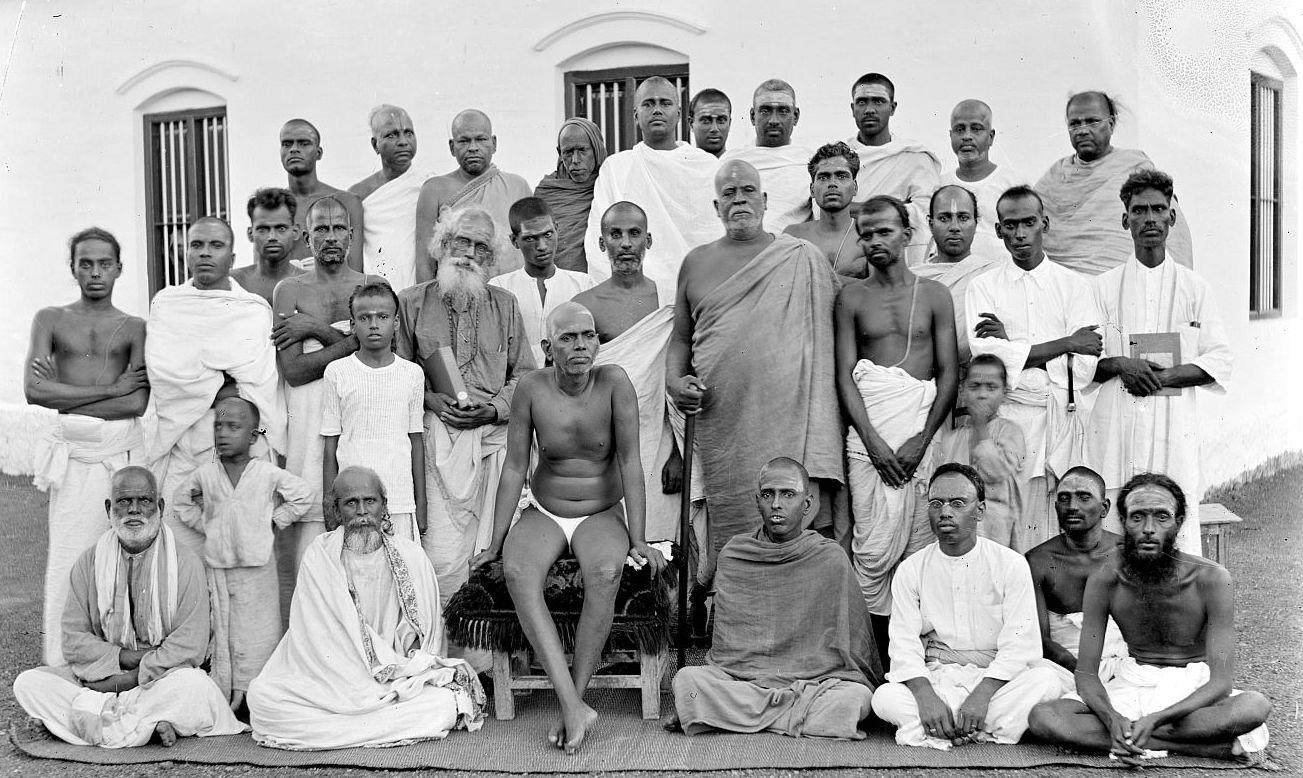
Kavyakantha, B.V.Narasimha Swami, Yogi Ramiah, Chinna Swami and other devotees
The first three - looking after the body of the guru, looking after the premises and preserving the teachings of the guru - are included in horizontal expansion and are activity oriented. The last one, putting the teaching into practice, is vertical expansion. Bhagavan, very compassionately, patiently and silently sat in the ashram twenty four hours, giving equal importance to horizontal and vertical expansion. Those who were involved in the activity of preserving the rights of the ashram, printing books or collecting Bhagavan’s teachings, might have served only in horizontal expansion. But Bhagavan bestowed upon them too, the blessing of vertical expansion, the attainment of the truth.
Chinna Swami’s life should be seen in the light of these four principles. Chinna Swami assumes great importance because he concentrated exclusively on the first three principles. He was needed because he looked after Bhagavan’s body and Bhagavan’s needs. Mistakes might have been made. However, a constant twenty four hours a day, seven days a week attention had to be given. In this way, he contributed to the preservation, maintenance and continued presence of Bhagavan’s body for all of us. Secondly, he had to fight to preserve the property of Ramanasramam. It is because of him that we can conveniently stay there now. He also religiously collected Bhagavan’s written works. When Bhagavan was up on the hill in Virupaksha cave and Skandashram, most of his writings which were on small slips of paper were lost. Bhagavan himself admitted this. After coming to Ramanasramam, under the management of Chinna Swami, not a single word that Bhagavan wrote has been missed.
Since Chinna Swami attended very scrupulously to the first three principles and had therefore no time to spend on individual sadhana, Bhagavan bestowed his blessings on him. In his last few days, he expiated for all his mistakes. His body suffered greatly. Then, Bhagavan gave him release. Viswanatha Swami was witness to this. In his dying moments, Chinna Swami put out his hands happily and Viswanatha Swami said, “I could feel it - Bhagavan came and took him and helped him get absorbed in Arunachala.”
It is perhaps appropriate here to quote what three remarkable devotees of Bhagavan told me about Chinna Swami. This is what S. S. Cohen told me: “Chinna Swami joined the master in 1917 at Skandashram with a view of dedicating his life entirely to the service of Bhagavan. In 1930, he was made the sarvadhikari of the ashram and managed its temporal affairs. Since then, and until his death in 1953, he worked tirelessly and with exemplary devotion for the welfare of the ashram. This necessarily meant that Chinna Swami had to stand firm and struggle hard to save the ashram’s rights during litigations and court cases as well. The present Ramanasramam and all its contents owe their existence entirely to his labour and iron determination. How thrifty he was in the ashram’s interest can be judged from his last message given a day before his death to his successor and son T. N. Venkataraman. Chinna Swami said, ‘I am departing with a clear conscience and clean hands. I have not used a penny from the ashram funds for my own benefit. Everything here belongs to Bhagavan and should be guarded with care and vigilance. Devote yourself heart and soul to the service of Lord Ramana and in return, I assure you, he will shower his grace on you. Be sincere and truthful to the core of your being. Uphold our revered, ancient traditions with the working of this ashram as I have upheld them all my life.’”
This is what Major Chadwick, who stayed in the ashram from 1938 till his last days, told me: “Without Chinna Swami, there could have never been a Ramanasramam at all. He raised it from a grass hut to an ashram of solid stone. He was full of zest and worked hard and tirelessly. His one joy was to feed the devotees visiting Bhagavan with good and nourishing food. For us ashram residents, he was like the protective metal shield used by soldiers fighting in the battle field. Therefore, unmindful of the happenings in and around the world, like wars and earthquakes, we plunged into our inner sadhana, undisturbed, thereby getting purified day and night in the spiritual presence of Bhagavan.”
Arthur Osborne always stayed outside the ashram because he lived with his family. Since Chadwick lived inside the ashram, I felt at that time that as a resident he would probably support the management. So I went to Arthur Osborne for a more objective view. Arthur Osborne told me, “For me there can never be a better management than that of Chinna Swami, for he was my gracious master Sri Bhagavan’s choice.” In his devotion to Bhagavan, he did not evaluate Chinna Swami’s management. Instead, he went one step further and said, “Since he is my master’s choice, my mind does not work on evaluating whether it was good or bad; there simply cannot be a better management for me.”
With great reverence to Chinna Swami, I want to share some of his unique achievements. Bhagavan’s birth place at Tiruchuzhi is a very sacred place and it was lost because it was auctioned off. When Chinna Swami became the manager, he took great pains to secure that house and make it a shrine for Bhagavan and Bhagavan’s parents to be worshipped. He named it Sundara Mandiram and it is still there in Tiruchuzhi. Another achievement which we cannot forget is that he managed to obtain the house where Bhagavan attained Self realization through his death experience. He struggled very hard to buy it and finally converted it into a shrine named Ramana Mandiram. Mandiram means most sacred shrine. Both these places are now pilgrim centres for devotees of Bhagavan to visit.
Fifty years after Bhagavan arrived in Arunachala, Chinna Swami wanted to celebrate the occasion in a grand way. Thousands and thousands of people were fed. Great scholars from all over the world came and paid their tribute to Bhagavan. The best musicians were called in too. Chinna Swami’s wish was that Bhagavan should have the best of music, food and everything because Bhagavan had not moved from Arunachala. Details of these celebrations can be found in Letters from Ramanasramam. I was ten years old at that time and witnessed it all and I have memories of some of the incidents.
Chinna Swami’s greatest achievement, according to me, was that on the golden jubilee of Bhagavan coming to Arunachala, he got the temple elephant to bestow the temple honours on Bhagavan. Why the temple elephant? Among all those present on that golden jubilee day, that temple elephant was the only creature that was with Bhagavan when he arrived in Tiruvannamalai. There is a thousand pillared hall in the Arunachaleswara temple where no one used to go because it was dark and frightening. An elephant was tied there and this was where Bhagavan was seated. At first, many urchins troubled Bhagavan in his meditation; therefore he chose this secluded spot. Bhagavan used to say that the elephant was his sole companion in all those months. Chinna Swami, remembering this, brought the elephant to pay him its respects.
In 1949, another devotee brought the elephant again and an American devotee took a photograph of Bhagavan with the elephant saluting him. When he went back to America, he sent that picture with these beautiful words written behind it: “A big Self which does not know the body (meaning Bhagavan) and a big body which does not know the Self (meaning the elephant) are both in one place.” Bhagavan read it out much to everyone’s enjoyment.
In 1949, Chinna Swami performed the kumbhabishekam - the consecration ceremony - for the Mother’s shrine. Though Bhagavan had no liking or aversion to ceremonies, he actively took part on the request of his devotees. This ceremony went on over four days and was beautifully organized. Thousands of people were fed and after its completion, Chinna Swami distributed gifts to all those who had worked for the success of the celebration. One group of people, who used to adore Chinna Swami, brought him to Bhagavan’s presence and placed a chair for him in front of Bhagavan. As Hindu admirers are emotionally wont to do, they wanted to wash his feet and adorn them with flowers. When Chinna Swami saw this, he refused to sit on the chair. He cried angrily, “This pada pooja can only be done for one who is not aware of the body. I am not fit for this. I still have body consciousness.” He pointed towards Bhagavan and said, “Here is Bhagavan; he is the greatest. No one here deserves any credit except our master, Bhagavan.”
There are some interactions between Bhagavan and Chinna Swami which throw better light on their close relationship. Once, Bhagavan’s birthday was to be celebrated and on the day before the celebration the residents realized that there were no provisions in the store. Hundreds of people had already arrived and Chinna Swami was unnerved. He did not know what to do - there was no money and no time. He began to panic and ran from pillar to post. Bhagavan was in the hall with his devotees. At midnight, a big bullock cart arrived and unloaded rice, lentils, oil and vegetables and drove away. However, all the residents were asleep and there was nobody to cut the vegetables and cook the food. Bhagavan understood this and with his wooden staff gently prodded all the sleeping residents awake, saying, “Chinna Swami is struggling there like a cat that has put its mouth into boiling milk. Let us help cut the vegetables.” Bhagavan and others cut the vegetables and cooked meals for the next day. Needless to say, Bhagavan’s birthday celebration went off beautifully.
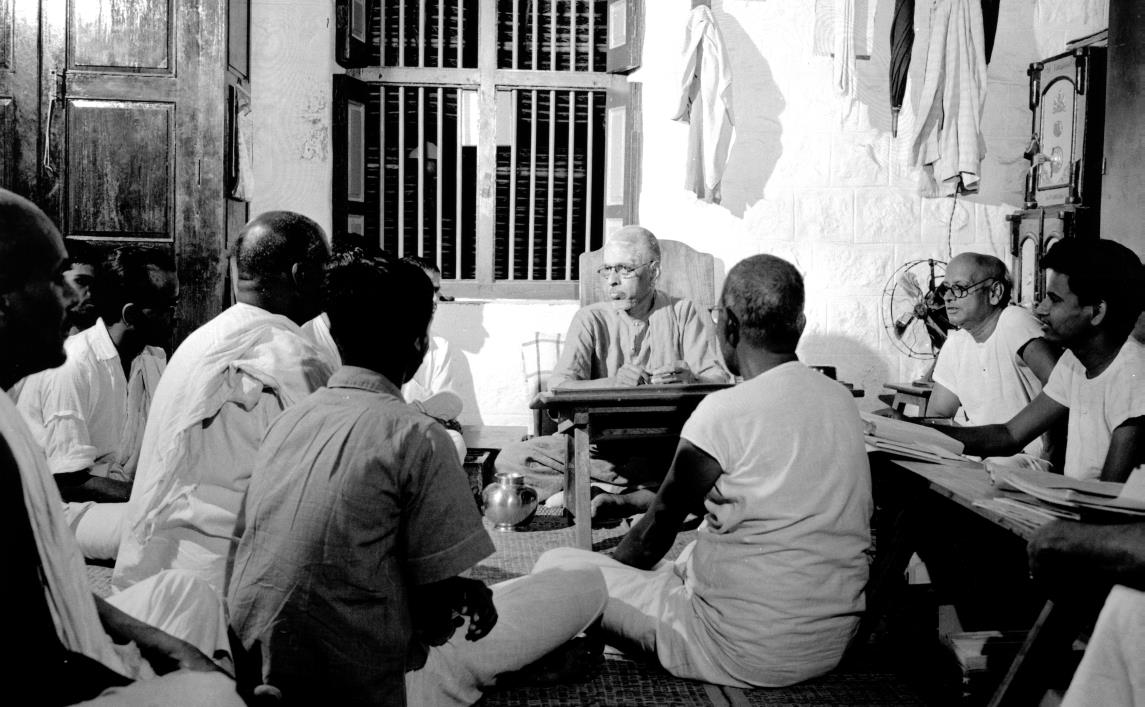
Niranjanananda Swami active in office
There is some controversy surrounding Paul Brunton, Munagala Venkataramiah and Chinna Swami which I would like to clear. It is recorded that Chinna Swami rudely stopped Paul Brunton from recording conversations in the hall. He is said to have done the same thing to Munagala Venkataramiah who recorded the talks which are now compiled in Talks with Ramana Maharshi, a must read for all devotees. It is true that Paul Brunton was stopped by Chinna Swami. This was because Brunton had started taking notes in Bhagavan’s presence and was selling them without even mentioning Bhagavan’s name. He even made statements that Bhagavan was popular because of his book. When Chinna Swami got to know of this, he marched straight to the hall where Paul Brunton was seated and told him point blank, “Stop it. You do not carry the right to do this anymore.” Brunton was furious and he turned indignantly to Bhagavan and asked, “Is this the view of Bhagavan also?” Bhagavan was silent.
Similarly, when Munagala Venkataramiah took down Bhagavan’s talks in a notebook, he would gather a group outside the ashram and try to impress them. When this came to Chinna Swami’s notice he came into the hall and stopped him in Bhagavan’s presence. Munagala Venkataramiah was deeply hurt on being insulted in the glare of public eye. Later, when Munagala was with Bhagavan, still feeling slighted, Bhagavan said, “The greatest form of ego for an individual is to present himself as a teacher and become a guru.” Understanding that this message was for him, Munagala immediately prostrated before Bhagavan and begged him for his forgiveness. Bhagavan saved him and Munagala himself later said, “When a true seeker becomes a teacher, the first casualty is his own advancement in sadhana.”
I was in touch with Brunton and he admitted that he went to Bhagavan and apologized. How beautifully Bhagavan corrected them and nudged them back into their sadhana! Both Paul Brunton and Munagala Venkataramiah attained Self realization in their later years, because this was Bhagavan’s purpose. Horizontal expansion took place when Munagala Venkataramiah and Brunton popularized Bhagavan’s teachings and Bhagavan gave them vertical expansion. For this, Chinna Swami was used like a rough, washerman’s stone to beat away their flaws. This is something that Munagala himself told me, “He used Chinna Swami as a washerman’s stone. We all blamed Chinna Swami, but it was Bhagavan saving us through him.”
There are so many instances I could share, but one concerning Annamalai Swami is especially important. Annamalai Swami was responsible for masonry at the ashram but could construct only ordinary buildings. When Chinna Swami began the construction of a temple, specialists were brought in from all over South India. After the construction started, there was a technical difficulty which Annamalai Swami could not resolve. But, he still wanted things done his way. The temple specialists and Chinna Swami did not agree with him and he was told to leave. This is what Annamalai Swami shared with me later, “For all outward purposes, it is true that Chinna Swami quarreled with me and dispensed with me. But I realized later that I needed this treatment. Otherwise I would have been an eternal builder inside the ashram all my life. Recognizing this, Bhagavan commanded me not to come within the ashram premises any more. The fact that it was not a reprimand from Bhagavan was proved when Bhagavan visited me almost every day at my residence in Palaakothu and encouraged me in my austere living, sadhana and seclusion. What a blessing it was to have Bhagavan personally instructing me alone in my cottage! All this, I can honestly say, I owe to Chinna Swami for firing me. I plunged inwards and had the inner vision that our Bhagavan is truly the ‘I AM’.”
Viswanatha Swami explained to me why all the senior devotees went to Palaakothu. “We did that so that we could pursue our sadhana. Bhagavan approved of this. He would ask us, ‘In which way are you going to build your hut?’ Bhagavan would also encourage us to go to the streets and beg for food. This enabled us to be with Bhagavan all the time and made us what we are today - in a state of realization. This was possible only because we left the ashram. Bhagavan wanted things this way.”
Viswanatha Swami was the worst affected by Chinna Swami’s tough demeanour. He once had to go without food for three days. One of the kitchen assistants took him inside the dining hall through the kitchen and made him sit along with others. When he was about to eat, Chinna Swami came in and pulled him out. Bhagavan witnessed all this without objecting to it.
Strangely, during Chinna Swami’s last days, it was none other than Viswanatha Swami who assisted him. Surprised, I asked him, “How could you do that after being so deeply hurt and insulted?” He replied, “When I was in Dindigul, Bhagavan appeared to me in a dream and asked me to come to Ramanasramam. I immediately left for the ashram. It was 1953 and Bhagavan had already dropped his body. I had no idea why Bhagavan asked me to come. When I arrived, I found Chinna Swami fatally sick and with nobody to attend to him. I felt that this was the purpose for which Bhagavan had asked me to come. I waited on him day and night, nursed him and bathed him. One day, Chinna Swami held my hand and begged for forgiveness. It is sad, but Chinna Swami suffered gravely for his actions. Bhagavan had noticed all his mistakes and made him physically suffer and expiate. Chinna Swami spent his last two days looking at Bhagavan’s picture, all the time chanting, ‘Ramana, Ramana, Ramana.’ At the time of his death, he stretched out his arms with his eyes closed, his face serene, happy and luminous. Bhagavan had come to take him and get him absorbed in Arunachala.”
Personally speaking, Chinna Swami has always been very kind to me. He would brush my teeth every morning, take me to Bhagavan and make me prostrate before him, saying, “Here is Bhagavan, our God.” I am grateful to him for taking me to Bhagavan’s presence, the sacredness of which I didn’t understand then, but which I now gratefully remember. When I was four or five years old, I used to run away from home and go to Ramanasramam all alone. In those days, the streets were dark and desolate. The first time I did this, Chinna Swami was taken aback. He asked me, “Why did you come?” “I had a disagreement with my father, so I walked away,” I replied. He immediately took me to Bhagavan and said, “He has walked all the way alone without fear.” He hastened to add, “I have already informed his father.” Bhagavan looked at me and gave a mischievous smile which I remember very well, but which I could not understand then. Chinna Swami then took me to the office where he used to sleep on a comfortable bed and offered it to me. “Why did Bhagavan smile at me?” I asked. “When you were two years old, you got into a empty bullock cart which was yoked to a bull. Its driver too wasn’t around. Startled by a visitor suddenly opening an umbrella, the bull sped away with the cart into the town. We frantically searched for you in the ashram, but you could not be found. We went to Bhagavan and informed him that you were missing. Bhagavan said, ‘What can we do? Running away from home is built into our family.’” “What did he mean by that?” I asked, puzzled. “Bhagavan’s father had an elder brother called Venkatesa Iyer. He had also run away from home on a spiritual quest.” Chinna Swami informed me.
When I was in charge of constructing Bhagavan’s samadhi hall, I encountered many problems. One day, Mrs. Taleyarkhan told me, “All these problems will be solved.” I looked at her questioningly. She continued, “Last night, Bhagavan appeared to me in my dream and said, ‘Tell Ganesan to take up the construction of Chinna Swami’s samadhi alongside and everything will be alright’.” With Bhagavan’s grace, I managed to construct his and Niranjanananda Swami’s samadhis simultaneously. The consecration ceremony was done in 1967 of all three samadhis: Mother Azhagammal’s, Bhagavan’s and Chinna Swami’s.
Being involved in building Chinna Swami’s samadhi, I was going to place a stone tablet which would simply read, ‘Niranjanananda Swami’, with his birth and death dates. Instead, the stone cutter sent me a tablet on which was etched: ‘Niranjanananda Swami - absorbed in Arunachala on 29.01.1953’. This thrilled me, and later in the fifteen samadhis that were built, I used a similar tablet for each devotee. For example, ‘Absorbed in Arunachala - Muruganar’, ‘Absorbed in Arunachala - Kunju Swami’, ‘Absorbed in Arunachala - Major Chadwick’.
Let us remember Chinna Swami, one of the biggest boulders that rolled down from Arunachala to serve our master; the master whose only mission (if at all he had a mission) is to make his own state available to all of us - the state of ‘I AM’.
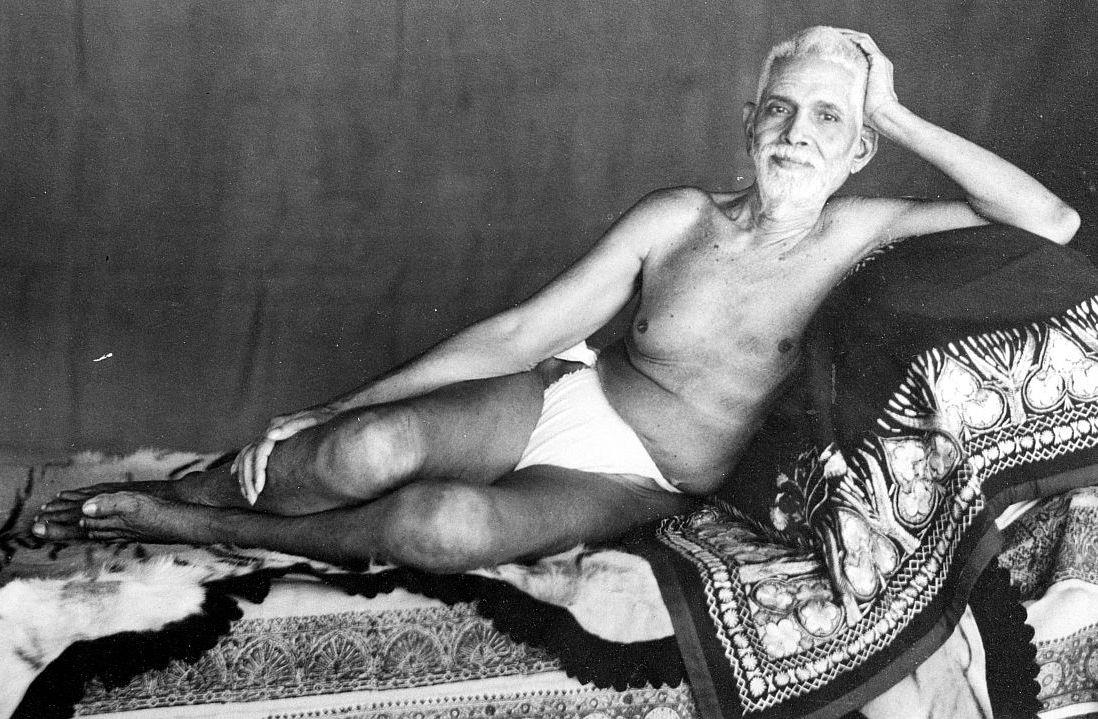
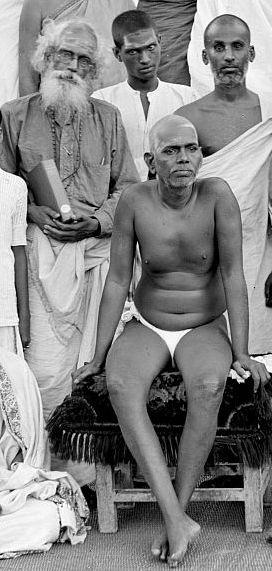
Sri Bhagavan with B.V.Narasimha Swami (holding a book)