Prof. G. V. Subbaramayya
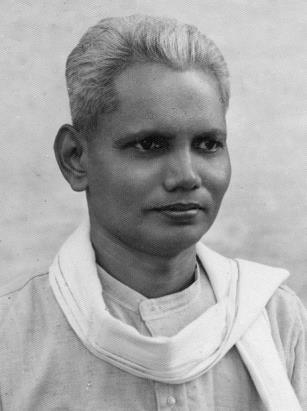
G.V. Subbaramayya, the principal of a college, was a remarkable person. Spiritual seekers are greatly indebted to him, because he extracted from Bhagavan an assurance that he will protect and emancipate all of us. Bhagavan dropped his body on the fourteenth of April, 1950. Around April seventh or eighth, Professor Subbaramayya and sub-registrar Narayana Iyer, went to see Bhagavan. They wept inconsolably. Bhagavan asked Subbaramayya, “What do you want?” Subbaramayya replied, “Abhayam yivale,” meaning ‘give me protection’. Bhagavan looked at him and said, “Ichchanu”, meaning ‘it is given’. By this, he meant not only protection, but also liberation. Sub-registrar Narayana Iyer who was also weeping, questioned, “Bhagavan, is it only for Subbaramayya?” Bhagavan turned to him and replied, “For everyone!”
In 1960, only two or three visitors used to come to Ramanasramam and they were not even aware of Bhagavan’s teachings. Today, Bhagavan’s message is spreading everywhere. It is not just the teaching as a philosophy that is spreading, but the essence of the truth about oneself. Everyone is waking up to this and this is the abhayam, the protection and the liberation that Bhagavan promised. Bhagavan once said that every being has to eventually come to Arunachala - not to the physical Arunachala, but to the Arunachala within. Everyone has to awaken to the teaching of ‘I AM’. Bhagavan’s abhayam is ever there, but we owe it to the Professor that Bhagavan gave a verbal affirmation a week before he dropped the body!
Subbaramayya came to Bhagavan in 1930 in a state of grief. He was overwhelmed by sorrow at the loss of his two year old son and was wandering around India. On one of these wanderings, someone advised him to go to Ramana Maharshi. Another person, coincidentally, gave him Bhagavan’s Upadesa Saram in Telugu around the same time. His immediate response was that if a Tamilian could write such great spiritual poetry in Telugu, then he must be a spiritual giant. So, he visited the Maharshi, still weighed down by great sorrow.
Bhagavan’s very first look was filled with such grace that it made his sorrow vanish. According to Subbaramayya, “The pole star of my life is, of course, my satguru Bhagavan Sri Ramana Maharshi. At a time of distress, I was drawn to him and the very first darshan plunged me into the ocean of peace and bliss. Ever since, he has been the light of my life. He is my mother. Bhagavan is my father, Bhagavan is my guru, Bhagavan is my own, Bhagavan is my all in all and in him my little self and all its moorings were consummated and sublimated. In a word, he is the embodiment of grace. At every step, even with the least incidents of my life, I have come to feel with a growing consciousness, the guiding hand of that divine grace that is named as Sri Ramana.”
However, even after this look, Subbaramayya was besieged by a sincere doubt. He questioned, “Bhagavan, the Bhagavad Gita says that mortals cast off their worn bodies and acquire new bodies, just as one casts off old clothes and wears new ones. How does this apply to the death of mere infants whose bodies are fresh and new?” Bhagavan looked at him with compassion and replied, “How do you know that the body of the dead child was not worn out? It may not be apparent; but unless it is worn out, it will not die. That is the Law of Nature – ‘ ஈஸ்வர நியதி ’.” Straight away, Subbaramayya’s sorrow and misery disappeared.
Subbaramayya, a good conversationalist, was also a scholar of Sanskrit, Telugu and English. He started translating Bhagavan’s works into English. His translation of the Ramana Gita is appreciated even today. Earlier, he had met a mahatma who had initiated him into a mantra. He was chanting the mantra very diligently. After coming to Bhagavan and having his darshan, he couldn’t continue with the mantra. He felt rather guilty and wondered whether he had done something wrong. He went to Bhagavan with his problem, “Bhagavan, suddenly the mantra has stopped. I am afraid.” Bhagavan responded, “You have done a lot of japa using the mantra. The fruit of the mantra has brought you here. Why do you need to fear?” At a much later date he asked, “What is the difference between japa repeated in the mind and meditation?” Bhagavan replied, “They are the same. In both, the mind is focused on one thing - either on the japa or on the Self. Mantra, japa, dhyana and vichara - all are different names only. As long as they require some kind of effort, we give them these names. When the goal is realized, they go on effortlessly. What was formerly the means now becomes the goal.”
Some time later, Subbaramayya had a different kind of problem. He had been practising breath control as taught by Swami Rama Tirtha in his works. Subbaramayya continued the practice at a particular time every day. One day, he suddenly felt a terrible sensation as though his head would crack and break into pieces. In spite of stopping the practice, the sensation kept recurring at the usual time of his practice. One night, when Bhagavan was alone, he approached him with his problem. Bhagavan said, laughing, “What? Are you again seized by fear? These are the experiences that people have when they practise yoga without the immediate guidance of a guru. But you have come to me, so why should you fear?” Then in an undertone, Bhagavan added, “Next time you get that sensation, think of me and you will be all right.” These words are to be inscribed in our hearts in gold. Whatever form of sadhana you are following, whenever you are in pain, think of the name of the master. Subbaramayya personally told me that there was never a next time!
Subbaramayya was also told very clearly by Bhagavan how seekers should offer their prayers. Should one pray for mundane help from the guru or should one ask for spiritual emancipation alone? Subbaramayya had a daughter who was two or three years old. The child lived in the village and would often have fits. Once, she became unconscious and it seemed as if she would die. Subbaramayya sent an express telegram to Bhagavan declaring, “Bhagavan! My child, Indira, is suffering. Please help her.” As advised, he also called for two ayurveda doctors to come. At seven that night, Subbaramayya’s brother-in-law who was staying in the next village happened to bring sacred ash that he had received the previous year from Ramanasramam. “Apply this on the forehead of the child,” he said. The ash was applied and to the wonder and delight of everybody, the child was declared cured by the two ayurveda doctors who had also just arrived. The very next day, there was a letter from the ashram confirming the receipt of the telegram. “Bhagavan saw your telegram at seven in the night. Everything will be all right.” To Subbaramayya, it was indeed a miracle! During the next holidays, which happened to be for Christmas, he visited Bhagavan. Like all intellectuals, he too faced the problem of accepting what had happened. Subbaramayya questioned Bhagavan: “Did you think you should save my child?” Bhagavan clarified to him that even the thought of saving the child is a sankalpa, a desire, and a jnani has no desires whatsoever. The moment a jnani looks at anything, the divine force comes into action automatically. We only have to pray and hope that the master’s glance falls on an object so that divine intervention takes place automatically. Think of Ramana, think of Arunachala and at once divine intervention occurs!
Every time Subbaramayya visited Ramanasramam, Bhagavan would wake him up at two thirty in the morning and take him along with sub-registrar Narayana Iyer and Kalyana Sundaram Iyer to the kitchen. There, they would prepare sambar or chutney. Bhagavan would do the actual cooking, while these people assisted him. Whenever Subbramayya saw Bhagavan perspiring because of the summer heat and the heat from the stove, he would pick up a fan to fan Bhagavan. Bhagavan, who never liked any special favours, would always say, “Stop!” Once, Subbaramayya crept up behind Bhagavan when he was deeply involved in the cooking and fanned him. Bhagavan noticed it and said, “So, you want to do it stealthily? Well, even that you are not able to do properly! Come, let me show you.” Bhagavan held Subbaramayya’s hand and showed him how to use the fan correctly. Subbaramayya said, “It was a divine moment when Bhagavan touched me!” They would then go to the next room to grind the chutney. Subbaramayya did not know how to move the pestle to grind the chutney. Once again, Bhagavan held Subbaramayya’s hand to show him how, sending him into ecstasy. After the chutney was prepared, Bhagavan would taste it and also give it to the others to taste. If their hands were occupied otherwise, he would say, “Open your mouth!” He would make a small ball of the food and pop it into their mouths. Subbaramayya commented, “I was in heaven when Bhagavan did this!”
Once I asked Subbaramayya, “What is so unique about Bhagavan?” Subbaramayya said, “One outcome of the originality of Bhagavan’s Self realization was that his approach to the problems addressed to him was equally original because his death experience was also original. He did not imitate. He did not quote from books; all his answers and actions were absolutely original and unique. His answers to questions were never bookish. They were simple and direct. Like Jesus Christ, he spoke with authority. His words were the result of firsthand knowledge and experience rather than bookish knowledge and hearsay. He went to the root of every question and simplified it. He did not use confusing terminology when he spoke. He would cite only concrete illustrations along with his answers, making his meaning crystal clear.”
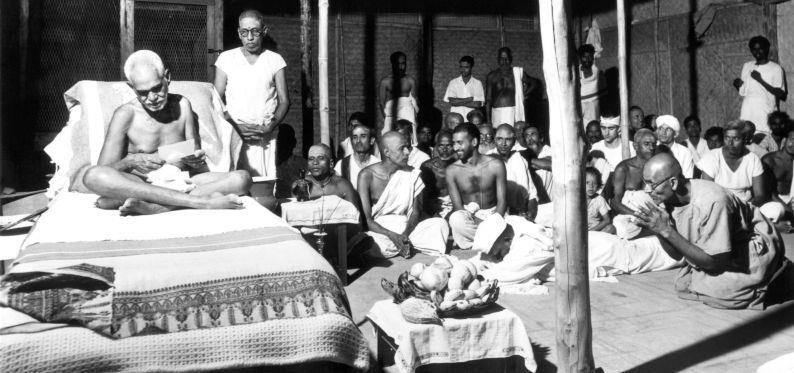
Bhagavan reading one of G.V. Subbaramayya’s letter
When G.V. Subbaramayya spoke about the clarity of Bhagavan’s utterances, he would always be in raptures. Bhagavan once told him, “When a person enquires, ‘For whom is this Self realization?’ the individuality goes and the delusion that the Self is yet to be realized disappears. This alone is the grace of the guru. The guru can only dispel the delusion that the Self has not been realized. Granting Self realization is impossible not only for the guru, but for God himself. Praying to the guru to let you have Self realization is like asking, ‘Give myself to me.’ We identify the body with ourselves because we have the delusion, ‘I am an individual.’ This creates another delusion that the guru is also an individual and is therefore other than myself. The guru is actually not someone different from you.”
During the last days of Bhagavan, Subbaramayya wrote a few verses and submitted them to Bhagavan. One of these verses is of utmost importance to us seekers, since he has made a commitment to Bhagavan on our behalf as well. The prayer is: “We take an oath to keep your teachings constantly in mind, to watch your movement attentively, and learn the lessons thereof to dispel the delusion of the ego and abide firmly in the Self like you ever are. This is the service which all of us devotees would render to you, my beloved satguru, oh Ramana.” We do have a duty towards our master. It is not enough to proclaim that Ramana is the greatest guru. We have to stay committed enough to constantly retain the teachings in the mind. During the last moments of Bhagavan, Subbaramayya cried inconsolably. Bhagavan’s last words to him were, “Do not worry. Be at peace. Everything will be well. To be is our nature. Coming and going is the trick of the mind. Our commitment is to be pivoted to the silence and the peace within us.”
Two other important experiences in the presence of Bhagavan were shared by G.V. Subbaramayya.
B. Ananthachari took great pains in printing the Ramana Gita. His help was appreciated in the preface of the book. He pleaded earnestly with Bhagavan to have his name removed. Bhagavan responded with, “Why do you worry? To ask for the omission of your name is as egoistic as to desire its inclusion! So, let it be. After all, who knows who Ananthachari is?” Most of us understand humility to be withdrawal from recognition. We seldom understand that accepting things as they are is the pinnacle of humility.
Pannalal, I.C.S., Commissioner of the Allahabad division, once visited the ashram with his family. He complained to Bhagavan that though he had riches, enormous power and material comforts, he did not have peace of mind. Bhagavan asked him, “Why do you want peace? Why can’t you be as you are?” Pannalal replied, “Because I am not happy otherwise.” Bhagavan answered, “Then it is like this: a man who has a headache will not rest until he has taken the right medicine and has got rid of his ailment because health is our true state and not illness. Similarly, peace is our true nature. Indeed, we are at peace but we forget that and seek peace from external sources. This is an impossible quest and creates all these problems. The moment you withdraw your mind from external objects and turn it inwards, it then takes to real peace and feels happy.”
Once in the early hours of the morning when Subbaramayya visited Bhagavan, Bhagavan talked about how we have a glimpse of our real Self every day. Between the state of sleep and waking, there is a moment of twilight. The waking consciousness begins with the thought of ‘I’. Just before the upsurge of this thought, there is a fraction of a second of undifferentiated pure consciousness. So, first there is unconsciousness, followed by pure consciousness and then creeps in the thought of ‘I’. It is during this state that we become conscious of the world around us. We can sense pure consciousness only if we are alert and watchful for the state.
The beauty of Bhagavan’s teaching is that it is simple, direct and natural. We are fortunate to be able to read about these sacred relationships between the supreme master and his old devotees. In the process, our own consciousness becomes purified. It becomes equipped to focus on the truth. We automatically turn to our brain, our memories, our desires, because we feel that security is there. One must have total faith. Arunachala means Aruna-achala. Aruna is being, aliveness, and achala means ‘unmoved’. When the mind remains unmoved, then it has no other choice but to dissolve itself in the Self, in Self awareness, in other words, that which is called ‘unmoved’. That is what Bhagavan meant when he said, “Everyone finally has to come to Arunachala.” If you want the truth you have to keep the moving mind immobile.
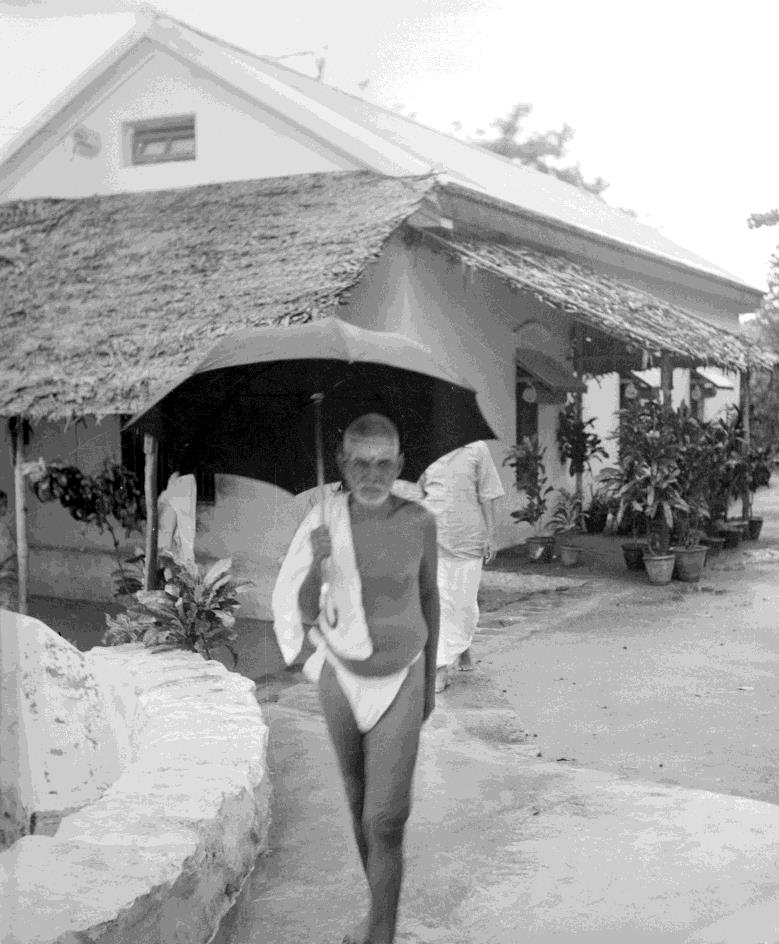
Sri Bhagavan near the Ashram well (‘Ramana Theertham’)
I was close to Subbaramayya and I once visited his home town. He then showed me the horizon and said, “Ganesa, Arunachala is there. Can you not see Arunachala?” Naturally, I could see Arunachala and I can tell you that it is not a miracle. When the mind says, “I do not see Arunachala,” you are paying attention to its immediate projection of non-seeing. Reject the mind’s false projection. One’s faith in oneself is Truth. He showed me Arunachala from a distance of four hundred miles and I could see it. K. K. Nambiar, whom I was acquainted with in Bombay right from 1960, was also soaked in truth. He was the managing director of a very big company and lived in a palatial house facing the ocean. He asked me to come to his house for dinner. I used to feel a little shy to enter his house. He set me at ease and took me to his upstairs patio and showed me the ocean. He then said, embracing me, “See Ganesan, look Arunachala is here.” Again, on that day, I saw Arunachala on the surface of the ocean. Only later on, did I stay in Arunachala and experience its depth.
“Everyone has to come to Arunachala,” are the holy words of Bhagavan. One must have faith not only in these words, but in our Self. We have to turn within to ourselves as we are the truth. There is truth everywhere. Do not turn to the brain or the mind because it will only project the untruth and lead you to believe that such things are untrue and false. This is what two great devotees, K. K. Nambiar and Professor G. V. Subbaramayya, imparted to me. They did this by showing me Arunachala. They showed me the Arunachala outside so that I would turn within and experience Arunachala within me - every moment. Each of these old devotees of Bhagavan has come from Arunachala, because Bhagavan is Arunachala and they are its rocks and boulders. They have gone back to Arunachala. N.R. Krishnamurthy Iyer, also a great devotee, once said to me, “Ganesa, you are also one of the rocks. I am also one of the rocks. You are going back. Let us go back consciously, not unconsciously.” I am only a speck of dust, not even a rock. Maybe you are a rock, a big rock. K. K. Nambiar was a rock. Kunju Swami once pointed to a rock up on the hill and said, “This is our Muruganar.” When going round the hill, I enjoy looking at these rocks because the relationship between the guru and the disciple is vital for plunging within.
Subbaramayya once said this to me: “There are many guidelines for going outside. We have doors and there are road maps to guide us. But for going within, there is no map and there is no guide. Just as the Upanishads say, ‘The bird has no path; where the bird flies is the path. The fish has no path in water; wherever it swims is the path.’ Similarly, you have to dive within and find your path. None of the scriptures can help you; none of the theoretical knowledge that you have will help you. You can achieve it by having complete faith in yourself. How beautifully the bird flies! Does it worry about the path? Does the fish hesitate? Then why do we hesitate? Plunge within! My master Ramana always said, ‘Dive within, plunge within and go inwards.’ Dive within with full faith in Bhagavan and you are sure to find the inner guru waiting for you with open arms.”
G. V. Subbaramayya had two daughters, Lalita and Indira. They used to come to see Bhagavan regularly even though it was very difficult for them to travel the distance. On one visit, Indira turning over the pages of the then new Telugu edition of Upadesa Saram, picked up the first two letters of bold type in the four lines of a Sanskrit verse by Sri Bhagavan, and read them together aloud as Deham-Naham-Koham-Soham. The words together meant, “I am not the body. Who am I? I am He.”On hearing this Bhagavan said, “Very good! That will do. The rest of the stanza you need not read. What you have read is the quintessence of wisdom. Make it your mantra.” Thereafter, every time Bhagavan saw Indira on this visit, he would ask her to repeat this mantra. Soon, she knew it by heart. On the final day of their visit, the two of them were taking leave of Bhagavan just as he was ready to go for his usual walk up the hill. They approached him and said, “Bhagavan, we have to go home.” Saying this, she cried. Patting Indra most lovingly Bhagavan said, “You go to your place, while I go to my place,” pointing to the hill. Significantly it proved to be Indira’s last leave taking. After reaching home, both children wrote to Subbaramayya. Lalita wanted him to convey her salutations to Sri Bhagavan and inform him of her promotion to the next class. Indira wrote that she was constantly repeating the mantra and meditating on Sri Bhagavan. On perusing these letters, Bhagavan looked most graciously pleased. Sometime later, little Indira passed away. Subbaramayya had a samadhi built for her, on which was inscribed the mantra Deham-Naham-Koham-Soham.
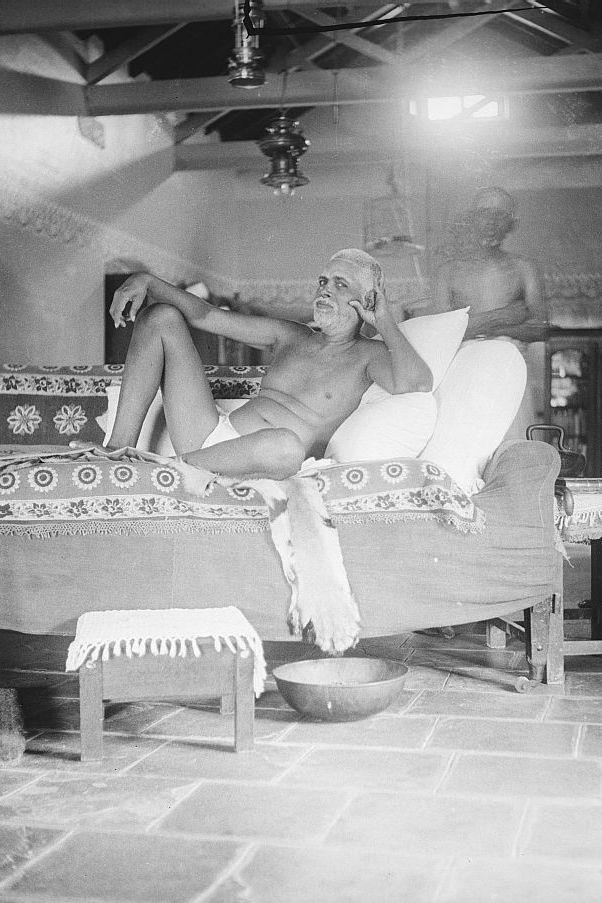
Sri Bhagavan’s assurance : “Abhayam Ichchanu” ( Fear not. I am with you. )
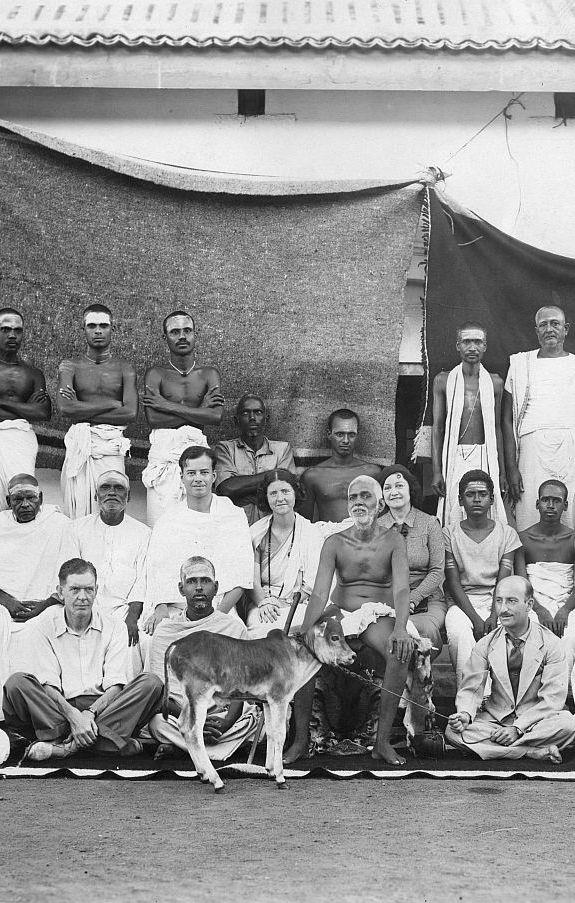
Paul Brunton seated to the left of Sri Bhagavan