Ashram Lady Cooks
Throughout Bhagavan’s life, there were two things he was emphatic about: Self Enquiry, and not allowing a single seeker to leave the ashram unfed. On reading Day by Day with Bhagavan and Letters from Sri Ramanasramam, it is interesting to note that anyone who came to the ashram was first asked to go to the dining hall. In fact, some devotees questioned Bhagavan on why he always insisted that every devotee should first be fed - regardless of the time of day. Bhagavan simply replied, “I know what hunger is.” Bhagavan gave importance not only to feeding but also to cooking - being an excellent cook himself. Sadhu Sundaram, who later became Swami Trivenigiri, assisted Bhagavan in the ashram kitchen for some time. He reveals, “With time, I realized that working with Bhagavan in the kitchen was not mere cooking, but definitely a form of spiritual practice.”
A valuable lesson that Bhagavan taught by entering the kitchen and participating in the cooking was that one has to rely on and completely abide by divine will. To surrender and accept how the divine guides us is grace. As Annamalai Swami who served as a kitchen assistant for a short time recalled, “One morning, when there was virtually no food in the ashram, I saw Bhagavan take what little ingredients we had and begin to cook a meal. He had enough faith that Arunachala would send more before the cooking was over. It was about five thirty in the morning when Bhagavan began to clean a handful of broken rice. He washed it in a pot, removed all the small stones from it and started cooking it on a charcoal stove. I found his activities rather strange and perplexing as the rice would not even be sufficient for one person. As the rice came to a boil, a devotee appeared with two litres of milk. When the rice was cooked, Bhagavan put a larger vessel on the stove and began cooking the rice and milk together. A few minutes later, another devotee came with an offering of raisins and sugar candy. Bhagavan washed the offering and put it in the pot. At about six thirty, when the cooking was almost finished, a party of devotees arrived from Kumbakonam, bringing with them a big pot containing idlis, chutney, vadas, special hill bananas and some cups made of dry banana leaves. These dried banana cups were what we needed to eat Bhagavan’s homemade payasam (rice pudding). At seven, after Bhagavan had taken his bath, we all sat down and ate a sumptuous breakfast.”
Gudipatti Venkatachalam, or Chalam, a very famous Telugu writer, was responsible for recording what is about to be shared. Without his efforts, we would have lost the ashram’s kitchen chronicles, and hence, the opportunity to pay homage to the blessed cooks of Ramanasramam. Coming to know Chalam had recorded all of this in Telugu, Maurice Frydman, who was in Mumbai, arranged for its English translation. He himself rewrote the manuscript and brought it to me. Such a saintly man he was that he left the manuscript without a word, knowing fully well that the ashram was in a financial strait and would not be able to publish it.
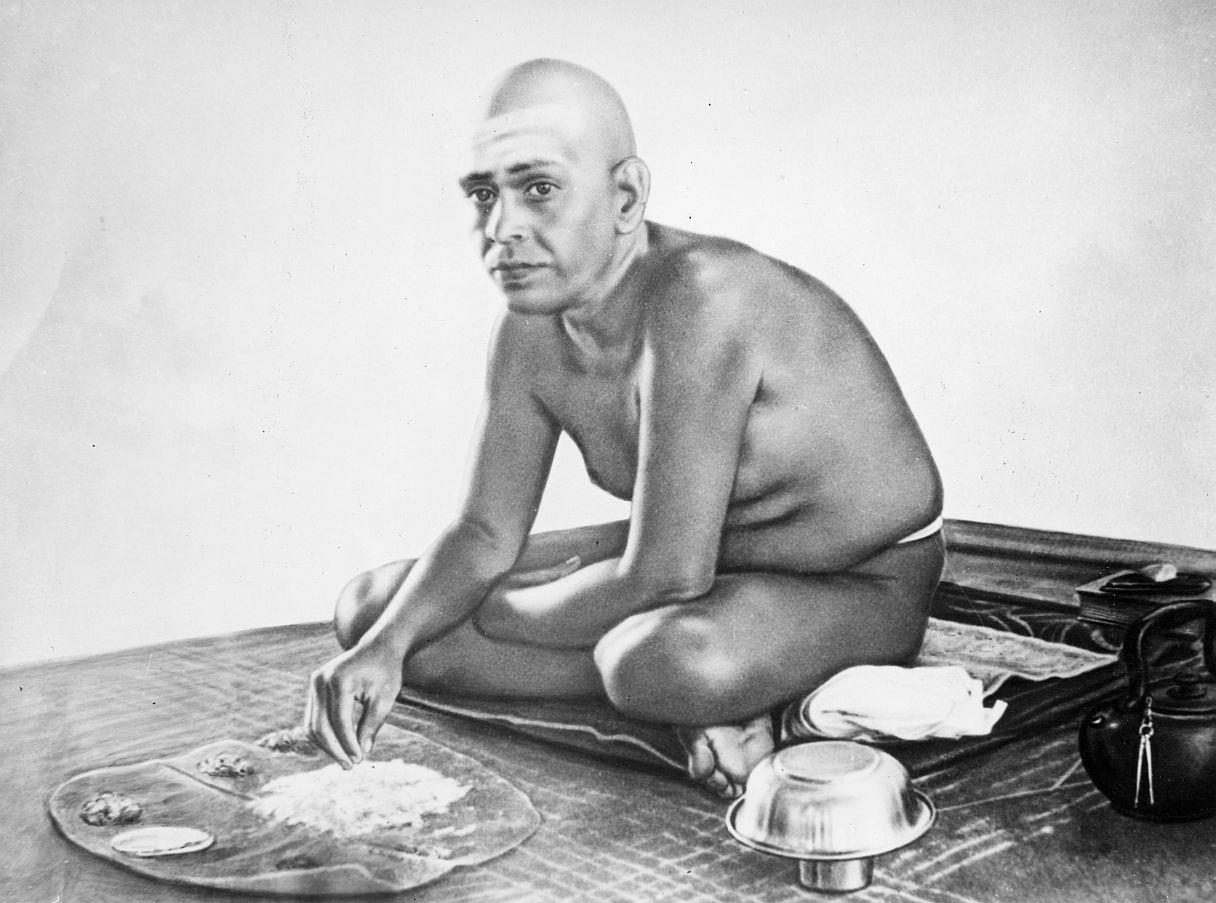
Sri Bhagavan having his meals on His Jayanthi (birthday)
In 1979-80, Bhagavan’s birth centenary was to be celebrated and I was sent by the ashram all over India to meet devotees and collect funds. One of the means of raising money was to bring out a souvenir with advertisements from various sponsors. My respected friend, T. S. Nagarajan, a sound businessman, graciously offered to take charge of this project, but found that there were not enough articles for the souvenir. I requested him to search the archives, not remembering that Maurice Frydman had left the kitchen manuscripts. He located the articles and printed them in the souvenir. I am very grateful to all these three devotees - Chalam, Maurice Frydman and T. S. Nagarajan - because of whom these humble ashram cooks came to be known.
The reader must remember that these are not just stories or anecdotes. They are experiences shared by people who lived with God. As one of the lady cooks said about her time with Bhagavan in the kitchen, “Bhagavan would sit in the middle of the kitchen, watching and offering suggestions. The kitchen was small at that time and every time I needed to move I had to go around him. Thus, I would perform numerous pradakshinas of Bhagavan during the course of the day. Was he not my God? Was I not fortunate to have him in the middle of my kitchen?” She continues, “Bhagavan would taste all the food before it was served. As a result, the food was consecrated and sanctified for all.” Even today, the food that is being served in Ramanasramam is sacred because Bhagavan’s touch is always present.