Lokammal
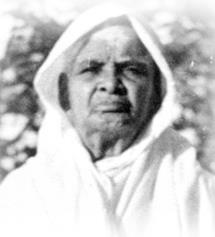
Lokammal, like all the other cooks, was totally overwhelmed by her very first darshan of Bhagavan in the 1930s. Just one look from him was enough for her to surrender to him completely. When she was a young girl, her uncle, a holy and pious man, initiated her to the panchakshara mantra, the five holy syllables, ‘Om Nama Sivaaya’. From childhood, her attention was on God.
Lokammal became a child widow and was looked down upon by both family and society. Her only friend in the village was Tenammal, also a widow. The two of them would exchange information about spirituality. Tenammal, who had been to Arunachala and had met Bhagavan, would constantly narrate incidents about Bhagavan. Lokammal began to wonder, “Will I also not go to Bhagavan and sit at his holy feet?” But she belonged to an affluent family who did not allow her to do so. Her pleas fell on deaf ears. But could God ignore her sincere prayers? One day, a woman pointing to a newspaper told Lokammal, “Hey Lokammal, your saint in Arunachala is no more.” Lokammal was heartbroken and wept continuously. However, what the lady was referring to was the news of Seshadri Swami dropping his body. Soon after this, when she was alone one day, Lokammal had the vision of Bhagavan walking in her direction and calling out to her. She pleaded with her brother to take her to Arunachala and finally he relented. She accompanied some ladies who were going on a pilgrimage to Tirupati, a place close to Arunachala.
When she reached Arunachala, like the other women in those days, Lokammal too had to stay in town. Those were the days when the ashram served only rice gruel or coffee instead of the idlis served today. On the very first day, when she went into the ashram, Bhagavan called out to her, “Here they serve only rice gruel or coffee. Which do you prefer?” Immersed in Bhagavan, she answered, “Whatever it is, it is all the same.” Saying this, she followed him into the kitchen because she had decided to be in his physical presence. In the kitchen, she assisted Bhagavan while he cooked. While in the hall, she would sing melodious Vedantic Tamil songs, which Bhagavan appreciated. Lokammal was well known for her singing. Bhagavan would tell her to sing one song or the other.
In the meanwhile, the group of women returned from Tirupati and this meant that she too had to go back to her family. As she was about to take leave of Bhagavan, he asked her very affectionately, “Are you going away?” Lokammal was moved to the core. Bhagavan gave her a copy of Upadesa Saram. Lokammal cried endlessly. She told Bhagavan, “Bhagavan, but for you, I have no one of my own to hold on to. My relatives are cruel to me. I do not want to leave, but they are all compelling me to. I pray that somehow you will pull me towards your holy feet. I will remain a slave at your feet. Please shower your grace on me.” Bhagavan looked at her very compassionately for a long time, and that look remained with her.
The look that he gave the lady cooks in the first darshan captivated all of them. He bestowed on them his personal affection. What is marvellous about Bhagavan is that although he had so many devotees, he gave unique individual attention to each one of them. He also gave each of these five women a book which would induct them deeply into spirituality. To Santhammal and Lokammal, he gave Upadesa Saram; to Sankarammal he gave Kaivalya Navaneetam and to Subbalakshmiammal he gave Ribhu Gita; Sampurnammal got a copy of Who am I? Ultimately, he gave each one of them the opportunity to experience the truth of ‘I AM’ in the Heart.
Bhagavan finally drew Lokammal back to him. She tore herself away from her family and started cooking at the ashram. This is something that Bhagavan appreciated. One day, when he came into the kitchen, he noticed that the sambar was boiling and he asked Lokammal, “Is it still on the fire?” to which Lokammal replied, “Yes, it has to boil further.” Bhagavan replied, “Only Lokammal appreciates me and listens to me. She makes sure that the sambar is completely boiled. Everyone else in their haste to complete the cooking prepares food that is half cooked.”
Women in those days had to stay outside their house every month for the first three days of their menstrual cycle. They had to stay out of sight on these three days. Only plain food was served to them. They were not allowed to eat with the rest of the family and were not given the same food either. In one sense of the term, they remained untouchables during those three days. One morning, when Bhagavan entered the kitchen to see whether his instructions were being followed, he found Tenammal preparing a lentil dish. He commented, “This was not discussed in the morning. What is Tenammal making?” Tenammal was forced to reply, “One of us has the menstrual cycle. She has been confined to a different place and needs to be served separate food.” Bhagavan became upset and angry. “Why should she eat separately? Why can’t she eat the food that is being served to others? What does it matter if she is not well? Do not differentiate; serve her the food that has been prepared for all. Let her have the rice, dal and curry from the common kitchen.”
In spite of Bhagavan’s instructions, there was resistance from a lot of people in the office and in the ashram. They were not prepared to accept these new rules. This made Bhagavan flare up occasionally. He would say, “The ashram gives food to all. There are no untouchables here. Those who do not like it this way may eat elsewhere. There was the same kind of hassle at Skandashram with my mother. Here the problem is menstruation, while there it was the problem of untouchables. She would refuse to give food to the man who brought us our firewood because she was afraid that he would pollute us. She would insist that I eat first; then she would eat, and finally she would give the leftovers to him. Even this, he would have to eat on the grounds outside the ashram. However, I would be adamant and insist that the man be fed honourably. At first, she refused to eat, and would instead weep constantly; but seeing how resolute I was in the matter, she too came to understand that it could not be any other way. What is the difference between one man and another? Is it not correct to see only God in all?” Lokammal said, “Bhagavan lifted each one of us up from our state of lowly ignorance. The state he elevated us to is that of supreme equality and oneness.” Like all the other cooks, Lokammal too ripened spiritually because of the instructions and directions of Bhagavan.
Today, we eat idlis for breakfast at the ashram because of Lokammal. As I have stated earlier, previously there was either rice gruel or coffee. At the time of Lokammal, the village Patakuruchi had fertile soil that produced the right kind of grains to be made into parboiled rice. This is the kind of rice that is needed to make idlis. Lokammal’s brother sent this rice to the ashram on one occasion. Bhagavan ground the rice himself and made idlis from the rice. They turned out very tasty. Bhagavan appreciated the rice by saying, “How good this parboiled rice is!” Lokammal at once wrote to her brother and relatives, “You need not do anything for me, but please continue sending parboiled rice because of the comment Bhagavan made.” From that day onwards, idlis became the staple breakfast in the ashram.
In her final days, Lokammal stayed in a cottage in the Ramana Nagar. I attended on her, as I did on other devotees. Lokammal was a ripe individual, but her prarabdha was that she remained an irritable person till the end. She once said to me, “You must send a maid to attend on me.” She was so difficult to please that I had to change her maids eighteen times! Each of them pleaded to me with folded hands, “Please do not ask us to serve Lokammal.” When I went to see her the next morning, Lokammal scolded me, “I was alone. I was afraid. You did not send a maid.” I was afraid of her abrasive tongue and ran away. Even for that one night, I couldn’t get any maid for her. The next day I entered the cottage with great trepidation. But I found her face all aglow. She asked, “Is it Ganesa?” I replied, “Yes, amma.” I thought she was going to scold me because I had not sent another maid. She said instead, “Come here, my child. Come.” She held my face tight, kissed my forehead and said, “Because of you, I had the darshan of Bhagavan. Last night, I scolded you. But look at Bhagavan. Here is the picture that Bhagavan gave me when I once told him that young men are troubling me. He at once got up from his sofa and gave me this picture. He gave it to me saying, ‘From today onwards, you will not face this problem.’ Just look at me, Ganesa. I am ninety years old! After that day, I have never had any problems from any man. Last night, as I was scolding you, I heard Bhagavan say, ‘Lokammal, Lokammal!’ And you know, Bhagavan seemed to come alive in that picture and say, ‘Have I not told you that I am always with you? When I am with you, why fear. Be happy!’ Bhagavan spoke to me because of you.” I was delighted. Next day, Lokammal passed away. I lit her funeral pyre What a blessing! It doesn’t matter whether the cooks were ordinary people or great people. They were all transported to the highest state of ‘I AM’.
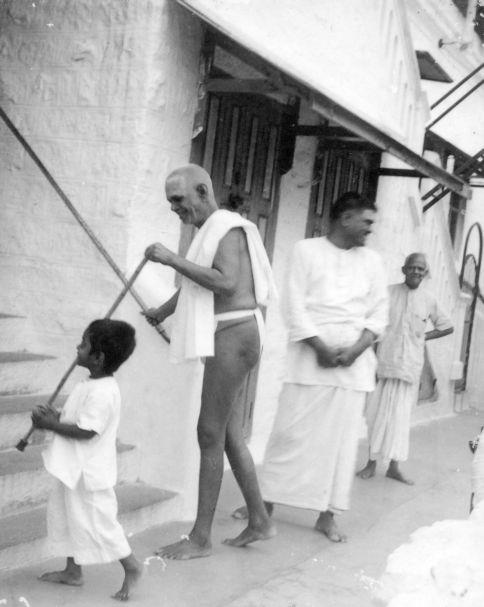
Sri Bhagavan is all joy being led by a playful child into the dining hall
While in the kitchen, Bhagavan once told Santhammal, “Not an inch of space in the whole of Arunachala hill has been untouched by my feet.” Is this physically possible? What he implied was that he is Arunachala himself. All these rocks we have shared about are extraordinary, as they are all rocks of Arunachala. You and I also belong to Arunachala, perhaps not as boulders or rocks, but as grass or pebbles. The author knows very well that he is just a speck of dust on Arunachala. This speck has been blown around by whirlwinds many a time. But, because of good fortune, it has always been blown in the direction of the hill and not away from it. That is grace. Grace is not something which is not understandable. It is happening around us all the time. We only need to recognize it.
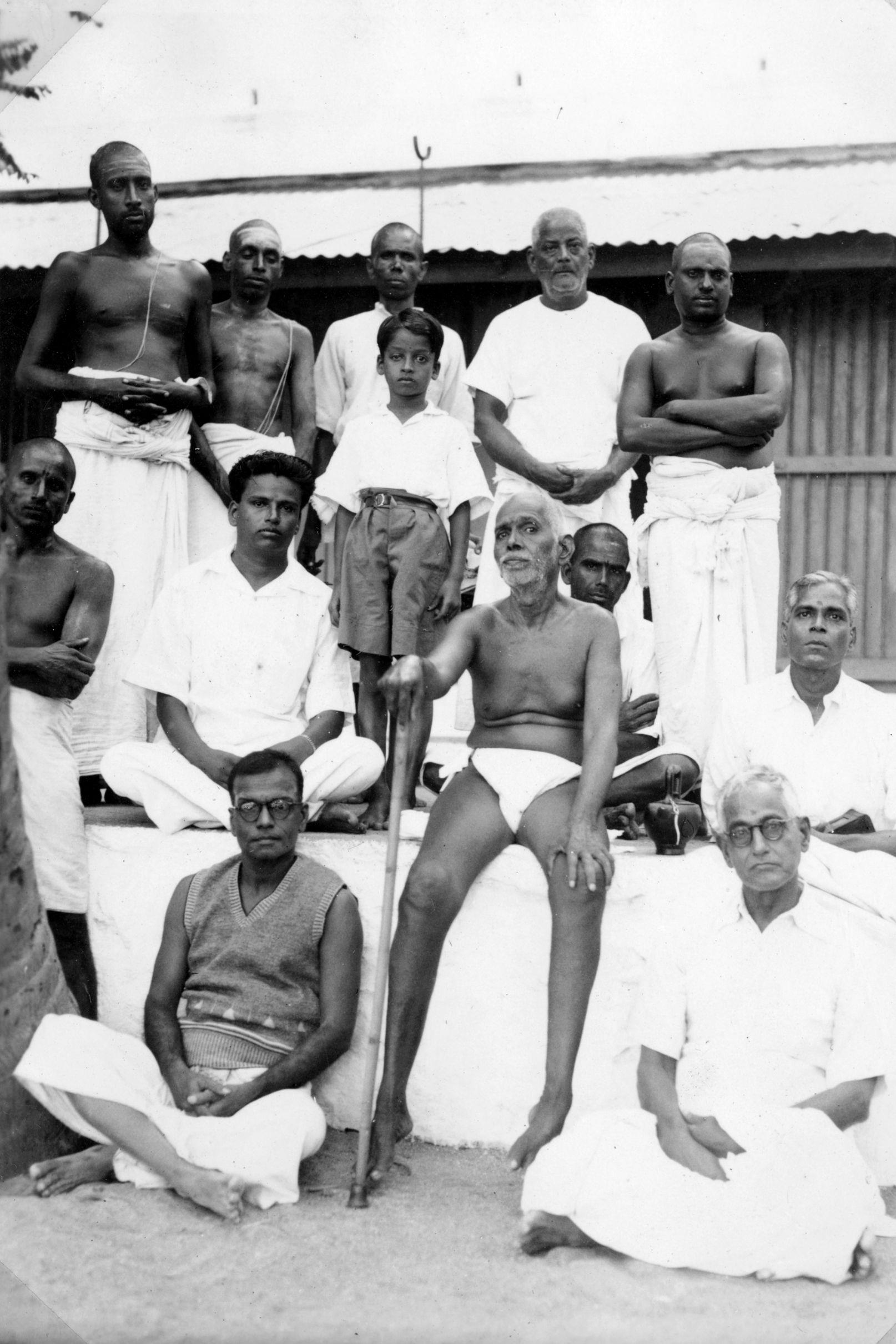
Sri Bhagavan at Skandashram (1945), TPR is seen seated on the floor to Bhagavan’s right (Boy Ganesan is seen standing to Bhagavan’s right)