H. C. Khanna
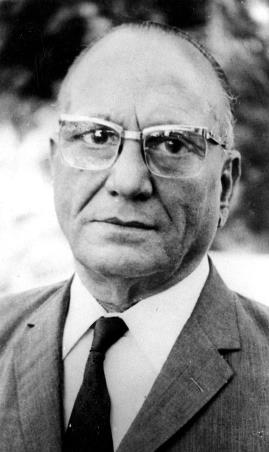
Hari Chand Khanna or H. C. Khanna, a remarkable devotee of Bhagavan, came from a very large family in Kanpur. The tenth child of his parents, he was a keen observer of life even when he was very young. His father looked after the children very well. Khanna was a happy and contented child. However, he noticed that there were a lot of people in the world who were very unhappy. His limited experience told him that those with money were happy. Because of this, he made up his mind to earn a lot of money. He became an extraordinarily successful insurance agent, earning a great deal of money. Soon, he got married to Premavathy, a very pious lady. Khanna was convinced that he was happy because he was leading a comfortable life, eating well, drinking well.
His job required him to travel extensively. There were hardly any hotels in those days; the only places one could stay in were the government guest houses, which were meant almost solely for the British. Indians were rarely entertained there. Khanna, being a worldly wise man, knew how to make money talk. He would bribe the manager or the attendant of the guesthouse in order to stay there. One day, after collecting a great deal of money from his customers, he returned to his guesthouse in a jubilant mood because his money box was overflowing. On arriving at the guesthouse, its watchman said, “Every time you give me thirty rupees. My wife is about to deliver a baby. The doctor says that the situation is grave and I have to give him ninety rupees if I want to save her life. Please give me the money, sir. I will not take any money from you the next three times.” This was an enormous amount of money in those days because the watchman’s salary itself would have been just around fifteen rupees. Khanna, however, was in a different frame of mind. He flung three hundred rupees at the watchman and ordered, “Go get me my drinks and the best non-vegetarian food available. We will look into your pleas later.” When the watchman obeyed, Khanna opened his money box, flaunted it at the watchman and boasted, “See how much money I have collected today!” He was so intoxicated by his own success that he forgot to close the box. Not only that, he even forgot to lock his room from inside.
In those days, government guest houses were always on the outskirts of the town. They were often located in a very desolate area. When after a night of heavy drinking, Khanna woke up in the morning, he found his door closed. The watchman was seated outside as always. Khanna asked the watchman, “You said that your wife is about to deliver a baby. How come you are here?” The watchman replied, “How could I possibly leave you in the condition that you were in? Had I left, thieves would have robbed your money.” “But what about your wife?” asked a surprised Khanna. “I will go now and see about that sir,” replied the watchman. Khanna was astounded at the reply. All along, he had thought that happiness lay in satisfying one’s own needs and desires. But here was a man to whom he had refused money although he knew that the man’s wife was in a critical condition. It had not even occurred to the man to rob his money while he lay in an intoxicated state. Therefore, there was something in life beyond personal gratification. He wondered what that could be and thus his search began.
He read the Bhagavad Gita. This convinced him that it was necessary to have a guru in order to experience the highest spiritual truth. It was Khanna’s practice to lock all the doors and windows of his house at night. He would even lock his own bedroom door. One night, around midnight, he woke up with a strange sensation. He had a feeling that someone was in the room. He opened his eyes to find a sadhu he knew about sitting before him. The sadhu’s legs were deformed. The sadhu spoke to him and said, “Come to me at four in the morning.” Khanna woke up his wife and told her what had happened. He told her that they would visit the sadhu in the morning. Meanwhile, the sadhu informed his disciple that a great mahatma was coming, and in order to receive him, he would have to be lifted up and placed outside the gate. When Khanna saw the sadhu, he was thrilled and thought that this was his guru. However, the lame sadhu said, “I am not your guru. Ramana Maharshi is your guru.” Khanna was dumbstruck because he had never heard of Ramana Maharshi before. He had come prepared to surrender himself to this sadhu who had appeared mysteriously in his room the previous night, but now the man was saying that he was not his guru. Khanna was curious to have some information about the Maharshi. Professor Bhatnagar, a disciple of the sadhu said, “I know something about the Maharshi.” Saying this, he presented Khanna a copy of Upadesa Saram. The book also had the address of Ramanasramam. Khanna’s father offered, “I will look after your children. I have read a review of Paul Brunton’s book. Ramana Maharshi seems like a genuine sage. Go!”
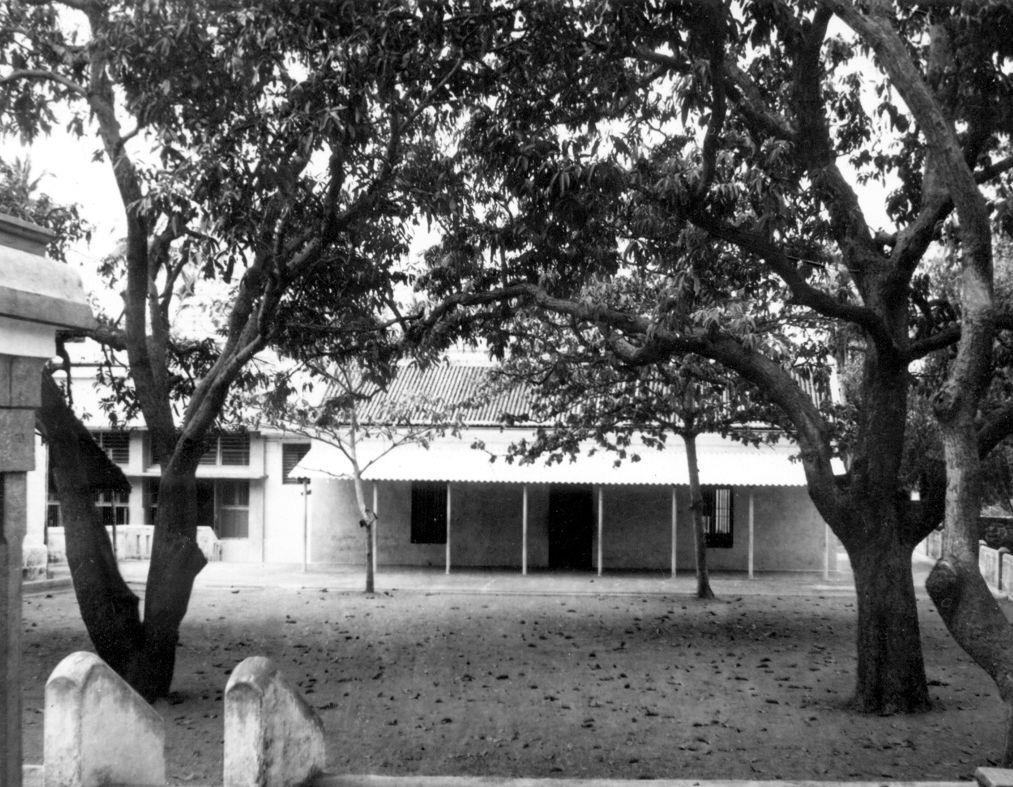
Khanna got the upadesa: “The Guru is within” at this Sacred ‘Old Hall’
So, in 1941, Premavathy and Khanna came to Bhagavan. As with the rest of the devotees, Bhagavan looked at him in such a way that Khanna felt Bhagavan was asking him, “Did it take you so long to come to me?” Khanna at once knew that this was his guru. He began frequenting the ashram, but he also wanted Bhagavan to state in a matter of fact way that he was his guru. He told Bhagavan, “Bhagavan, I need an outward guru. Please tell me that you are my guru.” In his customary fashion, Bhagavan replied, “The guru is within.” Khanna pursued him relentlessly and pleaded, “No, Bhagavan; you have to tell me that you are my guru.” Just look at the beauty of the situation! When the disciple is very intelligent, the guru becomes all the more intelligent! Bhagavan continued, “The outer guru is saying that the guru is within!” This was not just a clever answer; when Bhagavan told him this, Khanna experienced it. He felt throbbing vibrations within himself. Bhagavan’s intense, piercing look penetrated deep into his being, leaving Khanna with a feeling of spiritual awakening. True, Bhagavan was looking at him from the outside, but the experience was taking place within, proving that the guru within was giving him the experience of the ‘I’. Such was the power of Bhagavan’s look.
I was deeply attached to him. I have mentioned earlier that one of my tasks at the ashram was to collect money for its maintenance. Khanna, being a wealthy man, helped me whenever I approached him for funds. But all the while he would also caution me, “Wake up, Ganesan! This is not the only work you have to do! This is only part of your work. Attaining Self realisation is our paramount duty.” I owe a great deal to this noble man whom I affectionately called Pitaji, which means father in Hindi. Since I was very close to Pitaji, I ventured to ask him, “How often were you coming? After receiving this initiation, where was the need for you to come to Bhagavan?” He replied, “The truth revealed by the guru is so supreme, it takes time to soak in and become totally one’s own. Proximity to the outer guru is essential. Hence, I came as often as possible. All my doubts were being erased and there was a deepening inner peace - proof that doubts were indeed being erased.”
I then asked Pitaji, “Will you please share some of the dialogues that you had with Bhagavan?” He answered, “It is already in the book Day by Day with Bhagavan.” After a pause, he said, “I handed Bhagavan a piece of paper on which I had written my anguish. After reading it, Bhagavan commented, ‘It is a complaint. He says, ‘I have been coming to you, and this time I have remained nearly a month at your feet. I find no improvement at all in my condition. My vasanas are as strong as ever. When I go back, my friends will laugh at me and ask what good my stay has done me.’” Turning to Khanna, Bhagavan compassionately said, “Why distress your mind by thinking that jnana has not come? Or that vasanas have not disappeared? Do not give room for thoughts. In one of his verses, saint Thayumanavar says much the same as is written in this paper.” Bhagavan then asked Devaraja Mudaliar to read the verse and translate it into English for the benefit of those who did not understand Tamil. This is the translation of the verse: ‘The mind mocks me. Though I tell you one thousand times, you are indifferent. So how am I to attain peace and bliss?” Devaraja Mudaliar told Khanna, “You are not the only one who complains to Bhagavan like this. I have complained in the same way more than once and I still do. Yet, I find no improvement in myself.” To this, Khanna said, “It is not only that I find no improvement but I think I have grown worse. The vasanas are stronger now. I cannot understand it.”
Khanna then asked, “The illumination plus mind is jivatma, the individual, and the illumination alone is Paramatma, the ultimate Truth. Is that right Bhagavan?” Bhagavan gave a nod of assent. He pointed to his white towel and stated, “We call this a white cloth. But the cloth and its whiteness cannot be separated. It is the same with the illumination and the mind that unite to form the ego.” Then, he added, “The following illustration that is often given in books will also help you. The lamp in the theatre is the Paramatma or the illumination, as you put it. It illuminates itself, the stage and the actors. We see the stage and the actors by its light, but its light still continues when there is no play. Another illustration is an iron rod that is compared to the mind. Fire joins it and it becomes red hot. It glows and can burn things like fire, but still it has a definite shape, unlike fire. If we hammer it, it is the rod that receives the blows, not the fire. The rod is the jivatma and the fire is the Self or Paramatma.”
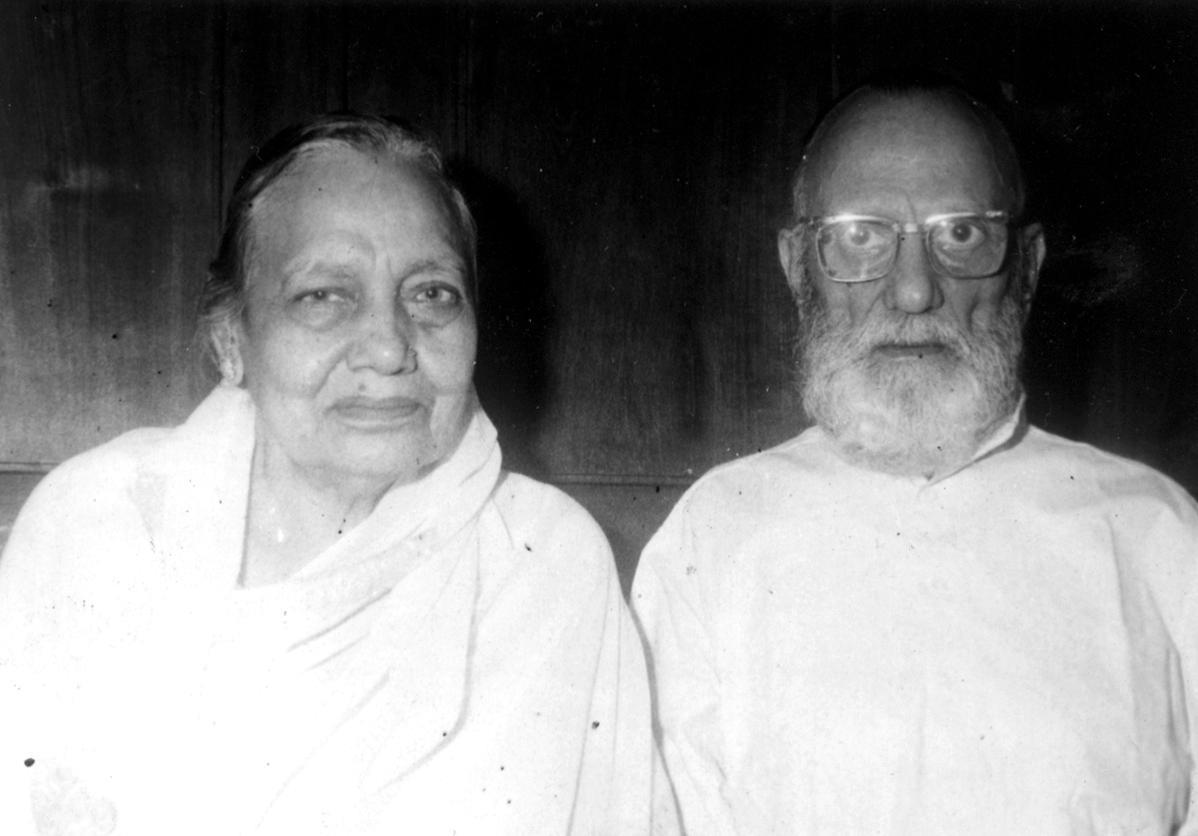
Sri Bhagavan to Premavathy Khanna: “ Continue saying ‘I’, ‘I’ – all the time. ”
Bhagavan helped not only Khanna, but also his wife Premavathy. One afternoon, while in the hall, Premavathy appealed to Bhagavan in writing, “I am not learned in the scriptures and I find the method of Self Enquiry too hard. I am a woman with seven children and a lot of household cares and it leaves little time for meditation. I request Bhagavan to give me some simpler and easier method.” Bhagavan looked at Premavathy with great compassion and said, “No learning or knowledge of scriptures is necessary to know the Self, even as no man requires a mirror to see himself. All knowledge is to be given up eventually as not Self. Nor is household work or taking care of children necessarily an obstacle. If you can do nothing more, at least continue saying ‘I’, ‘I’, to yourself mentally all the time, as advised in Who am I? Whatever you may be doing and whether you are sitting, standing or walking. ‘I’ is the name of God. It is the first and greatest of all mantras. Even ‘Om’ is second to it.”
Pitaji was a person of conviction and persistence. Once, while he was having lunch in the dining hall in the presence of Bhagavan, he had a very strong urge that he should carry with him Bhagavan’s prasad for all the members of his family. He thought the best way for that would be to carry the leaf on which Bhagavan had eaten food. (Some Hindus believed that if one eats the leftovers of what the guru ate, it will spiritually elevate the soul.) That particular day, the banana leaf on which Bhagavan ate was very tender. He prayed to Bhagavan in his heart that he should bless him that there would be no one in the dining hall to watch him steal Bhagavan’s empty leaf. He closed his eyes in prayer and when he opened them, to his surprise and relief, there was no one else in the dining hall. He jumped from his seat, took the empty leaf of Bhagavan, wrapped it inside his upper cloth and rushed towards the hill. Hiding behind a big rock, he took a small piece of the tender leaf and ate it as sacred prasad. The balance of the long leaf he kept to be carried back to Kanpur. He returned to the common guest house where he was staying and hid it at the bottom of his suitcase after carefully packing it well. He made sure that no one saw him. To overcome the tension that was building up in him, he went away to the town.
When he returned to the ashram in the evening, there was an enquiry awaiting him. The sarvadhikari was informed of the missing leaf and he was making extensive enquiries as to who was responsible for its disappearance. The post master Raja Iyer, who had served lunch, had already informed Chinna Swami that it was Khanna who left the dining hall last. Khanna was summoned to the office. He started quarrelling in his mind with Bhagavan, “Oh, Bhagavan, you graciously granted my prayer to lift the leaf unnoticed by others; now, are you going to expose me? Is this your grace? Please help me carry my act to its successful completion, by not exposing me to Chinna Swami.” Chinna Swami welcomed Khanna and narrated to him about the audacity of the leaf thief. Khanna concurred with him, saying that the culprit should be found out and well punished - all the while praying to Bhagavan that this should not happen. He ran to Bhagavan’s hall and prostrated. Bhagavan gave him a mischievous smile, which clearly indicated to Khanna the assurance of Bhagavan’s grace on him, “Don’t have any fear. Everything is all right.” Pitaji narrated this incident to me in the 1970’s with great reverence and concluded, “I left for Kanpur the same day, taking that sacred prasad with me. I gave a share of it to each and every member of my family. My children, who are as deeply devoted to Bhagavan, know well that each one of us owe a deep sense of gratitude to Bhagavan for enabling me to steal that prasad. It is all the grace of Sri Bhagavan!”
“One day in Kanpur, during the last days of Bhagavan’s illness - the month of March 1950 - I suddenly woke up with the feeling that Bhagavan was calling me. I took my wife with our baby daughter and reached Arunachala. When I stood in front of Bhagavan, he gave me a welcome smile and gave a strange look to his attendant. Later, I asked the attendant about it. He said, ‘This morning, Bhagavan asked me whether Kanpur Khanna is here! And, you are here!’ What I am today is entirely due to Bhagavan’s pointed attention on me, Bhagavan pouring his grace on me,” said Pitaji, with tears in his eyes.
I asked him whether he was at the ashram when Bhagavan dropped the body. “Yes! Bhagavan blessed me to be near him. On that fateful night, after the event had taken place, Bhagavan’s body was placed in the new hall for devotees to have darshan of it. I ran to the town to get a big garland to be put around my master’s body. All my life, I had the habit of insisting that my offering to be the first and primary one. In that light, I rushed the garland from town and under the advice of the attendant I reverentially placed it at the corner pointed out to me. The attendant assured me that when the next morning garlands were offered, mine would be the first one. When I came to the new hall the next morning, I was shocked. My garland was at the bottom most, over which piles of similar large garlands were heaped. I intently prayed to Bhagavan, ‘Bhagavan! You have always fulfilled my inner prayers to my fullest satisfaction when you glowed lustrously in the body. Now I pray, please fulfill this simple prayer of mine - my garland should be the first to adorn your body!’” After a pause, he added, “At the appropriate time, an attendant carried them all. Lo, what grace! When he put them down near the body of Bhagavan, he turned the heap of garlands upside down, making my garland come up first on the top! Bhagavan had fulfilled my childish prayer as well. Bhagavan, who is the universal truth, always fulfilled, and always will, fulfill prayers offered to him! Bhagavan is an ocean of grace indeed!”
Khanna had many commitments. He once wanted to go to Delhi because of some property dispute that involved millions of rupees. He used to consult me since we had become good friends. One day, he said, “I want to go to Delhi, but I want to die in Arunachala.” I told him, “Pitaji, if you go away from Arunachala, perhaps, by chance, you may die there.” The next morning, he embraced me and said, “I have cancelled my trip. I will stay here. I do not want to take any risks. Let the case and the money go to the dogs. I will continue to stay here. I want to drop my body only at Arunachala.” Next, he posed a question to me. “You were by your mother’s side when she died, right? Please tell me, how did your mother die?” I told him, “My mother died most magnificently in a state of full consciousness and happiness. During her last moments, though her eyes remained closed, there was a sign of recognition and she responded with expressions of devotion when we all sang Bhagavan’s Aksharamanamalai.” After listening to it intently, Pitaji said, “I too will die like that.”
One day, towards the end of July, 1984, he suddenly felt that he was going to die. He called out to his wife, “Premavathy, call Ganesan. Ask him to come immediately.” Khanna then took a chair and placed it in front of a large picture of Bhagavan. He sat in the chair and breathed his last, consciously! By the time I arrived, he was no more. The doctor’s verdict that his death was instantaneous was proof enough to me that when he died, Pitaji was fully conscious. For me, personally, Pitaji was a hero. He refused to succumb to the demands of his body, but conquered its travails by turning his full attention to Bhagavan. He had such implicit faith in Bhagavan that the master absorbed him in full consciousness! I strongly felt that though he was a family man, Pitaji’s body had every right to be interred within the ashram grounds. I managed to convince those who were opposed to this. Pitaji’s body was interred next to Chadwick’s and Cohen’s samadhis – devotees even today pay homage to it. He is the only grihastha among the saints and sannyasins interred in Ramanasramam.
Truth is not just a concept meant to be run after. You yourself are the real truth. Bhagavan used to refer to Vedantic scriptures that talk about the scent of the musk deer. The deer is unaware that the scent comes from its own body and therefore runs in search of this wonderful fragrance. Some of these deer, it is said, run themselves to death in search of this wonderful fragrance. Why should we, like the musk deer, run after the truth? We are the truth. Why move out? Let us remain as the truth within the Heart. With Bhagavan’s grace, Arunachala will absorb us. Remaining in the truth is being absorbed in Arunachala.
Once Bhagavan was asked who was a dhira. Bhagavan replied, “One who knows who he is.” Dhira literally means courageous. To remain as the truth is the highest form of valour and courage. All of Bhagavan’s old devotees had this quality. We have to share the lives of these devotees to remind ourselves that we are also always, only dhiras. This state of absorption takes place all the time - in the now.
We have come to Arunachala in order to merge with Arunachala. Bhagavan referred to this as ‘aikkiyam aakkikkol ‘. Bhagavan was not praying just for his mother when he said, “Absorb her into your Self.” He was praying for each one of us. We have to wake up. This is our wake up call. Let us not run in vain after the truth like the musk deer. Let us understand that truth is within us. That state of realization is absorption; it is also Arunachala. Bhagavan said of Arunachala, “Heart, thy name is Arunachala.” This Heart, the core of our being, is Arunachala. Plunging within and staying in one’s Self is being absorbed in Arunachala. This state does not take place in space or time. It is in the eternal now, the now which we are eternally in.
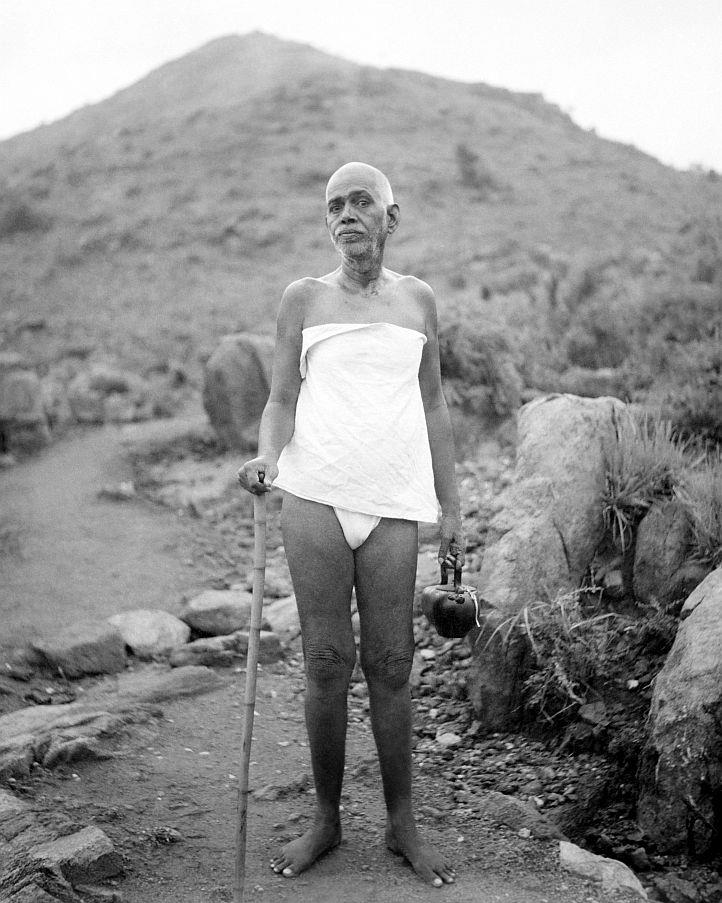
The Holy Hill and the Master