Yogi Ramsuratkumar
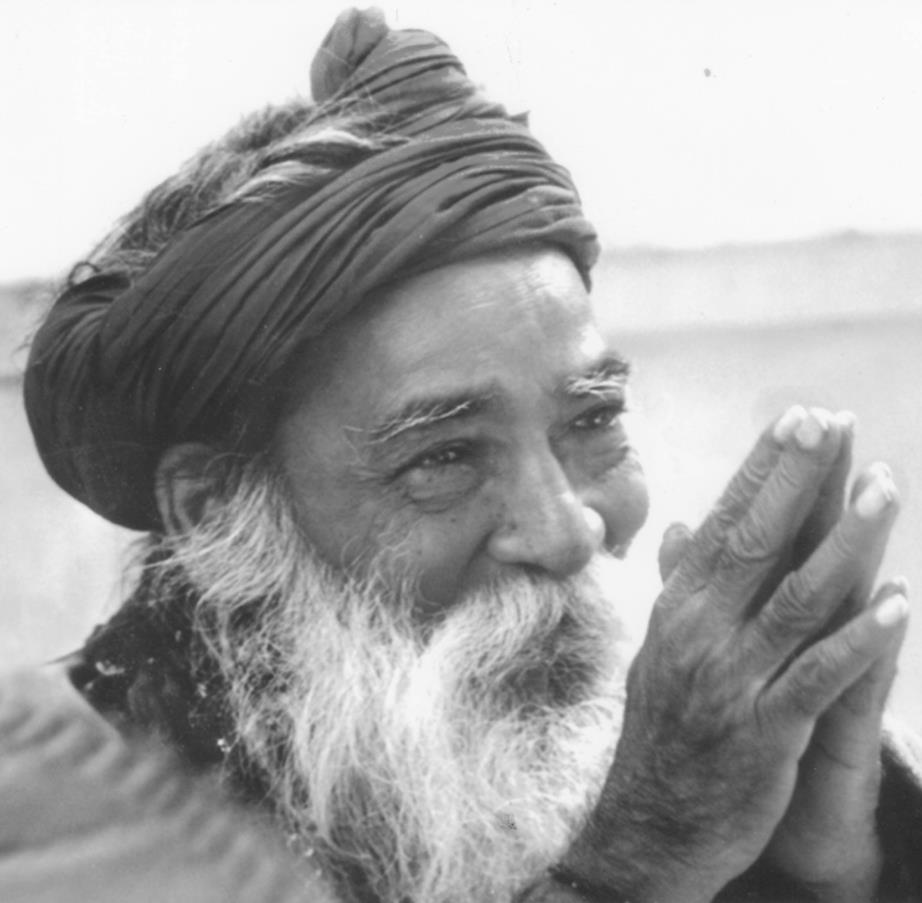
For all Hindus interested in ending the cycle of birth and death and attaining emancipation, the most important and sacred pilgrimage centre is Varanasi or Kashi. At Kashi, the holy river Ganges, having originated in the peaks of the Himalayas and forcefully moving down the plains, makes a turn towards the north, towards its source. From time immemorial, Hindus have been drawn to this vibrant and powerful city, and it is here that the story of an important mystic, saint, and devotee of Sri Ramana Maharshi begins.
Near the town of Kashi is a small village called Nardara. Many pilgrims who aim to complete a circumambulation of Mother Ganges often rest in the small villages that lie on the banks of the river. The local villagers pay special attention to these sadhus, sannyasins and pilgrims and this was especially the case with Yogi Ramsuratkumar and his family. Growing up in this environment, alongside the banks of the holy river and in regular contact with pilgrims and sadhus, had a deep impact on the young boy. He would sit along with them around the fire at night and listen with rapt attention to stories of saints and sages and epics such as the Ramayana and Maharabharata.
A sadhu called Kapadia Baba had a special role in young Ramsuratkumar’s life and influenced the turn of events. Kapadia Baba was a tall and imposing figure, who before taking sannyas was an erudite and scholarly judge. As a judge, he had to oversee a case where his only son-in-law had committed a murder. Without any hesitation, he issued the death sentence on his son-in-law after finding him guilty. Realizing the futility of worldly existence, he took sannyas and started circumambulations of the Ganges. During these journeys, he would spend a day or so in the company of young Ramsuratkumar in Nardara.
An incident that dramatically shaped Ramsuratkumar’s life occurred in his teenage years. One of the household chores he happily did was to help his mother by drawing water from a well using a long rope. One day, while he was drawing water, he noticed a small, beautiful sparrow looking intently at him from the other side of the well. He playfully threw one end of the rope at it. The bird was hit and it fell. Deeply shocked, Ramsuratkumar ran and took the bird in his hands, crying, “Please, do not die! Please, do not die!” He then took it to the Ganges and poured its sacred water on the bird in an attempt to revive it. That too failed. This traumatic event led him to contemplate and enquire deeply on life and death: “Where has the beauty of the bird gone? Where has its power to fly gone? The wings are there but it has lost the power to fly. What is the force behind the bird’s now lifeless body that allowed it to be active and fly just a minute ago?” Enquiring thus, he sat weeping on the banks of the Ganges. The death of the bird was the first shock he received from life and it sharpened his awareness about creation, life and death.
Carrying this sorrow and guilt, he searched for Kapadia Baba to get some consolation. When he met Baba again he cried, “I am unable to bear this guilt.” Kapadia Baba told the sixteen year old teenager to go to Kashi. There, as he stood in front of Lord Vishwanath, he experienced a flash of brilliant light and felt for the first time a divine ecstasy that made him forget everything - his depression, his body, the world, time and space. The divine energy had engulfed him. He wandered the cremation ghats on the banks of the Ganges and had the experience of his dead body being brought there and burnt to ashes and the ashes being immersed in the sacred river. He experienced the reality that he was not the body. In this state, he went to Kapadia Baba who turned the young lad’s attention to mastering the Tulsi Ramayana and Bhagavad Gita.
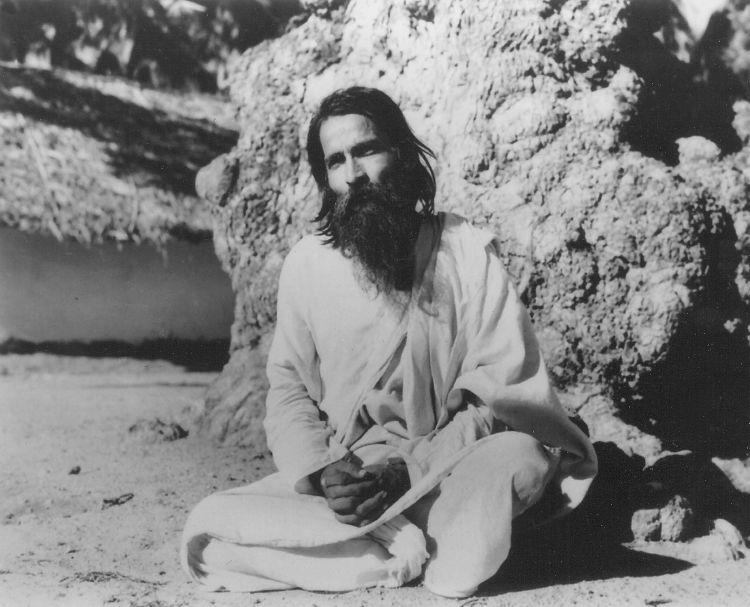
Yogi Ramsuratkumar seated under the ‘Illupai Tree’ at the Ashram entrance
All his life, Yogi Ramsuratkumar used to quote freely from the Tulsi Ramayana and Bhagavad Gita. He became indifferent to life. His parents and relatives noticed this and in an effort to rekindle his interest in life, got young Ramsuratkumar married. He settled initially into a life of a householder and though he was working as a headmaster in a school to earn money to support his family, his inner quest to find God and the true reality of what life actually is, remained undimmed.
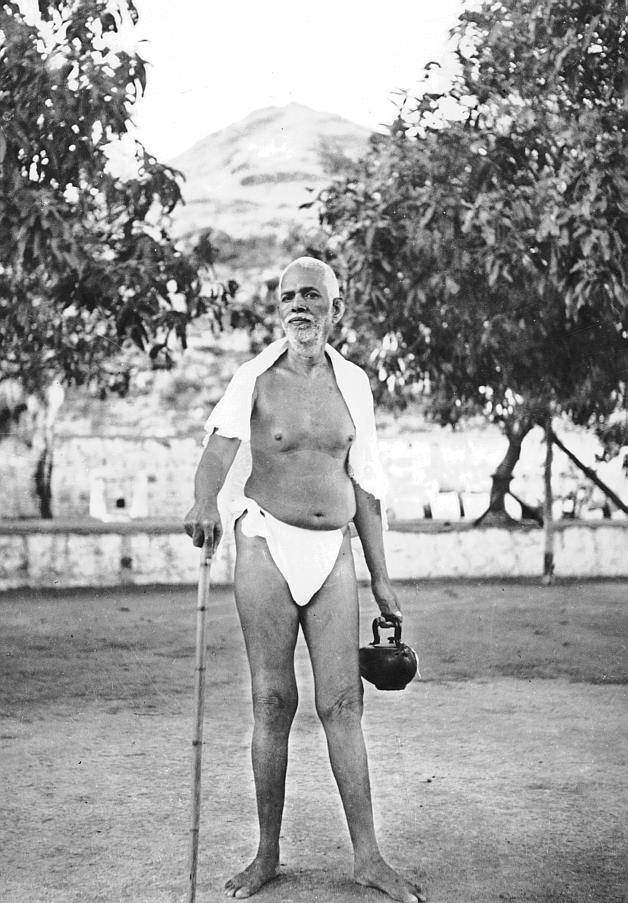
Kapadia Baba returned at this crucial stage in his life and instructed him to seek a guru. Ramsuratkumar was surprised as he had always assumed that Kapadia Baba was his guru. But Kapadia Baba told him to travel to South India and specifically mentioned Sri Aurobindo and Sri Ramana Maharshi. Following this directive, Ramsuratkumar went to Pondicherry first. Unable to meet Sri Aurobindo, he arrived in Arunachala. The first welcoming sight of the holy hill filled him with happiness. Brimming with nameless joy, he went to Ramanasramam. Bhagavan was seated on a platform and the whole atmosphere was filled with silence and peace. He went and sat in front of Bhagavan. A direct look from Bhagavan plunged him into deep meditation. After a long time, when he opened his eyes, he saw Bhagavan focusing his compassionate and love filled glance of grace on him continuously with a joyful smile.
He plunged into Ramana Maharshi’s path of Self Enquiry. This repeatedly led to states of samadhi. When he had to return to his village, he prostrated and silently prayed, “Bhagavan, please pour grace on me so that I attain your holy feet. Make me your own and keep me ever at your feet.” This was not expressed verbally. However, Bhagavan heard the silent prayer and nodded his head and said, “Shari,” which means ‘yes’ in Tamil. Later, Yogi Ramsuratkumar told me that this was the first Tamil word that he learnt. From then on, he used this word often in his life. Ordinarily, ‘shari’ is translated as ‘yes’. On this occasion, when Ramsuratkumar surrendered to his master, it meant, “Yes, I have accepted you.”
During the summer of 1949, he came back and saw that Bhagavan was inflicted with cancer and was available only for a few hours every day. This pained him greatly and he was affected until he heard a devotee ask in his presence, “Bhagavan, I am pained to see you suffer.” Bhagavan laughed and said, “The questioner has been listening to the teaching for many years which emphasizes ‘I am not the body’ and still he says I have got pain. Is this the way to grasp the teaching? Am I the body?” This answer struck a deep chord in Ramsuratkumar’s heart and it solidified his earlier experience in Varanasi.
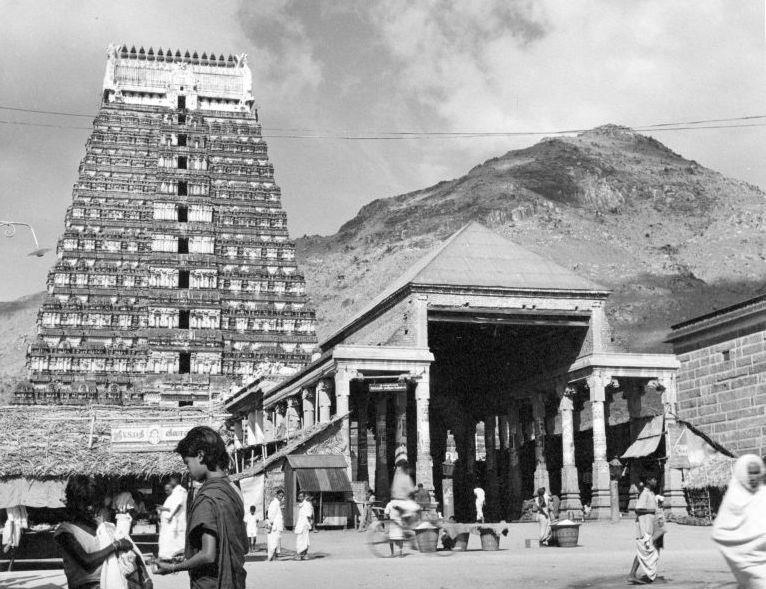
Yogi Ramsuratkumar’s ‘Spiritual Haven’ ARUNACHALA : Hill and Temple
In order to be established in this state, Ramsuratkumar went back to his village. Soon afterwards, he left for the Himalayas. In the course of time he felt the clarity he had experienced in Bhagavan’s physical presence dimming, just like when the farther one is away from a light, one feels it becoming dimmer. So, he decided to return to South India. It was then that he came to know that both his gurus, Bhagavan and Aurobindo, had dropped their bodies.
On reaching the ashram, he found that he sorely missed the physical frame of Bhagavan. Seeing this, T. K. Sunderasa Iyer guided him to another saint - Swami Ramdas of Kanhangad in Kerala. However, disappointed on his initial visit, Ramsuratkumar went back to his village. He read Swami Ramdas’s book, In Quest of God and was deeply moved. Slowly, but surely, he was drawn back to Swami Ramdas and returned to Anandashram. On his third visit, Swami Ramdas welcomed him with a big smile and the two shared a heart to heart laugh. He continued pursuing Swami Ramdas, till one day the Swami turned to him intently and asked, “What do you want from me?” Ramsuratkumar asked for initiation and Swami Ramdas agreed on the condition that he should chant the mantra continuously for twenty four hours without cessation. He asked him to be seated and uttered the sacred mantra, ‘Om Sri Ram Jai Ram Jai Jai Ram’ three times. This sent Ramsuratkumar into ecstasy and a divine power poured into his being. The japa went on continuously for the next three days without a pause. He got attuned to the mantra and this established him in the final state of absolute quietude where the limitations of body and mind were transcended once and for all. Whenever he recalled this he would state, “This beggar died at the holy feet of Swami Ramdas in 1952 and from that point only God exists for this beggar.”
He continued in Anandashram for some time after this. But the divine ecstasy that he was experiencing became a distraction to other ashram residents. They complained to Swami Ramdas who asked him to leave. Ramsuratkumar prayed, “Where will I go? I do not know how to live in this world, am I to beg?” Pat came the response, “Yes, be a beggar!” Swami Ramdas, with all compassion, added, “Under the shade of a banyan tree only bushes and thorns can grow - another big tree has no room. So, go. But, where will you go?” “To Arunachala,” said Ramsuratkumar. Swami Ramdas was immensely pleased! The Swami gave him the woollen shawl he was wearing. From then on, this woollen shawl became a trademark of Ramsuratkumar’s attire - even in Tiruvannamalai’s hottest summer months.
Before he came permanently to Tiruvannamalai, Ramsuratkumar travelled in ecstasy across India from 1952 to1959. He spent these seven years visiting shrines of realized saints, all along remaining in an unbroken state of samadhi. When he touched the sacred soil of Arunachala, he fully regained his normal consciousness. It was in that normal state that he returned to Ramanasramam in 1959, and this was when I first met him. I was spending time with my teacher, T. K. Sundaresa Iyer, when I noticed this dishevelled, unkempt ‘madman’ in front of me. As the thought flashed across my mind, T. K. Sunderesa Iyer turned to me and said “He is not a madman, he is a yogi. Ganesa, he is a Siddha Purusha. He is hungry, so go inside, get some food and give it to him.” Food was scarce in the ashram during those days. Despite this, I made it a point to try and feed Ramsuratkumar whenever possible. Later, he told me that it was T. K. Sundaresa Iyer who named him ‘Yogi Ramsuratkumar’ and that from that point on, the name stuck. He lived in a small hut in a neighborhood of the ashram called Ramana Nagar and went walking all over the hill, much like his master Ramana Maharshi. While walking around the hill, I would often chance to see him in the burial grounds, jumping from one tomb to another, chanting, “Om Sri Ram Jai Ram Jai Jai Ram.” During those years, I had many an occasion to have contact with Yogi Ramsuratkumar. I did not know that there was a spiritual cord that was binding Yogi Ramsuratkumar and me. Later in 1962, he started living in the temple, and also under a punnai tree near the railway station.
I lost contact with him after that point as I was immersed in ashram work - being actively involved with The Mountain Path. Still, I sometimes caught sight of him near the bus terminus during my trips to Chennai. He would suddenly appear, hand me a flower and then demand, “Ganesa, please give me a rupee.” It was only in 1980, after a gap of several years, that I came into contact with him again. The centenary of Bhagavan’s jayanthi was being organized at the ashram on a grand scale with lots of celebrations and poojas.
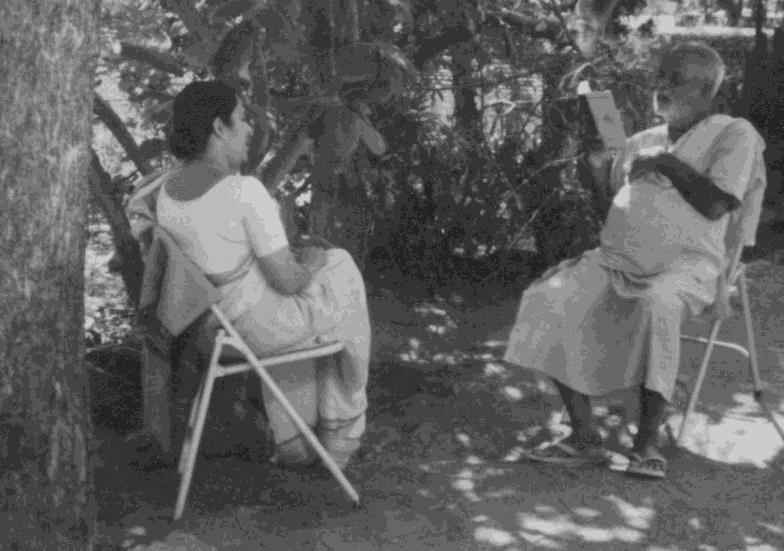
Kunju Swami teaching Tamil parayanam - 'Nool Thirattu'- to Anuradha
A group even toured all over the world singing Bhagavan’s songs. One day, Yogi Ramsuratkumar met me and said, “Ganesa, the local people of Tiruvannamalai are not in favour of what is happening at Ramanasramam. They are saying that it is a Brahmin institution and only Sanskrit is chanted there. During Bhagavan’s lifetime, Tamil parayanam from the Collected Works of Bhagavan was being sung. Start that again.” I tried, but except for two or three old devotees there was nobody who knew the entire Collected Works. I avoided meeting him again as he was very persistent with this demand.
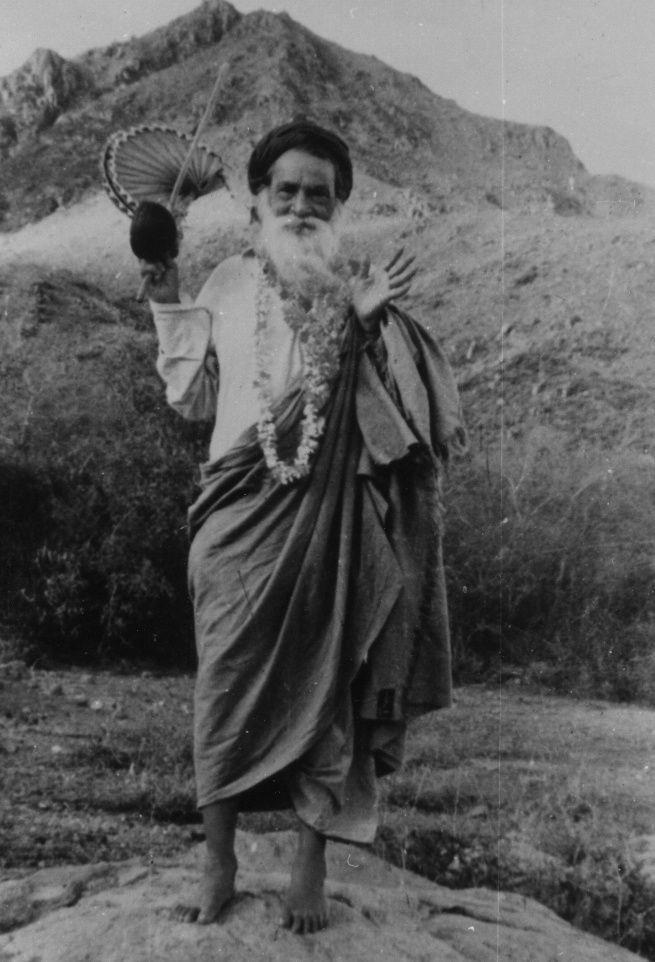
He solved this dilemma of starting the Tamil parayanam in his own inimitable style. My friend Anuradha had settled in Arunachala in 1983. My brother Mani had also resigned his job and moved permanently to Tiruvannamalai to help with ashram work. Together, they were helping me manage the ashram as its activities had grown significantly. During the Karthikai festival in 1983, Anuradha, Kanakammal (an old devotee of Bhagavan) and I were near the temple witnessing the procession of the huge wooden car. Suddenly, out of nowhere, Yogi Ramsuratkumar came and caught my hand and said, “Ganesa, this beggar has been sending word to you to meet you and ask you to start the Tamil parayanam. But you have been avoiding me.” He was in his garb of several shawls, carrying a coconut shell bowl, sticks and a large fan. Anuradha was quite frightened with this vision of a ‘madman’ suddenly accosting me - this was her first darshan of Yogi Ramsuratkumar! I admitted that I was avoiding him as I was unable to find someone to take on the heavy task of learning all the Collected Works of Bhagavan in Tamil and teaching these to others to do parayanam. He instantaneously turned towards Anuradha and said, “She will take up this task!” He then disappeared into the crowd as abruptly as he had appeared. Anuradha, still quite stunned by his dishevelled appearance and the familiarity with which he addressed me, asked, “Who is this madman who accosts you and gives orders to you? What is this Tamil parayanam he is referring to?”
Some power must have been transferred from Yogi to Anuradha because she started learning the Collected Works of Bhagavan from Kanakammal and Kunju Swami and started singing whatever she had learnt, in Bhagavan’s shrine. Many ladies were attracted to her singing because they had never heard Bhagavan’s Collected Works being sung in the recent past. Whenever Kunju Swami taught Anuradha, he used to say, “You have to learn it by heart otherwise I will not teach you.” She soon learned every poem in the Collected Works by heart and taught all the ladies who were interested. Ramani, my brother’s wife, was especially keen on learning them. Yogi Ramsuratkumar kept himself informed of the progress of the parayanam. A few years later, when Anuradha had completed and prepared six days of parayanam, Yogi asked her, “How many days of parayanam are ready?” When she replied that six days of it were ready, Yogi asked her, “What about Sunday?” Anuradha, who is very bold and quick witted, retorted, “Sunday is Sabbath!” Yogi Ramsuratkumar burst into peals of laughter and said, “Oh, then Sunday will be a rest day.” Even to this day, there is no Tamil parayanam in Ramanasramam on Sundays!
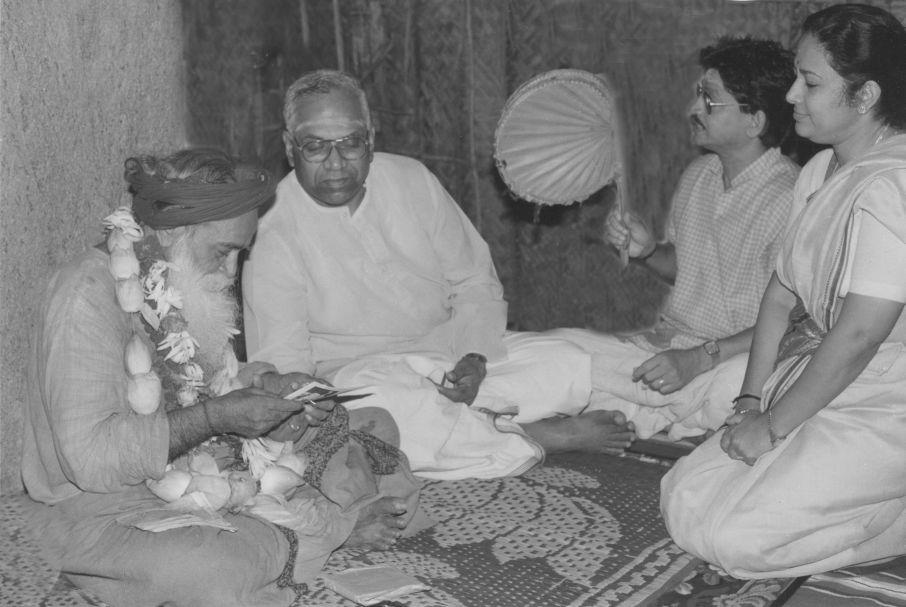
Justice Arunachalam, Ganesan, Anuradha with Yogi Ramsuratkumar
After that meeting, our next interaction was in 1986. I was collecting articles of the reminiscences of devotees of Ramana Maharshi for publication in The Mountain Path. Anuradha, J. Jayaraman (the ashram librarian) and I set out to meet Yogi in this regard. Since we were not planning on taking notes, we had decided on recording the meeting surreptitiously. Jayaraman tested the recorder outside Yogi Ramsuratkumar’s residence and made sure it was working properly. However, when he tried to operate the recorder in the room it wouldn’t work! Yogi Ramsuratkumar started angrily narrating an earlier incident in the day where he was photographed without permission and said, “Ganesa, people have no courtesy these days. They try to photograph or record this beggar without asking him.” Jayaraman and I exchanged a look and I mentally apologized for this indiscretion. Immediately, his mood changed and he ecstatically started recounting his experiences with Bhagavan.
“Once, when I was seated in the presence of Sri Bhagavan, he vividly narrated a fascinating story which is also highly significant. There lived a pair of birds by the side of the ocean. Leaving their eggs in their nest, they would fly to far off places in search of food. One day, on their return, they were aghast to find that their nest along with the eggs had been devoured by the waves of the sea. They became very angry with the ocean and in all seriousness vowed that they would empty it, if necessary, in order to retrieve their eggs. They immediately started the operation of emptying the ocean by taking the sea water in their beaks, mouthful by mouthful, and dropping it at a far off place. They did this endlessly without rest and with all earnestness and alertness. Days passed and they were still one-pointedly dipping their beaks into the ocean and flying away to dispose off the water. One day, a great being happened to pass by. Observing the tireless efforts of the two birds, he asked them what they were up to. The birds explained that their eggs had been washed into the ocean and that they were determined to empty it in order to retrieve them. Surprised, the great being exclaimed, ‘What! This is impossible! Can you two tiny birds ever hope to empty the ocean, however relentless your efforts may be?’ ‘What doubt can there be?’ replied the birds. ‘We are absolutely certain that we shall eventually succeed and retrieve our precious eggs!’ Moved by their tremendous faith and devotion, the great being compassionately put his hands into the ocean, found the eggs, and returned them to the overjoyed birds. Sri Bhagavan then said: ‘Emptying the ocean is analogous to knowing God. Alone, without grace, it is impossible. But if one has the unshakeable faith and earnestness of the two birds in the story, the guru will appear without fail and fulfill one’s spiritual aspirations.’”
“On another occasion, I was thrilled to witness the compassion of Sri Bhagavan. A devotee, Eknath Rao, brought into the hall a bowl filled with fruits cut into pieces and placed it before Sri Bhagavan. Within the large bowl was a smaller bowl with pieces cut specially for Sri Bhagavan. Bhagavan’s sense of equality was total and although his tolerance towards devotees was immense, he would never permit anything special for himself. When Bhagavan noticed a separate bowl for himself, he was annoyed and pushed the big bowl aside roughly. A few pieces of fruit spilled on to the floor and were left there. The devotee then began to distribute the pieces to all in the hall. Everyone sat with a few pieces in their hands, not wanting to eat since Bhagavan himself did not have any. Out of compassion for the devotees, Sri Ramana reached down, picked up the pieces that had fallen on the floor and began to eat them. The rest of the devotees were then able to eat too.”
Yogi Ramsuratkumar continued, with his narration: “Once, a devotee asked Bhagavan whether a disciple who has not realized can take to another guru after his guru drops the body. Bhagavan replied, ‘No, there is no need because the guru’s grace and blessings will continue even when the body is dropped.’” Anuradha promptly interrupted and asked Yogi Ramsuratkumar, “If that is the case, why did you go to Swami Ramdas after Bhagavan’s mahasamadhi?” Yogi Ramsuratkumar looked at her with a benign smile and explained, “The divine fervour that I experienced in Bhagavan’s presence began to wane when I left him and went to stay in the Himalayas. Nevertheless, I had begun to see that a higher power was expressing itself, using me as an instrument. Bhagavan Ramana was a principal influence in shaping this beggar to this state. After his passing away, this beggar needed a guru in the body. I did not see any conflict in going to Swami Ramdas. It was Swami Ramdas who initiated this beggar and gave him this madness. The inner life of saints like Ramakrishna Paramahamsa, Bhagavan Sri Ramana Maharshi, Sri Aurobindo, J. Krishnamurti and Swami Ramdas is far, far removed from what we can externally perceive of them. They operate rooted in the eternal infinite, which can never be known. There is no individual there to report differences!”
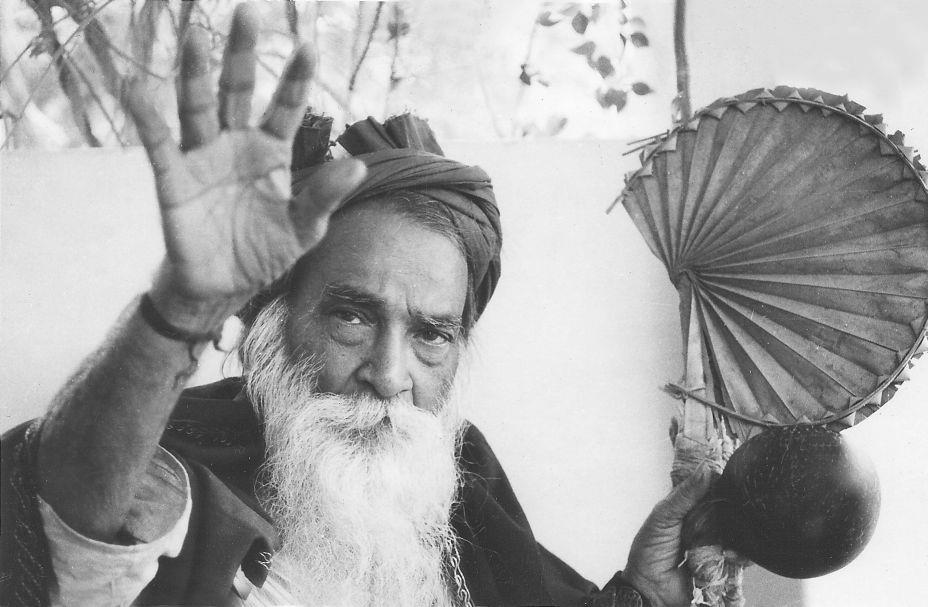
At Ganesan’s residence ‘Ananda Ramana’: “Father’s Blessings on you, Ganesa.”
I had the good fortune of interacting with Yogi Ramsuratkumar on several occasions after this. It is no exaggeration to say that he played a pivotal role in my life. The following is an example where he specifically stepped in and resolved a crisis. In 1987, I was caught up in a problem involving a printing press. I was trying to print the ashram publications locally at a lower cost so that we could sell them in our bookstore at reduced prices. A local printer offered to take this responsibility of printing our books if I could help him purchase a printing press. The bank gave him a loan on the condition that I was the guarantor. I agreed without fully understanding the consequences of this. Unfortunately, he defaulted on the payment and the bank manager held me liable to repay the loan. I was bewildered about the situation. As the pressure mounted, I even contemplated suicide. Seeing my increasing desperation and depression, Anuradha suggested that we take this problem to Yogi Ramsuratkumar as many of his devotees were in the printing business.
We met him at his house and Anuradha told him about the problem, “Ganesan is going through a lot of stress with a printing press issue and he wants to commit suicide”. Pat came the response: “Ganesa, what did our master Ramana Maharshi teach us? You have to enquire into the source of thoughts and kill the mind and not the body. The body has served you well all these years. Why take it out on the body?” I felt cornered and blurted out, “Let me then run away from Arunachala.” With a spark of inquisitiveness in his eyes, Yogi asked me, “Where will you go if you leave Arunachala?” I spontaneously said, “Kashi, swami!” Seeing an opportunity, he asked me with intense enthusiasm, “Will you promise to go to Kashi if the problem is solved?” I expressed my full consent. He then turned to Anuradha and asked her, “Will you be able to do the magazine work in the absence of Ganesa?” She readily agreed. He turned to me and asked, “Tell me what the problem is.” Anuradha explained the issue in detail.
One of the traits of Yogi Ramsuratkumar was his intense and complete involvement in any problem that he took up. He went into all the details and after a thorough understanding of the issue, remained silent for a moment, then took out his cigarette packet and wrote ‘Om’ and gave it to me. He then said, “The name of the person who will help you is one of my devotees, S. P. Janarthanan, and this is his address.” He directed me to write down the address on the plain side of the cigarette wrapper. When I contacted him, he came to Tiruvannamalai and without so much as looking at the printing press said, “My master Yogi Ramsuratkumar has asked me to take this press off your hands and I will pay the entire amount of this press.” I felt instantly relieved. But my relief was short lived as his partners refused to endorse this idea. It took another seven months for him to finally take the press and clear the loan. I felt completely harassed during this time. Yogi continued to be my only support and solace. Finally, the ‘press problem’ was solved. I was ready to fulfill my part of the ‘deal’! With Yogi Ramsuratkumar’s blessings and the help of J. Krishnamurti’s nephew G. Narayan, I retreated to Varanasi for an entire year. Even there, I could feel Yogi’s mystic hand helping me with the staying arrangements. I had a cottage right on the banks of the Ganges and spent a year there with a sense of quietude and dispassion. I felt he was guiding me by freeing me from the continuous involvement in the ashram. It was for the first time after nearly thirty years that I felt a new sense of spiritual independence. I actually felt that I was being weaned away from the karma of service to the ashram.
When I came back to Tiruvannamalai, he said, “Mother Krishnabai is on her death bed. Go and see her.” In 1960, it was Mother Krishnabai who had initially guided me to bring back all the old devotees of Bhagavan to the ashram and attend on them. After twenty seven years of doing this ‘work’ I returned to her to report the progress that I had made. I stayed with her for two months. During this time, building on my experiences in Varanasi, I asked her that I be released from life’s further duties. Mother asked me how many old devotees were still remaining in the ashram. I said I had brought back almost fifty or more old devotees, attended on them, completed their funeral services and only two more, Kunju Swami and Ramaswami Pillai, were left. On hearing this, she said, “Ganesa, you have some more work to complete. But, I assure you that I will fulfill your prayer to be a ‘nobody’ and establish you in that state of quietude.”
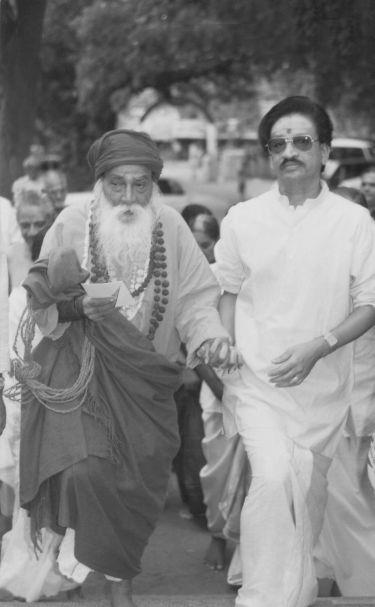
Ganesan welcoming Yogiji
In 1989, I returned to Ramanasramam. Three years later, Kunju Swami passed away. Towards the end of 1994, Ramaswami Pillai also passed away. The very next day I got released from ashram duties. I had already written in The Mountain Path about relinquishing all responsibilities in the ashram. I took that issue to Yogi Ramsuratkumar. He read it and then said, “Ganesa, do me a favour.” He held my hand and took me to Ramanasramam to meet my elder brother Sundaram who had already become the president of the ashram. He told Sundaram, “Do not be worried. Bhagavan is managing this ashram. Everyone will help you. Be bold, because the ashram activities will go on uninterruptedly.” He encouraged Sundaram and allowed me to leave.
Soon after, Yogi started building his own ashram. As was his wont, he was intensely involved. Whenever I went and stood in front of him after this, he would say, “Ganesa, we have spent a lot of time together. Go back to your home Ananda Ramana and put Bhagavan’s teaching into practice all the time.” He served as a constant reminder to me of the ultimate goal of one’s spiritual quest. It was his constant prodding to share the teaching and put it into continuous practice that reshaped my spiritual life. There was always the grace of Sri Bhagavan and the blessings of his old devotees, but it was Yogi Ramsuratkumar who moulded my life in many ways. All the travelling and the sharing I have done of Sri Bhagavan’s teachings in the U.S. and elsewhere, was done on his instruction.
I was with him during his last days in 2001 before he dropped the body. I mentally prayed to him from a distance and he immediately raised his hands and blessed me. After he dropped the body, I carried his body along with the others. When his body was to be interred, I prayed that I get an opportunity to make a final offering to him. Almost immediately, his close devotee, Ma Devaki, requested me to inter his coconut shell bowl, fan and sticks. Yogi Ramsuratkumar continued to fulfill my desires even after he dropped the body!
I want to end this chapter with a recollection that still brings tears to my eyes. It was a Thursday, which in Hindi is called Guruvar. I went and prostrated to him and said, “Today is Guruvar.” He lifted me up and then said, “Ganesa, your guru is Bhagavan Sri Ramana Maharshi.” Then, with tears of ecstasy flowing from his eyes, he said, “This beggar’s guru is also Bhagavan Sri Ramana Maharshi, Ganesa!” Yogi Ramsuratkumar, ever established in the ‘I AM’, is one of the greatest devotees of Sri Bhagavan and therefore, one of the biggest boulders of Arunachala. Obeisance to Yogi Ramsuratkumar!