Wolter Keers
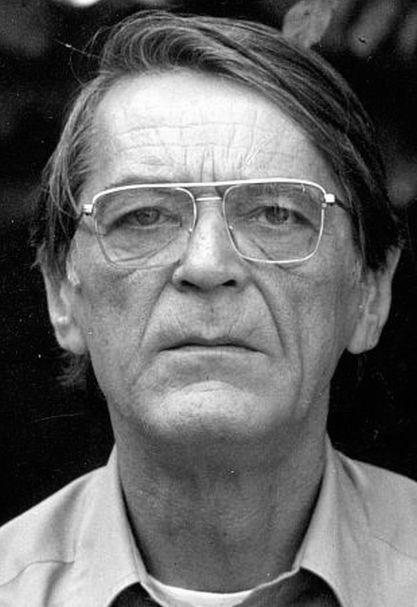
Wolter Keers was an admirable devotee of Sri Bhagavan from Holland. Though he had been telling his friends that his death was imminent, he passed away very suddenly on 7th January 1985 in a manner which would be the envy and dream of all devotees of Sri Bhagavan. His friend Menno Blazer was with him during his last days, later joined by another friend. Blazer made some photographs of the snow in the forest as promised to Wolter. It was the coldest winter in 25 years ! Wolter drove Blazer to the railway station on the morning of 7th January as he had to leave for work. A couple of hours later, Blazer received a call from the friend who was with Wolter asking him to return as Wolter was no more ! It seems that on his return from the railway station, Wolter cancelled an appointment on phone, then placed a cushion in front of the photo of Bhagavan Ramana in his living room and stretched himself on the floor before it and he was gone, with a hand placed on his right chest. At his cremation, his favorite composition of Schubert,'Die Winterreise ',was played.
Wolter was certainly a zealous person because he gave up his body just as a videha mukta would do. The Hindu scriptures make a distinction between two kinds of Self realization - jivan mukti and videha mukti. When a person is in the state of jivan mukti, he is in a liberated state of oneness even while he is alive. People who look at him can intuitively understand that here is a realized soul. A videha mukta is one who is completely established in a blissful state at the time he leaves the body.
As the managing editor of The Mountain Path, I was in close correspondence with Wolter. After its editor, Arthur Osborne passed away in 1970, the editorship was taken up by other scholar devotees and I took on the responsibility of collecting articles for the issues. This is how my association with Wolter developed. He always obliged me by being prompt. Every article was soaked in his individual and personal experience of being immersed in the Self. Whatever we have about Wolter Keers has been obtained from these articles. We are indebted to David Godman for editing and compiling them.
According to Bhagavan, God, the Self and the guru are synonymous and identical. God or the Self chooses a vessel and fills it with divine wisdom. This is done right from the devotee’s childhood days. This is something that you must have observed in the previous chapters. Almost all the people mentioned there have been attracted in some form or the other to the truth or to God, or have had an experience of transcending body and mind. Wolter Keers was undoubtedly one such person who was chosen by the Self.
Wolter Keers was born in Holland in a clergyman’s family. They were devout Christians. Wolter himself said that such families were rarely found. At the age of five, Wolter had a remarkable experience, which at a later age he realized was a spiritual one. A family friend was visiting and was conversing with them. Being a child, Wolter was not interested in any of the conversation. However, his ears perked up when he heard the words ‘British India’. The child was thrilled for some inexplicable reason because he realized that there was something mysterious about it. Though the child had no comprehension of the word, it was a spiritual experience of some kind.
When he was still the same age, Wolter was playing one day outside in the field with mounds of sand. He chanced to see a hedge that had pink flowers with fluffy balls. Suddenly, everything, including the hedge, the flowers, even his body, disappeared into a light. Everything around him was brilliant light. True, he belonged to a family of theologians, but he couldn’t bring himself to discuss this experience with any member of his family and ask for an explanation. Until he was twenty one years old, Wolter did not understand that these were spiritual experiences. One day, he was seated next to an elderly man on a bench. The man was reading a book, when suddenly for no reason at all he read out a passage. Wolter did not pay attention to the words, but again everything merged into the same kind of light, just like it had happened when he was five.
In the Hindu scriptures, such a state of transcending the world and everything else is called nirvikalpa samadhi. Wolter had experienced this state thrice by the time he was twenty one years old. This time he was brave enough to ask his family for an explanation. He told them, “This has been happening to me repeatedly.” His family brushed his queries aside, saying, “These are bizarre experiences. Do not pay any attention to them.” Wolter was disappointed at their response to his genuine queries. He then asked his friends. None of them could understand or even share his thirst to know more about his experiences. He started reading widely to find out more. No book gave him an acceptable answer. Wolter had a strong feeling that there was some reality in the experiences; he also felt that the experiences were actually the source of one’s existence and one’s body. He understood that this was the substratum on which all existence, the world and everything else in it, was based. And that force was the light of silence.
His efforts to find an answer met with no success. Then, a voice inside him whispered, “Perhaps, you have to seek a master who will be able to help you,” and the guru also started playing an active role. Within a few days of this feeling, an elderly lady came to his house and lent him two books. She said, “Wolter, read these books.” Well, we know Wolter’s attitude towards books; he was always disappointed with books. But his respect for the woman compelled him to pick up the books - Jnana Yoga by Swami Vivekananda and The Secret Path by Paul Brunton. As he read the first book, he was in a state of ecstasy because for the first time the truth of his spiritual experience had been confirmed, though by a Hindu monk. He plunged into the book with great vigour because he found that the book was not only certifying that his experience was a spiritual one, but was confirming it. This was something that neither his relatives nor his friends had been able to do. The book also revealed that it was a common phenomenon for real seekers to have this kind of spiritual thirst right from childhood. The book had the best news for Wolter when he found Swami Vivekananda confirming that the tradition of sages and saints still continued in India. Wolter immediately felt, “I now know that my master is in India. I need not search anywhere else.”
With this exultant feeling, he started reading the second book, The Secret Path. In this he found a picture of Bhagavan. After the first few pages, he knew that Bhagavan Ramana was his guru, his satguru. He took this picture and placed it where he could see it and practised in front of it the various kinds of meditation which he was already following. He felt grace and power flowing from the picture. The book stated that the right side of the chest in the human body is the spiritual centre, the spiritual heart, and that one should concentrate on that. Wolter did this and received good waves and vibrations, confirming the fact that Ramana Maharshi was his guru. However, he was anxious about one thing. The book was many years old. He wondered whether his guru ‘would be available in the body’. This was the only craving that he had - to see Bhagavan physically. When he meditated on this heart centre, it seemed to him that the photograph of Bhagavan responded in a mystical way, assuring him, “I am here. You will come to me. Do not worry.”
Wolter couldn’t go immediately for innumerable reasons - there was World War II, the German occupation, and he had no money. He could leave for India only in the beginning of 1950. The moment he set foot on Indian soil, he left for Arunachala. Roda McIver was his host. It was she who took him to Bhagavan. He entered the ashram with a feeling of awe, respect and intense longing to meet the divine. He was thrilled when he stood in Bhagavan’s presence and was also filled with gratitude. He went before Bhagavan and said, ‘Thank you, Bhagavan. You have answered all my prayers. I wanted to see you in your physical form.”
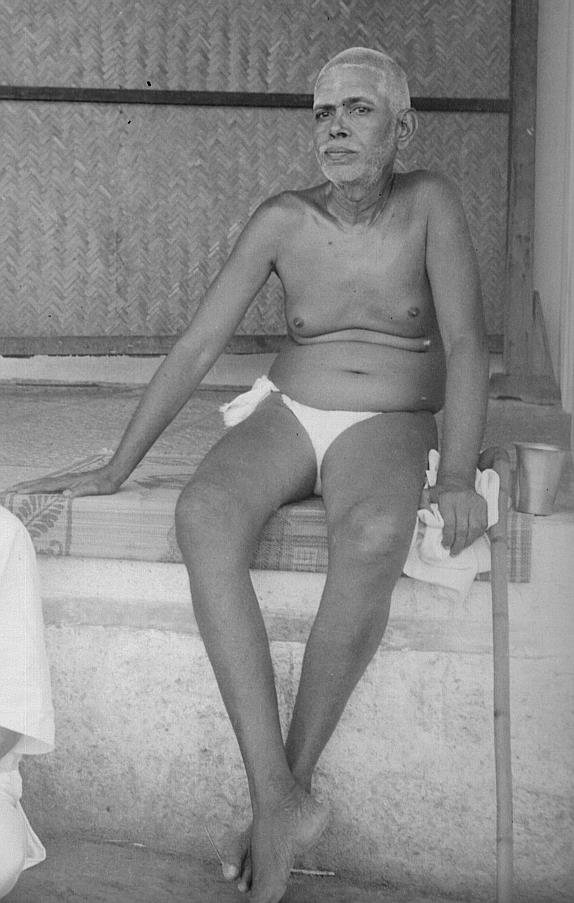
Later, he described his first darshan of Bhagavan: “I saw Bhagavan sitting on a chair in the small passage that connected his room with the hall. This is where he met visitors and devotees. The mere sight of him made me tremble all over. It was not because of nervousness or uneasiness. It was because I had come face to face with the divine. The recognition affected me so much that my body shook involuntarily. I looked at this being who had been the focus of all my dreams, hopes and expectations for so many years. There could have been a let-down, a disappointing realization that I had come so far just to see an ordinary man sitting in a chair, but this was not so. As I gazed at Bhagavan, I felt I saw God himself sitting there. I felt I was seeing that early morning, a blazing light that had taken human form. It was more radiant than anything I had ever seen before.”
Bhagavan turned his attention on Wolter and smiled at him. Wolter felt that the smile meant, “So, finally you have arrived,” affirming that Bhagavan had been guiding him from that picture back home in Holland. “Waves of ecstasy inundated me. I feasted my eyes on his form. I looked and looked, soaking up every emanation of this radiance.
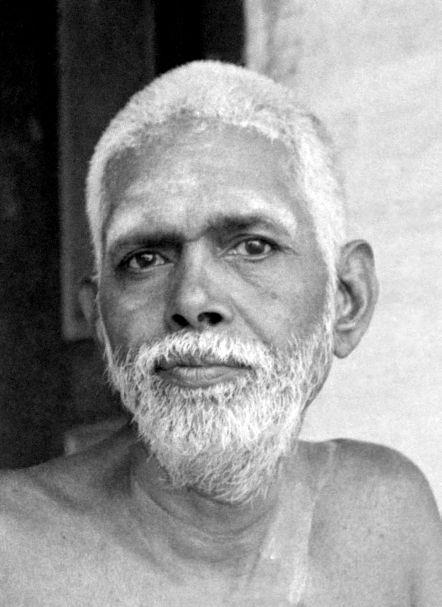
Long, long ago, when I was very young, I had believed that God was a magnificent being who had a human form that radiated light and goodness. I had long since abandoned this childhood belief, believing it to be a fairy tale told only to credulous children. Yet, now this childhood belief turned out to be true because here before me was a human form that seemed to be made of light itself. How do I describe what I experienced on that first morning? God became manifest before my eyes, announcing his presence to me by radiating a blazing penetrating light - a light that went right through me like an X-ray.”
The beauty of this description is that Wolter was talking about this light and this experience before even knowing that the sacred mountain Arunachala is the hill of the holy fire. Tradition says that Arunachala is wisdom itself. Bhagavan confirms it, “It is the Self.” It is the ‘I AM’ and it is in the form of fire. Jesus talks about fire; Moses talks about fire because it is pure wisdom, the inner wisdom. Arunachala too is the hill of fire, of wisdom. Since humanity had forgotten this wisdom, Arunachala took the human form of Bhagavan in order to spread the truth about Arunachala, the wisdom of ‘I AM’ across the world.
At that time, Wolter did not know that he was one of the messengers to assist in spreading this wisdom of fire. Western Europe eventually came to know of Bhagavan through Wolter. This was his destiny and he talked about it without even knowing about it. Any writer or editor has the ability to write flowery language about the master. Wolter said, “Every word I utter is my true spiritual experience. Nothing that comes from my brain can write poetry. It is all horse language.” Only Wolter could write like this.
Wolter remained in the presence of Bhagavan, knowing fully well that he was in the presence of divinity. He says about the experience, “Those first few days were the fulfillment of everything I had ever hoped to find. In fact, I can say it was much more than that. I had had lucid, radiant moments in my years of practice, but nothing had prepared me for the possibility of coming into contact with even a portion of this blazing presence of light. No part of my imagination had even conceived that such an experience was possible. There was a radiant power and energy in Bhagavan’s presence that effortlessly swept through my mind and matter. His grace silenced my mind, filled my heart and took me to realms that were way beyond the phenomenal. In his radiant presence, it was so evident that I was not the body and not the ego and no such analysis was needed. The light radiating from Bhagavan filled my being, sweeping away all the darkness from me in a stroke.” For weeks on end he sat in the presence of Bhagavan, experiencing these waves of ecstasy. He felt the radiance of this light when he was in the presence of Bhagavan, but it seemed to wear off when he went back to his cottage. He strongly felt, “I must ask Bhagavan to make this radiance or ecstasy permanently rooted in me. Bhagavan himself should end the waxing and waning of this experience.”
So, one day, he sat away from Bhagavan but from where he could still see him. He then started bombarding Bhagavan with thoughts: “What is the use Bhagavan, of your radiance if it is available to me only in your presence and leaves me the minute I leave your presence? Tell me!” Bhagavan however did not easily give in to these demands. Wolter waged, not a war of words, but a war of hearts. Wolter persevered with the intensity that was characteristic of him even as a child. (This is something that we have to learn from Wolter. Perseverance is a must for us all. It is not enough to have the experience just for a few days.) After some time, Bhagavan slowly turned his attention towards him and smiled, meaning, “What do you want?” Wolter was almost in tears because his prayer to Bhagavan had been genuine, sincere. After some time, Bhagavan looked at him again and focused his gaze, his blessings and his grace so powerfully that it touched his heart. Bhagavan seemed to be saying to him, “Wolter! You are looking for your glasses and they are right on your nose!” He was thrilled by the experience and felt waves on waves of ecstasy. He surmised, “This permanency can never be obtained from outside. Anything that is outside is impermanent; it will come and go. Bhagavan, your guru, confirms that the permanent thing you are seeking is like an everyday experience by saying, ‘Your glasses which you are searching for are right on your nose!’” He felt that the answer had come from Bhagavan, the inner guru, but Bhagavan, the external guru was also looking at him intently.
This is how Wolter felt: “Suddenly, Bhagavan’s eyes emitted light and fire at me. I can think of no other way of describing that immense explosion in his gaze. His powerful look went straight into me, burning away everything that made me think that I was different and separate from him. I felt the right side heart centre begin to get warm. The heart centre got warmer and warmer as he continued to gaze at me until I felt it to be a hot, fiery ball glowing inside me. It felt as if Bhagavan was charging it with some immensely powerful spiritual electricity because as he continued to look at me, I had the unmistakable feeling that this heart centre was some kind of spiritual dynamo that was emitting sparks of light and energy. I felt as if some enormously potent electric apparatus had been suddenly transplanted into my chest. I sat rigid and straight. My eyes were glued to his. Fire flowed from his glowing eyes into the core of my being. How long this transmission lasted I cannot say. This was beautiful. I had received what I had come for. There was a complete transformation inside out, and it all happened without a word being spoken. That consummation through silence was clearer and more direct than any explanation that could have been given in words. Bhagavan had taken me to the limit of my readiness. I felt that the infusion of grace that Bhagavan had blessed me with on that day would do its own work in its own time. I had received my parting gift from him and I could have asked for nothing more valuable.”
Wolter went back to his country even though he was aware that Bhagavan was to drop his body. He did not stay because he knew that Bhagavan was not the body. Bhagavan was the light from the Heart at all times. Later, he returned to India and went to a master in Kerala with whom he spent some years. But, all the time, it was Bhagavan who was his stay, his prop, the centre around which every activity gravitated.
In the 1970’s and 1980’s, he visited Nisargadatta Maharaj regularly and listened to his Advaitic teaching. Yet, he held on to Bhagavan, his satguru, in his Heart, feeling his presence in the form of light. He toured Europe widely, delivering numerous lectures. He edited and published many spiritual magazines, showing the practical side of spiritual teaching. Wolter Keers was an outstanding example of the truth that external activities are in no way a hindrance for us to plunge within and be the Self that we always are.
I was fortunate to be in correspondence with such a beautiful devotee. I once asked him, “Wolter, what did Bhagavan mean to you?” This is what he wrote: “What does Bhagavan mean to me? I am asking myself that. What has Bhagavan meant to me and what does he still mean to me? I find that it is impossible to give a neat answer to this question. Well, this is just it. Sri Ramana Maharshi was, and is, the unimaginable and therefore the indescribable. Bhagavan was not the frail, old dying body that I saw reclining on the sofa, but the unimaginable; he was egoless and pure radiance; and the body, however much we loved its appearance, was merely like a glittering diamond reflecting the light that really was. I did not understand all this when I first arrived. To me, he was something like a divine person and I was inclined to compare him with Jesus Christ or the Buddha. But Jesus Christ or the Buddha were images in my head formed on the basis of the beliefs I had been brought up on, and all the stories heard and read later on. But Ramana Maharshi, from the first moment I saw him, was anything but an image. He was a bomb exploding the myth of my life within a few minutes and without a word. His famous question, ‘Who am I?’ immediately got a totally new colour. It was only three or four years later that the full impact of what his silence had revealed to me became clear. Perhaps these two words ‘my own’ and their inverted commas indicate the problem. Bhagavan never gave anyone the possibility to believe that you as a person could realize the truth. The axis, the central point in the sadhana that he proposed to most of us, was the invitation to examine who put forth the questions? Who came to see him? Who wanted to realize?”
“Once Bhagavan asked someone, ‘How do you know that you are not realized?’ This was a counter question to what the person had said: ‘I am not realized.’ Bhagavan asked, ‘How do you know you are not realized?’ If you ponder over it, you will find that this question is like an earthquake. Who says so indeed? So, pondering deeply over this question, one cannot but come to the conclusion that Sri Bhagavan told us the plain and naked truth when he said, ‘The Self is always realized.’ When it is seen that every perception, sensorial or mental, is nothing but a movement in consciousness, a movement in light, then from that moment on, every perception chants the glory of this clarity just as one can see a wave, any wave, as a song of the sea. Whatever I understand now, is entirely my good fortune in meeting the right person, the embodiment of truth, at the right time at several points in my life. I received all of it free. I never had to pay a penny. Authentic teaching is always free except in one way. You pay for it with the depth of your personality. This implies that you must be prepared to give up everything that you have ever considered as yourself.”
“Bhagavan has never given me anything. When I arrived, regarding myself as a poor man in need of help, he revealed to me that I was more than a millionaire and the source of all beings. Bhagavan has never asked anything from me, not even my love or respect. It was his mere presence that uncovered or unleashed in me what cannot be described by words such as love or respect. It went deeper than the deepest feeling. My meeting with him was in no way a matter of giving and receiving. Even though for a long time I had thought that he had given me his love, and that I had given him my heart, it was the naked confrontation of illusion and truth in which illusion could not stand up. It was wiped away, but not because he wanted it. He wanted nothing and accepted me as I was. He did not wish to change me. He saw me as a whirlpool of light in an ocean of light. Perhaps it was the radiant certainty that he was, that broke through my fears and desires and enabled me to let go of the desire to enrich an imaginary me. Bhagavan was what he was, and Bhagavan is what he is and because of that I can say certainly now I AM what I AM. Does it not mean to say that just being who he was, Bhagavan enabled me to realize the timeless, unthinkable unimaginable ‘I AM’? Bhagavan is the stillness; Bhagavan is the silence. These two last sentences should become each one’s life. Every moment we have to remember that the light is within each one of us.”
The greatness of this mukta purusha is that he lived from his childhood for the truth. He strove for it, and when he sought it, the guru came as the sentence in The Secret Path says, “When the disciple is ripe, the guru will appear.” Let us turn within as Wolter did. On the right side of one’s chest is the light within. Close your eyes and see the brightness there. That is the glimmer from the Self!
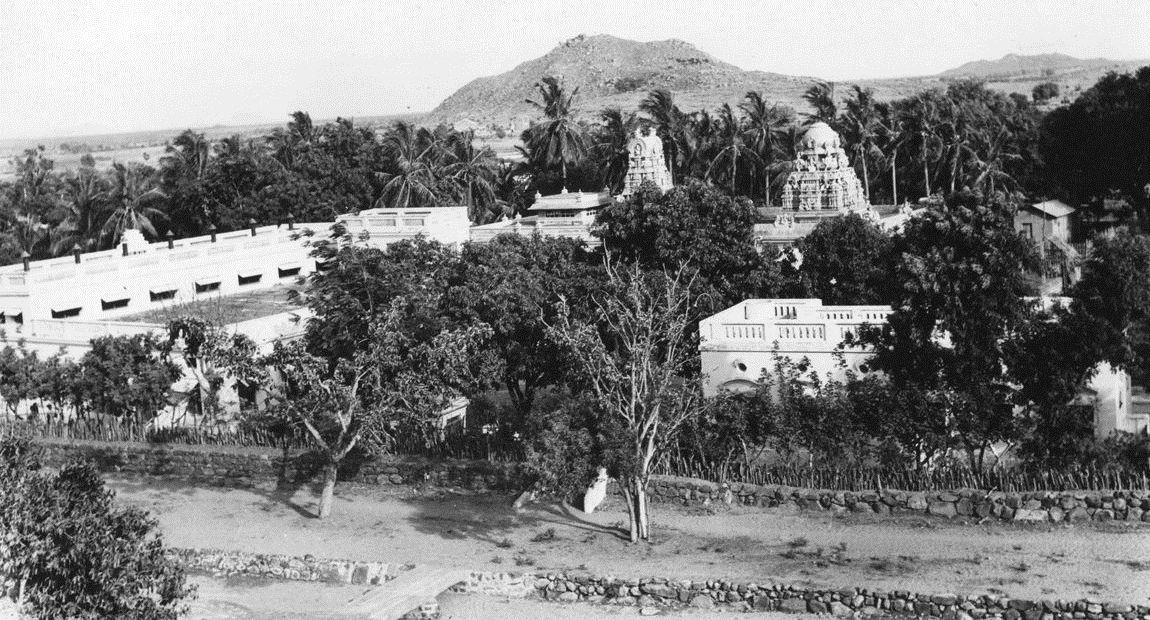
Sri Ramanasramam viewed from the Hill
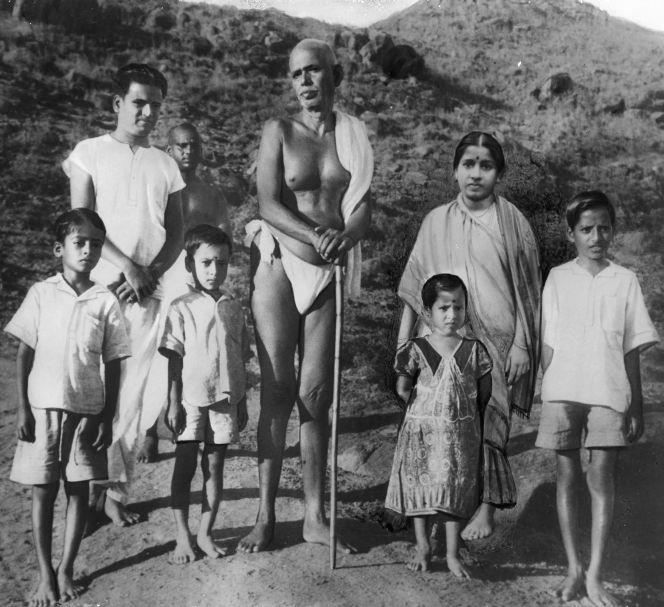
Nagalakshmi and family with Sri Bhagavan