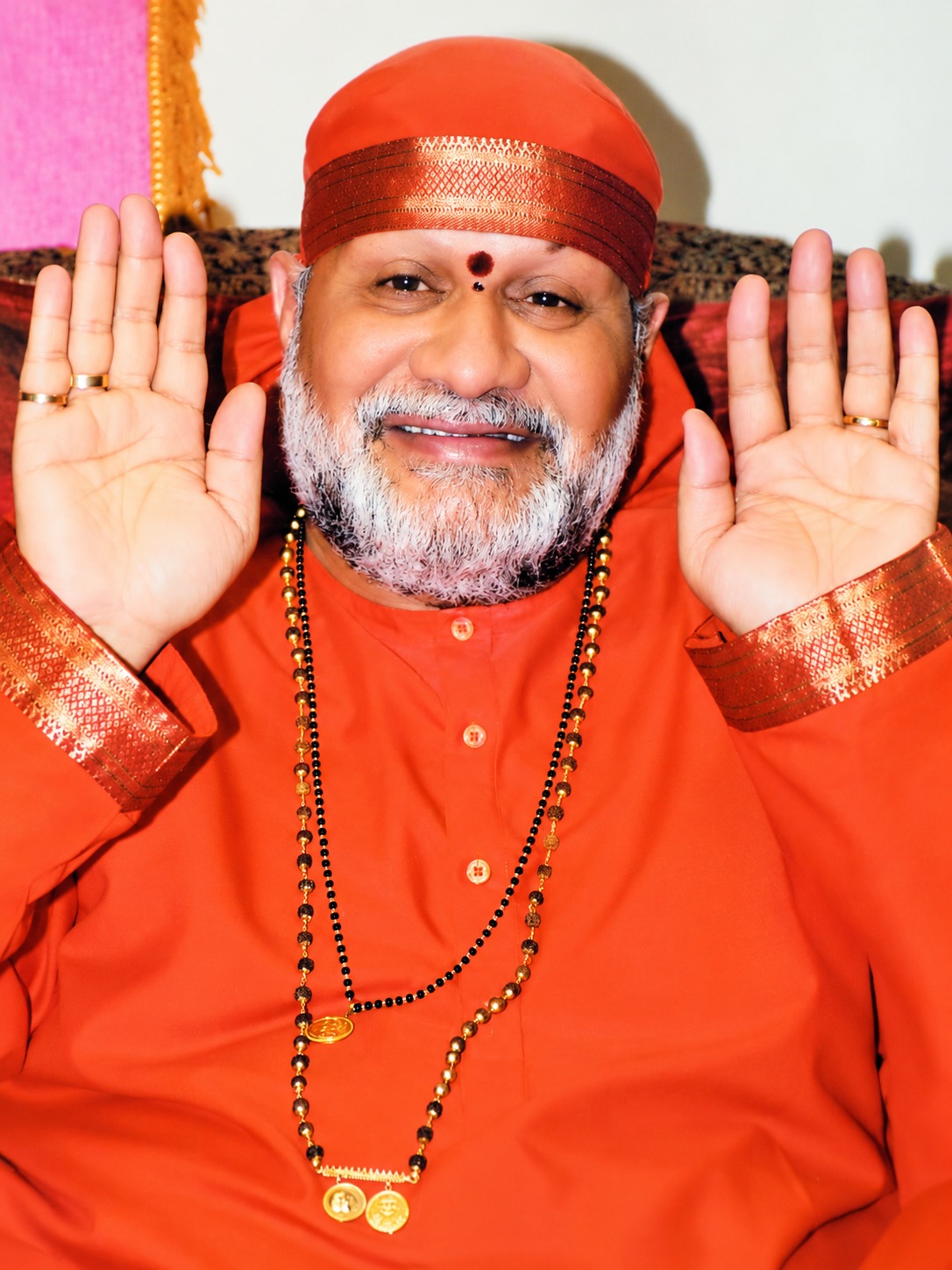
Sri Sai Das Babaji
c. 1940 to September 2006
16 chapters
He called himself a wandering fakir with a message, and he gave his life to two things. The first was that Sai is one: that Shirdi Sai Baba had come again as Bhagawan Sri Sathya Sai Baba. The second was Sai Prema, which he lived far more than he explained. "We would have been the poorest of the poor," he said, "had SAI not enkindled in us a spark of Divine Love for HIM." And he carried it from Ujjain to Nottingham, Nairobi and Muscat: "Love is expansion of life. Hatred is contraction of life. So spread love, not hatred."
He was found as a newborn, crying among the trees in the forests around Shirdi, and he was laid to rest on the banks of the Kshipra at Ujjain, on a spot he had marked out himself. For most of the years between he walked across India unknown, a beggar in saffron with a brick for a pillow. Then, in the last fifteen years of his life, people began to notice him, and he spent those years giving those same two things to all who came to him.
He was not a long-form preacher. Sai Das Babaji taught in short sentences meant to be carried home rather than studied, and Sai Foundation gathered them into a collection. He left that body of short sayings alongside the prayer he composed at eighteen and the handful of answers he gave when people asked him who he was. His teaching is told within his life, where he gave it or where the life turns on it, and his sayings are gathered on their own, by theme, so that each can be read slowly and given room.
His devotees wrote down for themselves what happened to them when they met him, in Sai Foundation's own publications, and their accounts are given here as they told them, at the time and in the place where each one happened.
1. The Child Left in the Forest
Somewhere in the forests around Shirdi, around 1940, on the day of Vijayadashami, a child was born to parents who had nothing. They were pilgrims walking the circuit of the Jyotirlingas, and the birth came on the road. Poverty decided the rest. They left the baby in the jungle and prayed to Lord Shiva to look after him.
The mother died not long after. The father finished the pilgrimage and spent his last days at the Mahakaleshwar temple in Ujjain, where his final prayer was that he might one day be brought back to the son he had left behind. Half a century later that son would make Ujjain the centre of everything he built.
A fakir found the baby crying among the trees. In Shirdi that same day, a childless couple, Yarlagadda Venkatanarayana and his wife Raghavamma, were praying for a child before the idol of Shirdi Sai Baba in the Samadhi Mandir. As they came out of the temple the fakir put the infant into their arms and told them their prayers had been answered. They took the child as a gift from Shirdi Sai and named him Sai Das, the servant of Sai. They carried him home to Tirupathi.
A child left in a forest with nothing but a prayer over him, and put into the arms of a couple who had been praying for him: the life began the way it would go on, with the needs of one person answered through another.
He said afterwards that he knew what he had come for by the age of three.
2. The Broken Pot
In his third year they took him to Annavaram in Andhra Pradesh, the seat of Lord Satyanarayana, for his mundan and his Aksharabhyasam, the ceremony that starts a child on letters. He would never see the inside of a school. Soon after Annavaram his adopted mother died, and the boy was left with his father.
He was about five, and it was Guru Purnima. His father had gone to work. Three sadhus came to the door asking for food, and the child, who recognised them as Brahma, Vishnu and Mahesh, gave them the whole day's rice without stopping to think about it. He did not ask whether they deserved it, or whether there would be anything left. Of need, he would later say:
Do not pass judgment as to whether others need your service. If they are distressed that is enough credentials.
He went without lunch himself. His father came home tired and hungry, found the pot empty, and demanded to know where the rice had gone. When the boy told him, the father lost his temper and brought the empty earthen pot down on his son's head. The pot broke, and out of it poured enough rice to feed the family.
The child told his father that the time had come for him to leave the house. His father begged him to stay. He went anyway.
He came back once more, to a deathbed. "I have only come to give you Mukthi," he told the old man. He performed the last rites at Tirupati, and then he left home for good.
3. Thirteen Years Old, in Saffron
At thirteen he put on the saffron kafni and took sannyas. At eighteen he composed the prayer that his devotees still sing, and it stayed his favourite for the rest of his life:
Baba chalo mere saath, raho mere saath, mera kaam karke do.
Baba, come with me, be with me, do my work for me.
It asks for nothing for himself. It asks God to walk with him, to stay with him, and to do the work, which is the whole of the life that followed in three short phrases.
His favourite shloka came from the Bhagavad Gita:
Ananyash chinthayantho maam
ye jannah pariyupaasathe
Thesham nithyabhi yukthanam,
yoga kshemam vahamyaham
If a devotee thinks single-pointedly of the Lord all the time and lays his burdens there, the Lord takes responsibility for his welfare. And if his own life was any indication, he said, the shloka was absolutely true.
Having composed his own prayer at eighteen, he never stopped recommending the practice. Faith, for him, was less a conviction than a working habit, something done every day with the hands as well as the heart.
4. Unknown, Unsung and Unheard Of
For decades after that he lived in Shirdi. He took Shirdi Sainath as his guru, though he never received a mantra from him. He slept with a brick under his head, the way Sainath had. He begged for his food, and was often chased away. He lived in the world and stayed outside it.
He never went to school or college, and he spoke excellent English along with at least a dozen other languages. Long afterwards, on a visit to Madame Tussaud's in London, he startled the devotees with him by narrating the histories of the kings and queens on display. Whatever he knew, he said, came from the grace of Bhagawan Sainath. His own beloved form of God was Venkatachalapathi.
At some point while he was still young he met Bhagawan Sri Sathya Sai Baba in the flesh. He never told anyone what passed between them.
He went to Tirumala, to Tirupati, to Puttaparthi, and back again to Shirdi, and out of that circuit came the conviction that shaped the rest of his life: that Shirdi Sai had come again as Sathya Sai, so that the fountains of Sai Prema could keep flowing. He began telling the world so.
Until 1990 he walked across India unknown, unsung and unheard of.
5. Ujjain, 1991
In 1991 he came to Ujjain, and to the Shirdi Sai temple at WRS Colony in Raipur, and people began to notice him. He stayed forty-five days in the house of Dr G. S. Sharma. A Malayali family, the Nairs, persuaded him to stay with them and built a room for him.
It was in that house that Mrs Nair caught him one morning hurrying back from his bath, covering his back with a towel more quickly than he needed to. She had caught sight of something. She insisted on seeing his back, and found it covered in welts and bruises, as though somebody had beaten him black and blue with a stick. Caught out, he explained it:
Last night a poor woman was being beaten up by her drunken husband; she has had faith in this Fakir and she called out for me for help: so I went and took the beatings for her.
Mrs Nair also described his knees swelling up overnight with arthritis that he said he had taken on from somebody else. That was the pattern people kept finding in him. He carried things away from other people and said as little about it as he could get away with.
A back beaten black and blue for a woman in trouble is love as he spoke of it:
A person filled with LOVE is ready to make any sacrifice. Love is the solvent for the hardest of hearts.
6. How People Came to Him
They came the way people come to such men, which is to say by accident, in bad weeks, on somebody else's invitation. Two women of the south told how it happened to them.
Lalitha of Madras
Lalitha had been posted for a year to the Treasury Office at Cuddalore, in a deserted place, and had begun to feel very lonely. Then trouble started at home; her husband and her son drew away from her and left, and she stopped sleeping. Her doctor, Mrs Hira Malini, told her to attend Sai bhajans regularly to ease the distress, and for six months she went through tests and prescriptions.
Then she heard that Sri Sai Das Babaji was leading a convention, and went with her mother to a Sai Foundation India meeting in Madras. She wrote that it took him less than an hour.
In the very first hour of the evening, Guruji removed my mental agony. The moment I bowed down, Babaji asked me to take Swami's Udi with plenty of water twice daily.
She took his advice, and she was reunited with her family in Madras. She kept going to Sai Foundation programmes afterwards. "I prayed in my loneliness and Babaji brought me to my people," she wrote. "I have a strong faith that He is my mother."
Ganeswari of Chennai
Mrs Ganeswari Jayasuryan was a schoolteacher in Chennai, busy with school work and housework, and had never been near anything of the kind. She first saw him at the closing day of the "Spirit of Unity" concerts, when he came in during Lord Venkateswara's marriage ceremony and sat on the dais until it was over. She had read about religious men; this was the first time she had seen one, and the first time she had seen great people falling at anyone's feet.
Not long afterwards she went to a colleague's birthday, and her friend said she was going on to her Guruji for blessings, and invited them along. The same holy man was sitting there, smiling at them. When she told her daughter in Tamil to do Shashtaanganamaskar, he answered her in Tamil at once and asked about her. That was the first time in her life she attended Sai bhajans. He gave them prasad and a one rupee coin and told her to keep it. She was thrilled and excited and did not know why.
She started going to bhajans with her daughter.
I never sang a song in my life, but now I have started singing Bhajans with His Grace... Slowly but gradually, I found my life style has begun to change. I saw my own transformation take place, started becoming more patient, controlling my anger, becoming a good listener to others problems.
A schoolteacher's account of becoming someone slightly different is not the kind of miracle that gets written down often, and it is the kind he seems to have specialised in.
One day she decided to accept him as her guru, the dispeller of her ignorance and darkness, and from that day, she wrote, she forgot her worries.
HE IS THERE TO LEAD MY LIFE, WHY FEAR WHEN HE IS THERE?
7. The Servant of Sai
His devotees noticed something they could not account for. Whatever Sai Das Babaji wanted arranged at Puttaparthi seemed to arrange itself: an interview, a blessing, an object accepted at the office, with no recommendation and against every apparent odd. They used to joke about it, and the joke had a question inside it. Who, exactly, was whose Das?
They found their answer in an account given by Smt. Jayanthi of Coimbatore. Babaji visited Sai Krupa at Coimbatore on Monday 8 February 1993. Smt. Jayanthi described receiving, that day, a message from Bhagawan Sri Sathya Sai Baba, which she set down in these words. Much of it is about the age they were living in, and about souls sent back into the world to hold it steady. Then it turns to the man who was sitting among them:
I exist in every atom of the universe. Though several crores of atoms are present in this universe, THIS SAI has pervaded this universe in this single form. The "MAHIMA" of this Sai can be understood as to how you see Him with your inner-eye.
I have ordained the re-birth of Yogis, Mahans, Rishis and Devaputhras again in this world. Sri Ramakrishna Paramahamsa, Meera, Prahlad, Tulsidas and even the supreme Hanuman Shakthi's part is also present in this world as per "MY WILL". Why? When this "KALA" becomes more and more powerful and disastrous, I need these shakthis to control it.
The Yogis, Mahans, and Rishis all of them are in a state of deep meditation praying for global peace and for their revival and rejuvenation of Dharma.
Control of the tongue and control of the senses, all these will be fully under their control. I expose and pass over part of my great splendor Anugraha and Ashirvadh to them and through them I am protecting this world.
Dasaka means one who is bonded to the Lord. The full and real meaning of this word is one who is sincerely engaged in the work of the Almighty. These Dasakas are persons who have passed the difficult "TESTS" put to them by Me. But still, they will remain as highly matured TEJO MAYA SWAROOPAS. Do you know who is this Dasan present amongst you? He is my DASAN, MY SERVANT. He is one who strictly adheres to and follows My commands. He is a purified soul.
The dasa of THIS SAI, SAIDASAN is forming part of my body right from his first janma, i.e. from MY KRISHNAVATHARA. Those souls who respect My words and gladly accept MY TESTINGS as I MYSELF and conquer the hardships put to them will come and remain with Me for ever.
The life of this Sai Das is a very different story. He took birth somewhere and was brought up somewhere else. During his growth, he had seen many places. On each and every occasion, I have been watching whether my DASAN is blooming and blossoming. I have ordained this SAIDASAN to remain with me as the third purified soul during My next Avathara also, i.e. PREMA SAI AVATHAR.
I will save those who prostrate before MY SAIDASAN. Dasan means slave. But DASANUDASAN means, I have become "DASAN" to this Saidasan for quite sometime past for the LOVE, POLITENESS, SERVICE and PATIENCE of this purified soul.
I always like to dwell inside athmas like these and enjoy "SPEAKING THROUGH THEM". This Saidasa is a great treasure I have given to this world. However, the time may change but MY SAIDASAN will remain as the UNCHANGED PAVITHRATHMA SWAROOPA (Purified Soul). See, see these Punya-swaroopas and give up your bad qualities such as Kama, Krodha, Lobha gunas from your hearts and remove your Ego and try to attain the Eternal Bliss of the Lord. Day will come and go in a routine manner, but think for a while what you have done during that day.
I will merge with you, only if you do good activities. "BE A TRUE SAI SERVANT WITH BLEMISHLESS HEART AND BE TRUE TO THIS PUNYA BHOOMI."
JAI SAI RAM
His devotees took that as the answer to a question they had asked each other for years, watching how readily things arranged themselves at Puttaparthi whenever Sai Das Babaji wanted them to: who, exactly, was whose Das. The line his devotees have repeated ever since is the one about the DASANUDASAN.
His own answer, whenever he was asked who he was, was simpler. People kept asking him the same question. I have heard of Shirdi Sai Baba, and of Sathya Sai Baba. Who is this third Baba? Asked plainly, he gave the same answer every time:
I am just a servant (Das) of Sai; a mere beggar or fakir, a sanyasi; I am no third Sai. The third Sai Form who is to come after Bhagawan Sathya Sai Baba is Prema Sai; the Sai Trinity refers to Shirdi Sai, Sathya Sai, Prema Sai. This Saidas Baba is a mere servant of Sai and I have only two missions. Firstly, to make people realise that Sathya Sai and Shirdi Sai are one and the same, the former Shirdi Sai is the present Sathya Sai. My second mission is to show to all what Sai Prema is.
The second of his two stated missions was to show people what Sai Prema is, and he spent the rest of his life showing it rather than explaining it.
8. A Disused Supermarket in Nottingham
He came to Nottingham in March 1993, invited by Padama Nabha Sharma, and read the Sai Satcharita aloud with the people who gathered. He stayed two weeks. By the time he left, a Sai Parivar had formed around him, and he left them with a promise:
The beautiful Sai Centre that will emerge in Nottingham will herald many new works of Bhagavan Baba's... For all this, you people will not have to do anything, there will be no need to collect money or anything. In Sai's work it is faith and not money that is needed. It will all be Sai's and he will look to it all. It is his headache not our headache.
He came back that September. So many people were now crowding into Sharma's house that he told them to find a building. They showed him several. He picked a disused two-storey mini supermarket on Egypt Road in New Basford, a residential part of the city. He named the centre Sai Dham, and the temple inside it the Abhaya Hasta Sai Mandir, the Lord's hand raised to bless and shelter. He fixed the opening for Ramnavmi, 20 April 1994, and told them that Baba and the newly formed Sai Foundation India would supply the idols and everything else needed. On 11 December 1993 the devotees adopted the constitution that governs Sai Dham to this day.
It did not go smoothly. A local group who did not want a Sai temple in Nottingham made false offers on the building and drove the price up by forty per cent. The keys came through on Thursday 17 February 1994, and what the devotees walked into was caked in grime, needing rewiring, walls knocked through, a pooja hall planned on the upper floor, a platform built, benches made, carpets laid. They had two months. Letters arrived threatening to wreck the opening, and some threatened violence against Babaji himself.
He had told them it was Sai's headache and not theirs, and that in Sai's work it is faith and not money that is needed. An army of devotees turned up anyway, children and pensioners together, to scrub and plaster and wire. Seva was not a department of the spiritual life for him. It was the test of it, and he had said exactly how it was to be done:
There is no high or low, no big or small service, all acts of service done selflessly will reach Sai... do it because it has to be done and you are there on the spot, when your service is needed. Never promise or delay or think of tomorrow, do it now.
In India, on 14 March, members of Sai Foundation India carried photographs of the Nottingham idol to Whitefield for Bhagawan Sri Sathya Sai Baba's darshan, and he laid his hands on them. On Friday 8 April the marble Shirdi Baba arrived, four feet six inches tall and close to 180 kilograms.
Days from the opening, the pooja hall was unfinished, the wood for the benches had not come, the carpets had not come, and there was no money to furnish the room Babaji had asked them to set aside for Sathya Sai Baba. Then a lorry arrived with the wood, a van arrived with the carpets, and Uttam Bhai drove over from Leicester with his son Bharat, who walked straight to the right room. Bharat had dreamt the night before that Swami told him to go to Nottingham with a bed, bedding, a table, a chair and a lamp, and in the dream he had seen the layout of a building he had never visited.
Babaji arrived on the evening of 15 April with twenty-two devotees from India. As he walked in, Vinubhai Mistry was driving the last screw into a sign on the wall. The two had never met. Babaji stopped in front of him and beckoned, and Vinubhai, still in his overalls and holding a screwdriver, became the first person to receive charan sparsh inside Sai Dham.
On 20 April they installed Ganesha, the Shiva Lingam, Nandi and Shirdi Sai Baba. The marble Baba was so heavy it took eight men half an hour to set him in the middle of the platform. Babaji performed the Praan Pratishtaan. A giant photograph of Bhagawan Sri Sathya Sai Baba went up on the platform beside a giant photograph of the Samadhi at Shirdi. The place was full to bursting, and exactly as he had told them, there was no trouble of any kind.
That was the first Sai Dham. It had begun as a disused shop full of grime, and a family of devotees had made it a home.
Some of them saw more than a fakir. In Nottingham, Mrs Sharma looked up when he walked into her house and saw not Babaji but Durga Mata.
9. The Miracle Baby
Abhishek has been performed on Ganesha, the Shiva Lingam and Shirdi Baba every single day since the temple opened, and bhajans sung every evening. Among the children who grew up in that building was a boy called Sailesh.
Scans and tests before he was born had indicated that he would be severely deformed, and the doctors had offered his mother a termination on medical grounds. She went to Babaji instead. He told her all would be well and gave her certain prayers to offer. Sailesh was born healthy, to the astonishment of the doctors, and grew up at Sai Dham known to everyone as the miracle baby.
He himself never went to school, and no subject drew more from him than the education of children.
10. The Flame Carried Outward
Sai Foundation India was founded in 1994, with its headquarters at Prashanti Dham in Ujjain, on the banks of the Kshipra, and Babaji as founder international chairman of what became Sai Foundation Organisations Worldwide.
The map filled in quickly. By the turn of the century there were branches at Ujjain under Manoj Singhal, at Nairobi under Rupi Dosaja, at Iringa in Tanzania under Dharam Pal Marwaha, at Nottingham under Padama Nabha Sharma, at Massapequa Park in New York under A. V. S. Sarma, and at Cherry Hill in New Jersey under Vinnie Dhillon. In time there were around ten Sai Dhams, adding Massachusetts and Katra Vaishno Devi in Jammu. The jyoti lit at Nottingham was used to kindle the flame in the others.
He did not argue people into belief. He pointed at things. Wherever he performed the Praan Prathishtaan of a Shirdi Sai idol he made certain that large photographs of Bhagawan Sri Sathya Sai Baba went up in the same mandir, and at Nottingham that a room was kept furnished for him. For Shirdi devotees who had never given Sathya Sai a thought, and for Sathya Sai devotees who had long felt the absence of his picture in Shirdi temples, that single gesture was the whole of his teaching in physical form. He built that teaching into stone.
He built temples where two traditions could stand in one room, and spoke about religion the same way. When he explained his own work to people who had never met him, he put it like this:
I am a wandering Fakir, come on a mission and no different from any of you. When my work is accomplished, I will take "Maha Samadhi". I have come to unite Sai devotees who are unaware of Sai's reincarnation and for all, my message is that the avatar of this time is none other than Bhagwan Sri Sathya Sai Baba. All of you should pray to him, keep his form in mind and work together in love, peace and harmony.
11. A New Birth in Nairobi
Rupi Dosaja, who would come to run the Nairobi centre, first saw him without knowing who he was. In August 1993 she was on a flight from Bombay to Coimbatore when she noticed a holy man in saffron and a head dress sitting on the same plane. She had his darshan the whole journey without knowing who he was. Her first thought was, "God, how much he resembles Shirdi Sai Baba!" She thought about him for a year afterwards and wondered whether she would ever see him again.
On Sunday 3 July 1994 she looked through a window and saw the same figure. It took almost an hour before she could go in for darshan, the women busy in the kitchen turning out hot chapatis while the men served lunch. When she finally stood in front of him she burst into tears and could not say why. "I burst into tears, but I could not explain why," she wrote.
Babaji asked me what was the matter, but all I could say, "I don't know, but I need to talk to you privately."
He told her to come back that evening. Driving to lunch with her family afterwards, she argued with herself about whether she could still have her usual Sunday glass of wine before going back for darshan. She walked into the restaurant and her brother looked up and said, "my God, you are looking so holy! You are not going to have a drink today, are you?"
She gave up alcohol and meat from that moment. Three and a half years later, when she wrote the account down, she had not once gone back. She called that Sunday a Naiya Janam, a new birth. Of her first sight of him she later said, in Hindi, that it had seemed to her she was seeing Sathya Sai Baba's essence in Shirdi Baba's form.
The photograph
Her house in Nairobi supplied two more of the stories his devotees tell. A friend had given her a photograph of Bhagawan Sri Sathya Sai Baba holding the Shiva Linga he had materialised on a Maha Shivratri day. For Swami's birthday on 23 November 1996, the Nairobi devotees made copies of it to hand out at Sai Dham and performed Lakshacharan on them.
She gave her own copy to her son Ajay to keep in the shrine at home. Ajay had not been a believer, but his faith had grown after meeting Sai Das Babaji. Weeks later Ajay's wife Deepa was bowing before the picture when she realised it had changed, and that a liquid was standing on it. The two of them were frightened at first, not understanding what they were looking at. When they brought the photograph to Rupi, she knew.
Deep
The other story concerned her son Deep Vijay, thirteen, who developed severe bronchial asthma during a visit to Puttaparthi in January 1996, and they cut the trip short. Her guru told her to give the boy vibhuti twice a day, and she did. The attacks, which had come roughly once a month since he was six, dropped to once in three months.
In August 1997 Deep came home from a golf course badly out of breath, and his friend's father rang to say the boy's lung capacity seemed well below par and he should see a doctor. She consulted Babaji, who was in Nairobi at the time, rather than a doctor. He told her to keep up the vibhuti, and in addition to rub it on Deep's chest, clockwise, nine times, chanting "Om Sri Sai Ram", and then to lay Swami's healing photograph on his chest and let him sleep with it.
She did that every night for the next eight months. Then she noticed a speck of yellow appear on the photograph over the chest, which slowly travelled up to Baba's face, and the same on the other side, and then both yellow strips turned white. The marks had begun exactly over the lungs, on both sides. Deep had no further attack.
A mother, a photograph, a little vibhuti and a name chanted every night: it is the sort of remedy he gave.
12. Two Days in Muscat
He was moving constantly in those years. Chetan Shah kept a record of two days of it. Babaji arrived in Muscat, in the Sultanate of Oman, in the early hours of Friday 15 August 1997. The whole morning went at Chetan Shah's house, with friends and relatives arriving for darshan, most of them meeting him for the first time and unsure what to expect. He blessed them with photographs and vibhuti. Committee members of the Muscat Sai Samiti came too; there were five Sai centres in Muscat at the time, holding weekly bhajans.
There were bhajans at Ruwi that evening, and afterwards he spoke for forty-five minutes. The next day he visited the Shiva and Krishna temples, blessed the family's business premises, gave personal interviews to devotees in the evening, and then went on to bhajans at Al-Khuwair, where word had spread and the crowd was very large. He spoke for an hour and a half after the bhajans. On Sunday he left Muscat for Nairobi.
What he said, and how he said it
However long he spoke, he was not a long-form preacher. He taught in short sentences that people could carry home, and Sai Foundation gathered a hundred and fifty-one of them into a collection.
What survives of him speaking is a handful of short recordings. In them he explains the difference between the devtas and God. He tells people that any difficult task they take on becomes possible if they keep God in mind. He says that the difference between Shiva and Vishnu exists only in our seeing, and that in the supreme soul there is no difference at all. In an excerpt from a Hanuman Gyan Yagna he speaks about how only God grants the right knowledge, and what to do with it once you have it. And in one short clip he tells a story about praying with humility instead of pride.
Service ran through all of it, and charity, as he taught it, was not a matter of money:
Giving money is not charity. The removal of all evil thoughts within you is charity.
13. Ujjain, November 1997
Between 10 and 17 November 1997 he gathered devotees from around the world at Ujjain for a Puja Mahotsav, the first of its kind there. Sujatha Anant came from the Sai Dham on Long Island, New York, and wrote down what she saw. She was one of hundreds who came, people of different religions, castes and nationalities in one place. She described a Mahachandi Yagna that ran three days in tents pitched on the ground where Prashanti Dham would later stand; the heads of other spiritual centres in India sitting together on the same sacred earth; priests brought from Tirupathi to pour a thousand and eight pots over Lord Venkateshwara; a thousand lamps lit on Karthik Poornima; and the coconut one of the swamijis broke open on the second day of the yagna, which had grown in the shape of Ganesha on the outside with a Shiva Linga within.
She also watched him at the Krishna and Tulasi wedding on the Tuesday evening, swinging and dancing to the music with his radiant smile while the Nadaswaram troupe played their best to match him. "It was a moment to watch!"
What she remembered most was the last day, and the Punya Vitharan, in which he washed the fruits of his own penance into a bowl and had the water sprinkled over everyone in the auditorium.
There was nobody in the auditorium who was not shedding tears... Babaji also gave an emotional message that he will be with us forever and will guide and protect us.
A room full of strangers from different religions and countries, all of them in tears and none of them needing a common language for it, was his teaching made visible.
14. What People Saw
People saw things in him that they could not explain, and some of them wrote those things down.
Dr Sham Tiwari celebrated Babaji's birthday at Jullunder, in Punjab, without telling him. Babaji telephoned from Amravathi, described the events of the day to him, and complimented him on the excellent prasad.
Devotees also told of him turning up at their doors as a tramp or a beggar, being turned away, and then telephoning afterwards to describe the scene to them.
Gauri Roy saw him as Shiva, and as Krishna. Lokesh Sharma saw Shirdi Sai, Sathya Sai and Babaji together.
Ranen Roy was given a vision of the Lord crowned, in yellow silk and jewels, and concluded it was Krishna. Babaji later asked him whom he had seen.
"Krishna," he replied.
"Did you see the peacock feathers?" asked Babaji.
"No," replied Ranen.
"Then who was it?" countered Babaji, with a smile.
"Narayana," exclaimed Ranen, and fell at his feet.
Whatever they saw, the man himself would have none of it. He was harder on himself than anyone else ever was, or ever managed to be. When devotees wanted to write about him he would tell them:
Why do you write about a dog?
You must be mad; write about Sai who is the Asli Baba; I am Naqli Baba (false Baba); Sai is a hero while Saidas Baba is a Zero; I am a Raakshas: don't you have anything else to write about?
15. When My Work Is Accomplished
Sri Sai Das Babaji laid down his body in early September 2006. He had said for years that he would go when the work was done, and he had said it in the same breath as everything else: When my work is accomplished, I will take Maha Samadhi.
On 4 September his devotees gathered at Prashanti Dham in Ujjain, on the banks of the Kshipra, a few miles from the Mahakaleshwar temple where a poor pilgrim had once prayed to be brought back to the son he had abandoned in a forest. The poojas began at eleven in the morning. At five minutes past three in the afternoon they laid him in the Samadhi Sthal, on a spot he had marked out himself, beside the Dhuni Mandir. Sai Foundation India asked devotees everywhere to hold bhajans and recite the Sai Gayatri and the Guru Mantra at that hour.
16. Every First of September
Every 1 September since, his temples have kept Aradhana Day. At Nottingham in 2007 they set up a large screen next to the place where he used to sit, and played their visitors a discourse he had given in 1995, the year after the temple opened, so that the people in the room could hear him talking in the building he had chosen for them.
Sai Dham on Egypt Road is still there, still a registered charity, still holding its evening prayers. It has grown along the street since the devotees took the keys to the old supermarket at number 55, and now runs from 75 to 79.
Prashanti Dham is still there too. In February 2025 it gave over its grounds on the Kshipra for nine days to a Chandi Sahita Atirudra Mahayajna, with fire pits larger than the organisers had built anywhere before. They came from outside his tradition and had no particular reason to mention him. In their thanks afterwards they wrote that the management had supported them unconditionally, and that in doing so they were living the message of Saidas Maharaj, whose life mission was to bring unity amongst Shirdi Sai and Sathya Sai devotees.
Nineteen years after he laid down his body, strangers were still describing his work in exactly the words he had used for it himself.
With gratitude
This life is drawn from the record his own mission has kept. Our thanks go to Sai Foundation and to Sai Dham in Nottingham, who preserved his words and the story of his life; to the devotees who wrote of their own experiences with him and shared the messages they received; and to Sai AtiRudram, whose account of the Mahayajna at Prashanti Dham in Ujjain remembers his mission of bringing together the devotees of Shirdi Sai and Sathya Sai.