Sivananda: Biography of a Modern SageHis life, by Swami Venkatesananda
RENUNCIATION
Dr. Kuppuswami’s renunciation of the worldly life is shrouded in mystery. He himself was reticent, and there were only two first-hand accounts, both of which concern what he did after he returned to India. The following ‘reflections’ are based on Sri Narasimha Iyer’s revelations.
The doctor mused: “True, there are good chances of performing charity with the money at my disposal. But, after all, the service that I can thus render unto humanity can at best be only physical service. I have heard it said that the only real service is spiritual service, by which I can help humanity to get rid of suffering once and for all. But I must first equip myself with the spiritual wealth if I am to distribute it to others.
“I must renounce. Yes, YES, Y-E-S. I hear You prompting me from the innermost core of my heart that I must renounce. It is long past midnight; and there is no trace of sleep. I shall pack up my things tomorrow and leave in search of my immortal abode. I must realise God now.“
About his mental condition at that time, he wrote:
‘Is there not a higher mission in life than the daily round of official duties, eating and drinking? Is there not any higher form of eternal happiness than these transitory and illusory pleasures? How uncertain is life here. How insecure is existence on this earth-plane — with various kinds of diseases, anxieties, worries, fears and disappointments. The world of names and forms is constantly changing. Time is fleeting. All hopes of happiness in this world terminate in pain, despair and sorrow.’
Such were the thoughts that were constantly arising in my mind. The doctor’s profession gave me ample evidence of the sufferings of this world. For a man of discrimination and dispassion, who has a sympathetic heart, the world is full of pain. True and lasting happiness cannot be had merely in gathering wealth. With the purification of the heart through selfless service, I had a new vision. I was deeply convinced that there must be a place — a sweet home of pristine glory and purity and divine splendour — where absolute security, perfect peace and lasting happiness can be had through Self-realisation. I frequently remembered the scriptural declaration: ‘The day on which one gets dispassion, that very day one should renounce the world,’ and also, ‘For hearing the Truth, one should take sannyas.’
The words of scriptures have great value. In 1923 I gave up the life of ease, comfort and luxury, and reached India in search of an ideal centre for purposes of prayer, contemplation, study and a higher form of service to the world.
I took to the life of a mendicant, a true seeker after truth. I left my belongings in Malaya with a friend. A school-master in Malaya who came to the ashram in 1939 told me, “Mr. S. is still keeping all your articles intact, awaiting your return.”
The following account of his renunciation comes from an old man whom Narasimha Iyer met in South India early in 1924:
Doctor Kuppuswami returned to India some months ago. He went straight to his native place. From the railway station he engaged a few carts to carry the things that he had brought with him and took them home. He was standing outside as the servants and the people of the household were busy unloading the things and taking them inside. All of a sudden, most mysteriously he was missing. We all thought that he might have gone to greet some of his old friends. But when nobody was looking he had slipped away to the railway station to catch the waiting train for his journey onwards. We waited and waited... and waited. When he did not turn up for a long time we went out in search of him. We could not find him anywhere. Yet, we waited; days and weeks fled by, but we could not get any trace of him. We were greatly worried; we searched for him everywhere, but without any sign of finding him.
Dr. Kuppuswami left Madras by train, with Benares as his destination.
Neither talk, amusements nor sights interested him on the way. The din and bustle, the hue and cry that the incoming and the outgoing passengers raised, fell on deaf ears and could not disturb him nor let a wave rise on the calm lake of his mind. He hardly stirred out of his seat, but was ever contemplating the object of his quest.
By stages Dr. Kuppuswami reached Benares. He knew not a word of Hindi, and most of the people there — especially those that mattered to him, viz., the caterers, the priests who direct pilgrims about and sadhus (holy men) — knew not a word of any other language. His supreme indifference during his life in Malaya stood him in good stead here. He seldom noticed what the shop-keeper put into his hands; he ate it and paid for it.
The doctor was a stranger to the North Indian habits and customs. He once took a mud-cup of milk from a shop. He thought that the mud-cup meant the same for a North Indian milkman as the brass ones meant for a South Indian; and he quietly washed the mud-cup and handed it back to the vendor. With a look of disgust on his face, the shop-keeper howled: “Throw it away.” Though puzzled, he did as he was directed, and left the place, telling himself that there was a lot that he had to learn in order to live in these parts.
In Benares he visited the famous temple of Lord Vishwanath and thus realised one of the ambitions of his life. He prayed and stood still for quite a while, communing with his Beloved. “I have come, my Lord, to be Yours. Take me and do whatever you like with me. To do is my business, not to wish for the fruits thereof; that is Yours. I shall be content to be wafted like a dry leaf in the gale of Thy will. I am Thine, all is Thine, Thy will be done, my Lord.”
Tears trickled down his cheeks all the time and he was in a high state of ecstasy. In a letter to Maharishi Shuddhananda Bharatiar, he wrote:
“The darshan of Lord Vishwanath gave me a new light, a new life. The memories of the past life disintegrated. I felt that Lord Vishwanath Himself was my guru.”
What he wanted to do in order to achieve his aim of God-realisation he revealed during the course of a talk: “I wanted to sit under a tree and sing the Lord’s name and do japa and meditate on Him, living on alms and chance morsels of food that passers-by might give me. I had not the least idea of starting an institution or conducting an ashram.”
When he left Madras, renouncing the world, he did not take with him more than an extra dhoti and shirt in a small handbag. And at Benares he gave away all the money he had in charity — where was the need for money when the destination had been reached? He had almost thought that Benares was in the Himalayas. Now he found out that it was not so and that the Ganges that he took his bath in had its origin hundreds of miles further north.
He wanted seclusion; but he found Benares (a pilgrim centre) almost a modern city. It was winter, the cold was killing. He had not anticipated it, for he had no idea of it; but his mind was soaring far above the earth, helping the body to ignore the cold and neglect the hunger. The first phase of his tapas (austerity) had commenced. But, to Kuppuswami, reaching the goal was of far greater importance than bothering about the body. A ‘Good Samaritan’ had observed this wonderful man shivering with cold but so indifferent to it that he would not ask anyone for a blanket. He gave it. That blanket was the first charity Kuppuswami received.
This Good Samaritan found out from Dr. Kuppuswami his ‘destination’ and advised him to go to Pandharpur, and also provided him with a ticket for Poona.
On arrival at Poona he gave away what little he had in charity —then he took to the life of a wandering monk. With no possessions with him, alone in the world but with God as his sole and constant companion, he began his pilgrimage on foot. Where to go was not a problem to be worried over. Naturally, wherever his Beloved, who was in his heart, directed his feet.
Bare-headed and bare-footed, scantily clothed, he wandered beneath the burning skies of Maharastra. At times overtaken by nightfall while trudging along strange roads, he slept on the bare earth at the foot of some roadside tree. Not infrequently he had no food, and there were days when, forced by hunger, he would pick up wild figs and cherries scattered along the way-side and eat them after carefully wiping away the dust and the dirt. The two pieces of cloth were reduced to rags, but he did not care.
The stern rigours of this hard life only fanned the blaze of dispassion that was burning in his heart. Attracted by the bright and striking countenance of this strange youthful pilgrim and noticing the rags that covered his splendid physique, the kind inhabitants of a village raised a collection among themselves and bought him a pair of new dhotis. Scantily protected, he calmly endured the severe chill that set in with the coming of winter. At yet another period he was caught up in heavy rain that drenched him to the skin. Having thus walked on for miles in the rain, he was forced by darkness to stop for the night in a tiny village. Finding no shelter he had to spend the night on a heap of straw, shivering in his wet clothes.
(Any young seeker will have to go through similar and various other ordeals sooner or later. He will have to face the trials with the same uniform fortitude the doctor displayed during all these hardships. The spiritual path demands rigorous austerity and heroic endurance at one time or the other. This has been the common experience of all such earnest souls who, fired by the ideal of Self-realisation, turned their backs upon the world of vanity and folly. The link between man and God is forged in the furnace of trial and adversity.)
Kuppuswami wandered here and there, in a strange land, amongst strangers who did not understand his language nor the ways of the educated and robust young man. He thus visited village after village. Born in a brahmin family, he did not know how to beg for alms. It was a strange experience for him. He would go to a house in a village, quietly approach a man and whisper into his ear: “I am a Madrasi brahmin. I am hungry. Can you give me some food?” He would neither question nor grumble. He would humbly take what was given, silently bless the giver, and then walk away. All whom he thus approached were astonished that he, whose very face indicated affluence, should hold up his palms for alms. They could not believe their eyes and ears. Some at once greeted him with great love, ushered him into their house and fed him nicely with good dishes.
After he had his food the radiant sadhu would bow low to his hosts, bless them and send up a prayer to the Almighty to bless them too. Very often he was requested by some pious family to make their house his temporary abode, but he would not stay anywhere for a second meal. He would quietly slip out and walk to the next village. He used to feel that he should otherwise prove to be a burden upon these good people, which was unthinkable to him.
By and-by he came to a village called Dhalaj on the banks of the Chandra Bhaga. He had the local postmaster as his host on the first day. The postmaster was a pious widower, of noble character and a religious bent of mind. He insisted almost to the point of compulsion that Kuppuswami should stay with him. He agreed, but on the condition that he should be allowed to serve the postmaster in any manner he liked. The postmaster did not see any alternative.
Kuppuswami at once fell to the task. He would draw water and hew wood, and tending the cows was a delight to him. As soon as the cows arrived from the fields he would greet them and give them fodder with his own hands. Kuppuswami made himself the domestic servant of the postmaster, who got less than the salary he had paid his own cook in Malaya. The postmaster was in a difficult position. To decline the service would mean losing him; and his conscience did not allow him to let the situation continue. But seeing that Kuppuswami did all the work in an astoundingly cheerful manner, he kept quiet. Then, after some time Kuppuswami moved on. His sole desire was to retire to some little-known corner, some sacred spot where he would be able to lose himself in the contemplation of the divine. After traversing the vast sweltering plains of the Deccan and lower Hindustan, he arrived at the foot of the Himalayas. A ticket procured for him by a kind soul, Sri Dastar (then postmaster at Dixal), brought him to sacred Hardwar.
From Hardwar he walked towards Rishikesh, and on the way as he was resting by the roadside a tonga (horse-cart) came clattering down the rough jungle road. As it passed the spot where he was seated, the pilgrim passenger in the tonga flung a coin as an offering. The young ascetic, who was then in a mood of intense dispassion and spiritual aspiration, desired to have nothing to do with the world and its gifts and so walked away from the place without so much as a glance at the coin. This was the attitude of mind with which this life commenced.
Sannyas
On the 8th May, 1924, Kuppuswami reached Rishikesh, an obscure spot by the Ganges, a place quite unknown to any in the outside world, save the few who hungered for God-realisation. His joy knew no bounds. The perennial Ganges and the majestic hills clad in green forests greeted him.
On the night of his arrival at Rishikesh he slept on the verandah of Charan Das Dharamsala, a public rest-house. His daily routine consisted of a bath in the Ganges, prayer in the mornings and meditation and intense tapas (austerities) throughout the rest of the day. Thus he subjected himself to sadhana. On the 1st June 1924 as he was taking bath in the Ganges there came His Holiness Swami Viswananda Saraswati, belonging to the Sringeri Math of Sri Sankaracharya. The doctor and the monk were attracted to each other. The doctor saw a guru in the monk and the monk saw a chela (disciple) in the doctor. Swami Viswanandaji took Dr. Kuppuswami to his kutir. After resting a while, the doctor went to Kalikamliwala Choultry (an alms-house for sannyasins) for alms, which were refused him as he was not a sannyasi. As he retraced his steps Swami Viswanandaji again met him. After exchanging a few words, Dr. Kuppuswami was initiated into the sannyasa order by His Holiness Swami Viswanandaji. (The religious rite of viraja homa was done by Sri Swami Vishnudevanandaji Maharaj at Kailas Ashram.) He cast off his secular dhoti and put on the gerua cloth presented by the guru. He was taught the secrets of kaivalya (liberation) and the mysteries of the mahavakyas (great sentences). Doctor Kuppuswami became Swami Sivananda Saraswati of the Sankaracharya order.
Asked whether he would follow Swami Viswananda to Hardwar and Benares, Swami Sivananda decided to stay, and plunged himself in sadhana. The guru wrote to him giving instructions about sannyasa. Further light comes from Swamiji’s own autobiography:
In search of a guru I reached Rishikesh and prayed to the Lord for His grace. There are many egoistic students who say: “I need no guru. God is my guru.” They change their own robes and live independently. When difficulties and troubles confront them, they are bewildered. I do not like the rules and regulations of the scriptures, sages and saints to be violated. When there is a change of heart there should be a change in the external form also. The glory and the liberty of a sannyasi can hardly be imagined by the timid and the weak.
A personal guru is necessary in the beginning. He alone can show you the path to attain God, the Guru of gurus, and obviate the snares and pitfalls on your path. Self-realisation is a transcendental experience. You can march in the spiritual path only by placing implicit faith in the words of sages who have realised the Truth and attained knowledge of the Self.
Explaining the glory of the ochre-coloured robe he said:
Wearing the ochre-coloured cloth (the orange robe) is very necessary for one who has a changed mind. Due to the force of habit, when the senses move among sense-objects, the moment you look at the coloured cloth that you wear it will remind you that you are a sannyasin. It will give you a kick and save you from vicious actions. It has got its own glory and advantages. Only a real sannyasin can cut off all connections and ties and completely get rid of attachment. His friends and relatives will not trouble him. The robe is of great service when one appears on the platform for preaching. It has got its own sanctity in the minds of Hindus. Common people will easily receive the ideas from a sannyasin. Some hypocrites say: ‘We have given colouring to our minds. We need not change the clothes.’ I do not believe these men. Even the famous Mandana Misra, avatara of Brahma who fought with Sri Sankara, became a sannyasin. The great rishi Yajnavalkya became a sannyasin. Only those who have cravings, passions and attachments and who are timid, dread to change the cloth, and thus bring forth false, ingenious, unsound arguments.
Why he chose to settle in Rishikesh is told in Swamiji’s own words:
Rishikesh is a holy place with many holy men. There are alms-houses to provide free food for all monks, yogis and aspirants. They can stay in any of the kutirs (single-room cottages) or have their own thatched cottages and huts in any place. Near about Rishikesh there are many charming places like Brahmapuri, Nilakantha, Vasistha Guha and Tapovanam. Monks who stay in such places get their dry rations once in fifteen days and prepare their own food.
The scenery of the Himalayas is charming and soul-elevating. The holy Ganges is a blessing. One can spend hours in contemplation, sitting on a rock or on a sand-bank on the side of the Ganges. There are some libraries from where one can get authoritative works on yoga and philosophy in Sanskrit, English and Hindi. Some learned men conduct regular classes and give private tuition to deserving students. The climate is pleasant — slightly cold in winter and slightly hot in summer. There are allopathic and ayurvedic hospitals to attend to the sick. Thus I found Rishikesh an ideal place for intense and undisturbed spiritual practice for all seekers after Truth.
Swami Sivananda was in search of shelter from the pouring rain. To sit and sing the names of the Lord he wanted a roof over his head, but he was eager that such a dwelling should be far away from crowds or even pilgrims. Kolghat in Rishikesh offered him the best choice. It was far from the market and the small township of Rishikesh. He had found out the timings for bhiksha (alms). He decided that he would present himself at the alms-houses at the appropriate time for his meagre fare and would spend the rest of the day in silent and intense contemplation of the Lord. The place was about two miles from these alms-houses. In sun and rain he would walk the distance to get four pieces of bread and a cup of dhal (soup). He had entirely forgotten at that time that he was not accustomed to such austere diet, nor to the added austerity of having to walk a couple of miles for it every day.
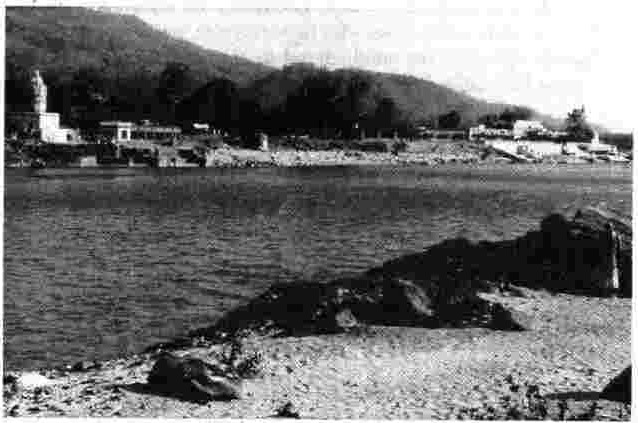
The Ganges at Rishikesh
How he managed to acclimatise and to adjust himself to such conditions of living is an interesting story. Sometimes while proceeding to the kshetra (alms-house) he would be told that some rich merchant was giving cooked food as alms to mendicants. It would be only a couple of roti (unleavened bread) and dhal, yet, to the hungry ascetic, that would be good enough. “The purpose is served,” he would think, and return to his river-side abode to appease the hunger of his soul. The body accustomed to rich delicacies may not all at once be able to adapt itself to insipid, poor and ill-cooked roti and dhal. Recognising the needs of some swamis, the Punjab Sindh Kshetra used to give them some chillies and salt. For a few days Swamiji would visit this counter and receive this ‘extraordinary luxury’, but, soon he found out that it was unnecessary for him. The fire of extreme dispassion that burned in his heart had burned all sense-cravings in him so that he had no difficulty in forgetting and foregoing what could be considered as necessities.
Similar was the case of the sweet rotis that would be occasionally served to swamis near the Chandrabhaga riverside. In the beginning Swamiji would permit himself this delicacy, but soon he found that it was not worth walking four miles for, and that the sweetness of meditation and repetition of the Lord’s name was all that his purified mind hankered after.
Time was so precious for him that a moment spent idly or in useless pursuits was torture. The Kalikamliwala Kshetra, where he took his alms, used to give swamis two tickets per month for getting a free shave, but Swamiji felt that waiting for the barber was a waste of time — and so grew a beard.
Last, but not least, was a special ‘chana-ki-dhal’ (soup with Bengal gram), which the founder of the Nepali Kshetra, the great Nepali Baba, himself served to the swamis. Very often Swamiji would walk all the distance from Kolghat to Nepali Kshetra, a distance of about three miles, for this dhal. He often referred to this during his visits to the Nepali Kshetra later on. Talking to Mahant Chetramji, a noble saint and disciple of the Nepali Baba, Swamiji would say: “I still remember the days when I would come all the way from Kolghat to take the cup of ‘chana-ki-dhal’. Babaji would give it so lovingly to me. He had great affection for me.” It was not the dhal (though Swamiji also used to say it was tasty), but the opportunity of having the darshan of Nepali Baba that was the power that drew Swamiji to the Nepali Kshetra.
From Kolghat Swamiji moved to the Brahmananda Ashram, nearer the present ashram. Two dilapidated rooms on the ground floor of this ashram were vacant, so Swamiji occupied one of them. Brahmananda Ashram was to the north of the alms-houses as Kolghat was to the south, but Brahmananda Ashram offered Swamiji what his heart longed for —an inspiring and constant view of the Ganges and the Himalayas.
The call of the Oversoul was often so insistent during this period of Swamiji’s life that he felt the absolute need of total seclusion. (Of course he was even then ready to attend to urgent calls from the sick.)
This inner demand led him to a solitary kutir on the bank of the Ganges between Lakshmanjhula and Swarg Ashram. It was not even quite a kutir — just a heap of stones, two walls, another heap of stones (which was almost a wall in those days), and without a roof except for the green foliage of an overhanging tree. Insects and reptiles used to reside in this kutir; it was their natural abode. This was also Swamiji’s abode for a considerable time. This satisfied him, for a few minutes walk would take him to the interior of the Himalayan forests for deep and undisturbed meditation. No one disturbed him, because no one dared to venture into that region even during daytime. He would take food only once in a while from the Swarg Ashram. Now that he had his fill of Self-bliss he was not eager to go for his daily alms.
This austere life was not one of dry self-centredness. It did not spring from any scorn of the world and humanity. On the contrary, its aim was to see the world as the body of God, and humanity as the children of the Lord. He was vigilant, therefore, that this tapas (austerity) should not turn into a selfish endeavour. Service was part and parcel of tapas, and of an extraordinary type. It was utterly selfless, intense, dynamic and austere, involving a great deal of personal discomfort and sacrifice.
Swami Kalikanandaji, a renowned mahatma, did not fail to notice that serving the sick was a fundamental trait in Swamiji. He thought that the opportunity was not to be lost, so one day he approached Swamiji with the proposal to run a charitable dispensary. The offer was gladly accepted, and a modest establishment was opened under the apt name, ‘Satya Sevashram Dispensary’ (satya — truth; seva — service). About this Swamiji said: “Service of the sick, the poor and the holy men purifies the heart; this is a field for developing all the divine qualities such as compassion, sympathy, mercy and generosity. That helps to destroy the evil qualities and impurities of the mind such as egoism, selfishness, pride, hatred, anger, lust, jealousy etc. Holy men and the poor villagers who were sick did not have proper medical aid. Therefore I started a small dispensary, ‘Satya Sevashram’, at Lakshmanjhula, on the way to Badri-Kedar (two famous Himalayan shrines and pilgrim centres).” Swamiji served the devotees with great love and devotion. The road to Badri was bad, the journey difficult and attended by several risks. He used to keep in packets the simple common drugs that Badri-pilgrims needed for use during the pilgrimage. He would give the packets to the pilgrim with the request that he might use the drugs when necessary and serve other pilgrims whenever opportunities presented themselves.
He arranged special diet for the serious cases and provided milk and other requirements.
(In 1934 before leaving Swargashram and finally settling down at Muni-ki-Reti across the Ganges, Swamiji handed over the management of the dispensary to a Swami Jnanananda. He too was a doctor by profession prior to his sannyasa.)
One of Swamiji’s contemporaries, Sadhu Prajnatha — a renowned vedantin and a highly detached mahatma — lived in Uttarkashi in the heart of the Himalayas. (Incidentally he is also the author of a book entitled Nada Yoga). He would visit Rishikesh for some months every year, and live in a humble hut in a forest colony of sadhus, locally known as Purana Jhadi. Swamiji had noticed that medical facilities were absolutely lacking in Purana Jhadi, and was therefore quick to entreat and persuade the venerable sadhu to look after the health and well-being of other mahatmas residing there. Swamiji did not rest content until Prajnathaji was busy going from cottage to cottage, enquiring about the health of fellow-monks and bringing medicines to those who were in need. Now and then he would come to Swamiji to inform him about the case-histories of the patients as well as to get the required medicines. Sometimes there would be a few critical cases on which Swamiji would be urged to attend personally.
On one occasion a pilgrim to Badri came to see him one evening. When he was taking leave Swamiji gave him the usual packet with the direction for using the medicines. The pilgrim left for Lakshmanjhula, the next halt. After the visitor had left it occurred to Swamiji that he should have given a certain special medicine that would be particularly helpful to the pilgrim. The thought that he had not done the utmost that he could have done, filled his mind. So very early the next morning, even before dawn, he took the medicine and started at a steady uphill pace to catch up with the traveller. When he reached the next halt he found that the pilgrim was an even earlier riser than he and had already proceeded on his way. Undaunted, Swamiji at once commenced running higher up to Garud Chetty, only to be informed that the object of his quest had moved further on. Undismayed, he pressed on to Phul Chetty, and not finding him even there, ran further, caught up with him after another four miles, and there gave him the precious medicine. By this time it was past nine o’clock and Swamiji had to race back to his kutir to be in time for his daily alms.
When a junior monk, Swami Atmananda, lay dangerously ill at Rishikesh, Swamiji left Swarg Ashram at once and went to Rishikesh, where he stayed for nearly three weeks nursing him successfully through a critical period. The grateful monk wrote: “He whom I have the honour to call Gurudev stayed with me during my severe illness, in some neighbouring dharamsala at Rishikesh, for about twenty days to personally attend on me. He saved me when my life was in danger during that illness.”
The Maharani of Singai, a very pious lady, had great reverence for Swamiji and used to visit Lakshmanjhula often to have his darshan. She owned a fine building just near the Swarg Ashram temple. Whenever she came she used to remain there for at least a month or two. During such days she would send fruits and sweets daily to Swamiji. Swamiji in his turn distributed them to others. He was doing rigorous spiritual sadhana and had no use for luxuries like fruits. By and by he tried to keep himself aloof and wanted to avoid close movements with the royal disciple. Even then the Maharani would not stop sending fruits and milk to him.
One day she arranged for a feast. She personally went and invited all the sadhus, and she very anxiously expected Swamiji to dine with her. But Swamiji realised that he should overcome all temptations. He was very determined and, calling one of his two disciples, he asked him to lock up the kutir doors from outside and go away. The disciple was perplexed. Swamiji sternly commanded him, “Look here. Lock me up here in the kutir for two or three days. Do it!” The young student carried out his guru’s orders.
Though disappointed, she was yet obstinate and she sent the various dishes through a servant, with instructions to wait at the kutir door and give them to Swamiji. The servant found the door locked, and awaiting Swamiji’s arrival (he thought that Swamiji might have gone out) sat outside the kutir. He sat and sat, till his hips ached. He then went to Swamiji’s disciples and enquired. They advised him to return to his mistress.
Swamiji did not stir out of the kutir. No one knew that he was locked up there. He had an earthen vase which he used as a bed-pan. When it became night he gently opened the kutir window and emptied the pan. Without water or food he was meditating during those three days. On the fourth day, as per his instructions, the disciple opened the door. Swamiji took a long breath on being told that she had left the place the previous evening.