Sivananda: Biography of a Modern SageHis life, by Swami Venkatesananda
THE MISSION SPREADS
Western Disciples
From within the four walls of his small kutir on the bank of the Ganges, Swamiji’s influence spread throughout the world. He understood the problems of people living in countries he had never seen and guided them along the spiritual path.
Swamiji recognised that through the English language he could reach the maximum number of people throughout the world. He thought, talked, wrote and sang in English. (Not only Westerners benefited from this, but also modern Indian youth who had lost touch with their culture and religion in their desire to emulate Western civilisation. On reading Swamiji’s books they were reawakened to their spiritual heritage.) The rational questioning minds of both Westerners and western-oriented Indians were won over by Swamiji, who adjusted his approach to the exact level of every person he met — he was a child with children, an adult with adults, an orthodox brahmin with Hindu pundits, a polished Westerner with Westerners.
Lucid, practical, uplifting and powerful, his books had a strong appeal to Westerners. His teachings on the different paths of yoga were enthusiastically received by them, and the way was opened for them to correspond on any problem they had with their spiritual practices and their lives. No letter to Swamiji went unanswered, and all felt an intimate connection with him through his wonderful letters. All who wrote to him were inspired and touched by his wisdom and his eagerness to befriend and guide them. He took as much care of his foreign disciples as he did of his Indian disciples and devotees.

Western disciples. (Taken from Sivananda in Pictures, published 1953.)
The first European contact was from Latvia, where a society dedicated to teaching yoga in its pure form came into contact with Swamiji’s writings in the 1930’s. The society was so thrilled to find a master who put the principles of yoga in simple language understandable to all, that it soon began to function almost as a branch of the Divine Life Society. One of the leaders of this movement was Harry Dikman, who kept up a regular correspondence with Swamiji.
Swamiji’s books were translated into Latvian, and from Latvia they spread to Estonia, where a branch of the Divine Life Society was also formed.
Swamiji’s articles were then translated into Danish by Louis Brinkfort, and they appeared in the periodicals of Copenhagen. Lectures were given by Brinkfort in Denmark, Norway and Sweden, and demonstrations and classes in hatha yoga began.
Dr. Heinz Baumblett of Belgium became inspired by Swamiji’s teachings. He talked to many groups, where he also read out portions of Swamiji’s books, concluding with prayers, kirtan and om chanting, (as suggested by Swamiji).
A Bulgarian clergyman followed Swamiji’s teachings, keeping up a regular correspondence with him, and translating many of his articles for free distribution. With his friend Boris Sacharow he put Swamiji’s precepts of selfless service into action as he helped the poor and the sick.
Swamiji’s influence spread to England, Mexico, Kenya and other places on the African sub-continent. Branches of the Divine Life Society were formed in Mombasa, Nakaru, El Dovet, Teheran, Egypt, Rangoon, Shanghai and Bahrein.
Then came World War II.
Although living far away from the scene of the war, Swamiji wrote to his European disciples as if he was with them every moment. His whole heart was in his words. In a letter addressed to Dr. O.C. Pfaus of Germany he wrote:
The weakness and cruelties which the Europe of today is accused of, have been the lot of all nations at all times throughout history. These are not going to be cured by any number of revolutions or organizations of the few. No charter, no declaration, no constitution can bring about overnight a perfect world of harmony, peace and plenty. World salvation depends upon individual salvation; world perfection is achieved through individual perfection.
A generation of Christs, Buddhas and Vivekanandas alone can materialise the dream world of perfection. And this kind of a perfect world by supermen is possible; and the agonising cruelties of the present-day are the great darkness before the dawn. It is a necessary schooling through which generations must pass in order to realise the futility of their endeavours, the hollowness of their achievements, the finiteness of their gains and the sorrowness of their joys.
The all-merciful Lord is manifesting only His extreme kindness in whipping us through such gruesome periods of history. If we are made to weep, it is because our animalism can melt away the easier and the earlier only through such a painful operation.
Never despair. Despair, when it sneaks into a heart, is a warning that the light of faith has blown out. In faith, patience and religious industry, and through steady practice, eliminate all weaknesses and passions from your heart.
Most disciples in Europe and other areas were unable to send letters to Swamiji during those troubled years, but as soon as war ended communications reopened, and with joy they wrote to Swamiji and expressed their delight in being able to contact him again.
Before the war many Europeans visited Sivananda Ashram in Rishikesh, and after the war many Americans came. Many others wrote, inviting Swamiji to tour America as part of his proposed World Tour. However, the tour was cancelled due to Swamiji’s poor health, and at this time he wrote: “People from all parts of the globe are coming here and receiving spiritual guidance. Through correspondence also I give guidance... It is enough if the divine message reaches all parts of the world. There is no need for my stirring from this place. My England is here; my Germany is here.”
At another time he explained: “It is a disadvantage to be always touring. You can awaken a few people by lecturing. You can thrill an audience. But unless you can immediately give them permanent inspiration in the form of books, they will soon forget all about the lecture in the din and bustle of their daily worldly life. If I had been always touring I would not have been able to write these books. It is in the interest of the service of the Lord’s children that I have secluded myself here. To produce spiritual literature such seclusion is absolutely necessary.”
Various devotees from other parts of the world requested Swamiji to send his disciples out of the ashram to help them in promoting Swamiji’s teachings and set up spiritual centres.
First was Swami Satchidananda, who was invited to Ceylon (now known as Sri Lanka). After being there for 13 years he was invited to the United States of America and other parts of the world also. Through these centres he promoted Swami Sivananda’s books and teachings.
The next to follow was Swami Vishnudevananda, who visited Hongkong, Australia, U.S.A. and Canada, where he finally settled. The Sivananda Yoga Vedanta Centres which he established in Canada and many other countries promote Swamiji’s teachings.
In 1959 Swami Chidananda was invited to visit America, Europe etc. and from then he has regularly visited many countries throughout the western world as well as Malaysia, Singapore, Hongkong, Japan, etc. (After the mahasamadhi of Swami Sivananda, Swami Chidananda was elected President of the Divine Life Society, and since then has continued his great work of visiting Divine Life Society branches and other centres throughout the world. Swami Krishnananda (as General Secretary) and Swami Madhavananda (as Vice President) have stayed at the ashram in Rishikesh and are continuing Swamiji’s glorious mission.
Swami Venkatesananda was invited to Australia and Ceylon in 1961, and from there Swami Sivananda sent him to South Africa at the urgent request of the Divine Life Society Branch in Durban. After 3 years in South Africa he began his world-wide tours, propagating Swamiji’s teachings and establishing centres in several places, until his mahasamadhi in 1982.
Thus Swami Sivananda’s teachings spread world-wide.
Westerners also were initiated into sannyas, went back to their own country and established ashrams and centres there. Notable among these is Swami Sivananda-Radha, of Canada.
Some foreign visitors to the ashram went armed with cine and TV cameras, and scenes of Swami Sivananda and ashram life were seen in Canada, France, Belgium and Switzerland by audiences which ran into millions. Many foreign journalists also visited Swamiji, and he was quoted as one of the greatest spiritual leaders of modern India. This again influenced many foreign seekers (as well as tourists) to visit Rishikesh, and so his teachings spread more and more. Most of these visitors were deeply impressed by their first meeting with Swamiji, and many tourists were transformed into disciples at their first meeting. One lady from Israel, Assia Malkiely, wrote of the impact that her first meeting with Swamiji had on her:
Sitting there opposite him, looking at him while he was doing a dozen and more types of work at a time, I felt my spiritual thirst being quenched, as a thirsty wanderer in the desert would feel when he finds, in the midst of the wilderness, a spring of refreshing water. All my doubts were cleared and resolved by themselves, with no need to use words, as I realized that everything was latent in us — all answers to our doubts — and we had only to learn how to unfold them.
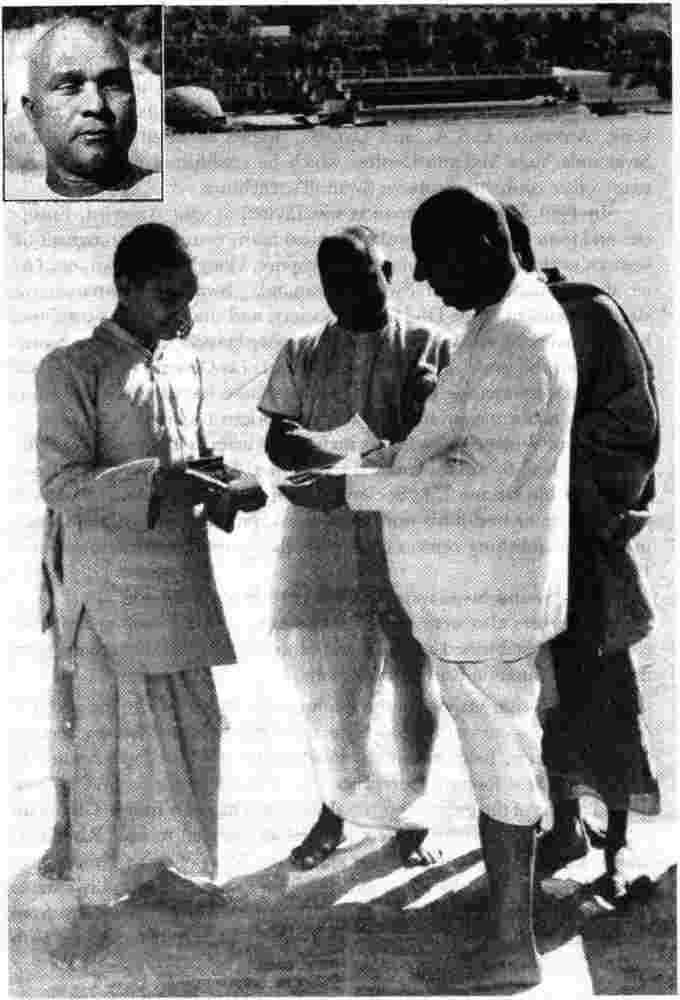
Swamiji with Swamis Paramananda (see insert also) and Venkatesananda
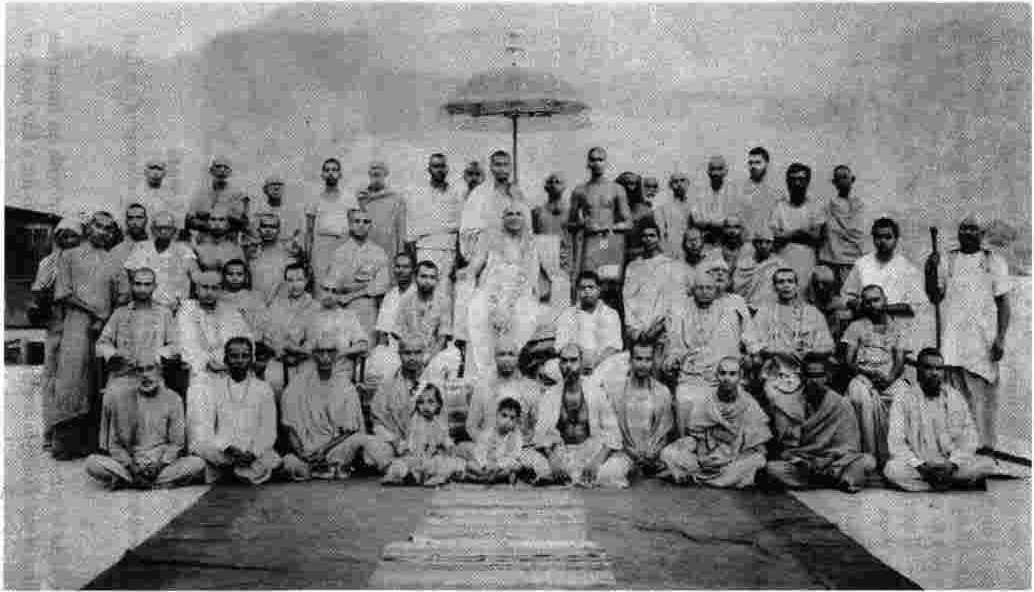
A unique photo of Swamiji with some of his close disciples. Holding the umbrella is Swami Venkatesananda. Seated on chairs are Swamis Madhavananda (2nd from left), Krishnananda (3rd from left), Chidananda (2nd from right), Vishnudevananda (far right), while standing next to Swami Vishnudevananda is Swami Paramananda. Swami Nadabrahmananda is seated in front of Swami Sivananda.
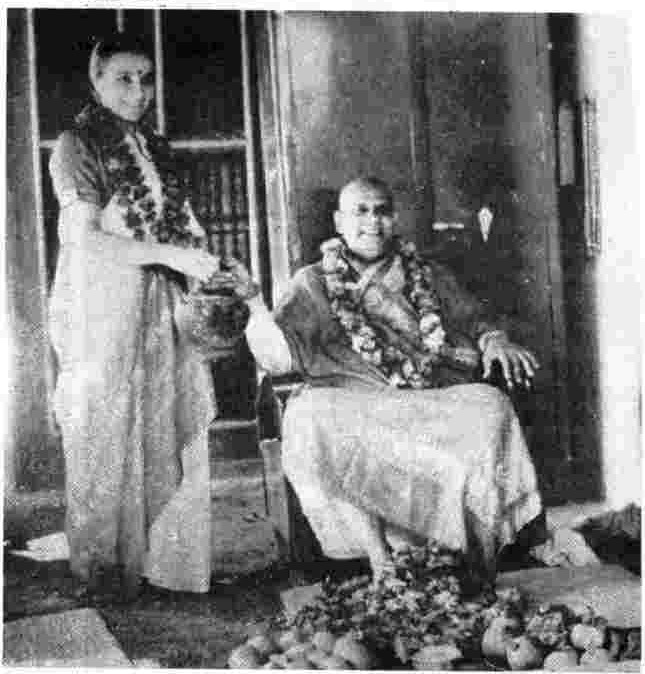
Swamiji with Swami Sivananda-Radha of Canada
Another seeker from Holland, Albert Bonwincester, wrote of his first meeting:
The sight of him filled me at the same moment with an immense feeling of joy. His eyes rested on me, he spoke to me a few words of friendship and welcome. They were not words of long-awaited big truths, but nothing could have made me happier. They were a few simple words, full of divine love and compassion. It was a radiating atmosphere, so full of peace, that I hurried to my quarters to find in myself a joy I had never known, a light I had never seen. What no books could convince me of, the mere presence of Swami Sivananda did.
Dr. Maryse Choisy, editor of Psyche, went to the ashram expecting to meet an Indian who had no understanding of Western science and culture. She wrote:
I sensed at once in him the presence of that real wisdom for which we all crave, whatever our material birthplace may be... Swami Sivananda knows all the things you can learn in a Western university and many more which you cannot. The most stubborn materialist must feel that aura, that magnetism, that serenity, that holiness which float about Swami Sivanandaji. What struck me as most admirable and new about him is the way he puts the divine in every moment of life... Whether it be psychology, medicine, philosophy or religion, Swami Sivananda has something to teach us.
Most of the Westerners who came to Swami Sivananda came from Christian backgrounds. Many had given up their faith and were seeking alternate spiritual values. On coming into contact with Swamiji, however, many found that their understanding of Christianity was deepened and enriched, and they became inspired by the teachings of Jesus Christ on a completely new level. Dr. R.T. Werther of Perth, a Jew who had been involved with Christianity, visited Rishikesh at Christmas time. About this he wrote:
There and only there I found the peace which comes when all your innner conflicts are resolved. I saw that this so-called ‘man of another nationality and religion’ was exactly in conformity with the teachings of our master, Jesus Christ. Yes, I found there real Christianity, which I missed to find in our Western world.
Erich Pierschel wrote in his book Indien, Geheimnis und Mysterium:
Christ is as much honoured here (Sivananda Ashram) as is Krishna... At Christmas, we, the Europeans, were requested —on behalf of Sivananda — to stage the event of Christ’s birth. Just imagine. In the country of Mother Durga and the gods Vishnu and Brahma, we are asked to glorify Christianity. This is a tolerance which seems unbelievable.
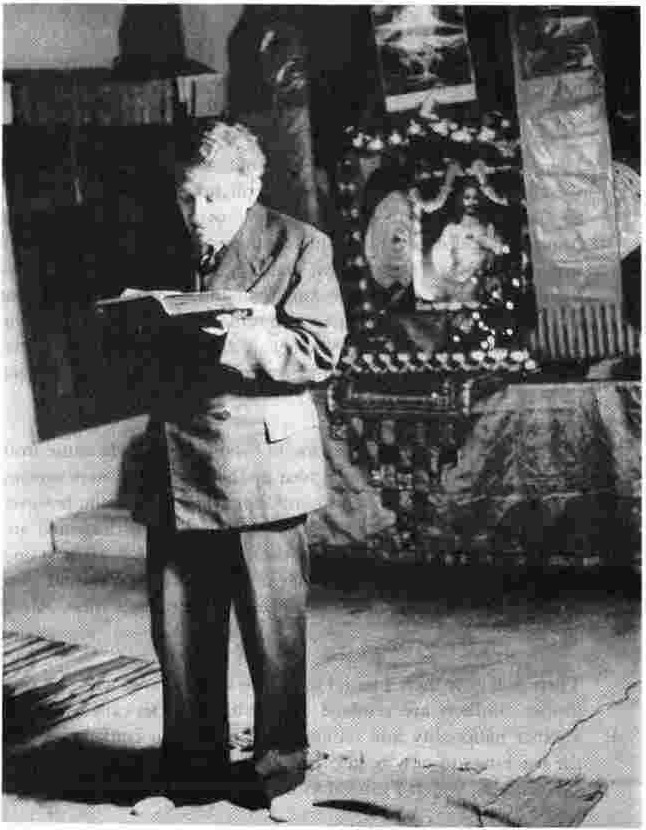
Dr R.T. Werther reads from the Bible at the Christmas satsang.
A Christian professor wrote that he saw in Swamiji’s books the interpretations of many an obscure passage in the Old and New testaments.
Branches
Swamiji infused spirit into his disciples so that they actually felt his invisible presence in their midst, making them competent to organise Divine Life Centres abroad. In just over a year several branches of the Divine Life Society had been started all over the world. This was brought about by two highly interesting methods. Firstly, an address coming into his hands meant that a packet of pamphlets and leaflets went to that person. Secondly, the articles he regularly contributed to several journals all over India, and outside, too, inspired everyone who came into contact with them — from the sannyasin-disciple who copied them, to the printer and proof-reader, the editor of the journals and the thousands of readers. After reading the articles they started to practise sadhana; when they found that they derived benefit, they wanted to contact the author. They wrote, and their names were caught in Swamiji’s Address Register.
During the course of a conversation, Swamiji remarked:
This is my address book in which I note down the address of all those who come into the Divine Life fold — editors of journals, professors, headmasters, European and American sadhaks, etc. Whenever a new book is published, it is this register that helps me to send it to various persons who will be benefited by it. These twenty-five years I have gone on maintaining this register. Writing addresses of all sadhakas is to me a greater form of sadhana than formal meditation. This is a form of meditation in which not only we, but others also, are benefited. There are seekers all over the world who correspond with me regularly. To them a book or a pamphlet or a leaflet sent occasionally will act as a tonic... It is this register that gives such spiritual food to thousands.
If their initial enthusiasm cooled down, Swamiji would not leave them. They got his leaflets, pamphlets and magazines. This worked wonders and brought about a simultaneous spiritual awakening throughout the world, without Swamiji having to go anywhere. Many of his first disciples were inspired to join the mission after they had received these. Individuals were encouraged by Swamiji to do their bit in this spiritual awakening among their circle of friends and relatives, and that became a Divine Life Branch. Many of these branches grew into dynamic institutions in course of time, under the divine leadership of Swamiji himself. They conducted sadhana-classes and conferences, celebrated all auspicious occasions and printed and distributed leaflets and pamphlets containing Swamiji’s teachings.
(One such early Branch of the Society — the Quilla Gujjar Singh Branch at Lahore — published The Divine Life magazine during its first year, before the Sivananda Publication League at Rishikesh took over all publication work.)
On the 29th September, 1949, on the receipt of the news of the inauguration of a branch of the Divine Life Society at Singapore, Swamiji gave the following directions:
There should be at least three people, able and energetic, to attend to the work of stirring up branches into intense activity. Regular despatches should go to the branches every month. Letters from branches should be answered promptly. Messages should be sent for the opening ceremony, anniversary, etc. Someone should keep track of the progress and inspire the branch office-bearers every now and then to greater peaks of activity.
The institution has grown more rapidly than anyone could have anticipated. However many efficient workers come, we still find that we are short of workers, and that everyone who works here is overworked.
The most important thing is to keep constant track of the work that is going on and the persons that we come into contact with. My address-book helps me in that. I have put the address-book under lock and key nowadays. It is the most precious thing for me. It is the channel through which I can serve the world. I have asked Puroshottamanandaji to take particular care of the two trunks of manuscripts in my kutir. Even if there is a flood and all other things in my kutir are destroyed, I will not allow these two trunks to be destroyed. Put me in a forest a hundred miles away from here; but give me my address-book and those two trunks, I shall begin all over again and build up the institution from there!
In the address-book I have addresses of every sort of person —ministers, maharajahs, maths and ashrams, professors, philosophers and scientists. As soon as I get an address my work begins. I may get the address in any manner: through letters I receive from so many people, from the corners of journals that I get, from books that we get for review or as gifts for the library. I am always watchful for addresses, and the moment I get an address I at once enter it in the register. Then the man is registered. At once I write a letter, send a packet of leaflets, some books also, have the address entered in the Magazine Register, send the The Divine Life, and enter the name in the Prasad List, etc. Previously, the moment I got an address I would start a regular campaign with letters. On one day the man will receive three letters! And for the first two weeks there will be a regular flow of Divine Life into his house. One day he will receive the magazine, the next day a letter, the third day a packet of leaflets, another day prasad, and then books, and so on.
That is how today I have established contact with many people all over the world. We should not have the motive of acquiring their sympathy for the institution, but should genuinely desire to serve them, and naturally they will serve the cause also. Thus, the institution will grow.
Divine Life Spirit
“Neither at the Headquarters nor at the branch centres should there be any clamour for position and power.” Swamiji made no mistake about this vital aspect in the conduct of the institution. In fact, the original rules for branches suggested that though selfless workers should eagerly come forward to shoulder the responsibility and the running of the branch, they should all adopt the uniform pseudonyms of Guru-das and Hari-das (servant of the guru and servant of the Lord). At the headquarters, too, the spirit of selflessness was insisted upon by Swamiji. The moment he discovered that a particular worker’s head was swelling, he would silently train another and transfer the work to him; the first man would thus learn the lesson that for Swamiji’s mission no one was indispensable, though everyone was welcome to contribute his share. This method did spiritual good to the aspirant concerned by guarding him against the greatest enemy of divine life — egoism (which first manifests as pride and then develops its manifold branches of selfishness, greed, lust for power and position, etc).
Swamiji set an example in the true spirit of service. During the years 1946 and 1947 visitors watched with the greatest amazement this sage serving food to guests and inmates in the dining hall. He would bend low before each one and say “Roti, Bhagavan,” and “Dhal Bhagavan,” and so on. If it was summer, he would take a big fan in his hands and fan the diners.
Once the Divine Life Society had to send a money order to a school student, towards his scholarship. The secretary was expected to sign and send it. When the money order form was presented to Swamiji for his perusal, he quietly signed as the secretary of the Society. “I have signed it myself: let the money order go today itself,” he said. He did not mind if you called him President or Secretary or even by a lesser designation; the service had to be rendered efficiently and smoothly, without any delay or red-tape. It is not by assuming titles and power that work need be extracted, but by love and personal example, and by instilling in the workers a high idealism.
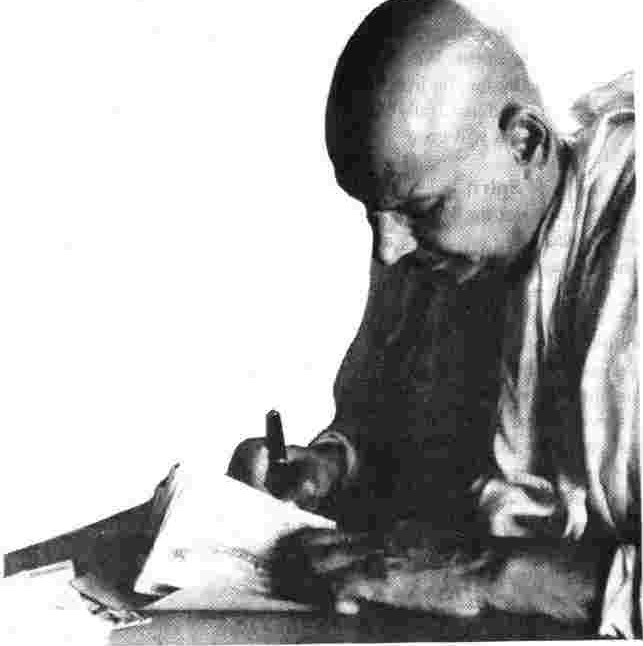
Swamiji once said:
“Do not overwork. Make other people work. You should know how to extract work from others through kindness, love and sympathy. It is not easy. It demands reduction of egoism. You should put yourself on a lower level and praise them, sing their songs and hymns, respect them. You should adapt, adjust and accommodate. You must become one with them.”
If a secretary or someone in authority in the ashram was a little lax in inner discipline, Swamiji’s behaviour towards him would be enough to turn his head and make him feel that, but for him, the mission would collapse. Swamiji would take the little man’s advice and faithfully abide by it.
Though the Divine Life Society itself is so broad and all inclusive, and though its aims and objects cover all aspects of the life of man, yet Swamiji founded a number of other institutions with specific purposes. In retrospect one cannot but be struck with wonder at the sagacity and far-sightedness with which he had established them all. It is clear that he was able to foresee the need long before it arose. He ‘saw’ crises long before they beset the path of man, and not only the problems but their solutions, too. He proclaimed them and forewarned humanity.
All-World Religions’ Federation
The All-World Religions’ Federation was established on the 28th December, 1945. Little did anyone imagine that even in these enlightened times there would arise riots in the name of religion. To the inner eye of the sage the future was as distinct as the present and he was able to envisage the calamity that was to overtake India soon after.
During the inaugural session of the Federation, Swamiji gave a clear-cut idea of the eternal foundation on which he had built this noble edifice of the Federation:
In the basic essentials of their belief all religions are in perfect accord and agreement. The little differences that are seen are merely with regard to superficial non-essentials. Therefore pay no undue heed to these, but grasp the fundamentals; then there will be no room for conflicts, misunderstanding and quarrels. Harmony and brotherhood will prevail. Humanity will become, feel and live as one. You cannot try to establish this sweet concord and unity through social association, esoteric brotherhood, political party or enthusiastic secular programmes and slogans, for all these touch but the outer fringe of the human being. Contact the fundamental part of him, his essential spiritual nature.
All-World Sadhus Federation
Equally significant was the establishment of the All-World Sadhus’ Federation. When Swamiji had pointed out this untapped, limitless source of power which could be fruitfully harnessed for the good of humanity, the national leaders of India and the other nations, too, were awakened to it. The main difference between his approach to the question and the politicians’ approach to it was, of course, that in all that he did Swamiji always aimed at the good of all concerned. However noble the argument, he did not favour any one group of people exploiting another. He had found that the men of renunciation could best be made to take active part in nation-building activities, with advantage not only to the nation, but to themselves. Though he had always exalted service of the sick and the poor as service dearest to the Lord, he emphasised that ultimately the sadhu’s field is spiritual awakening and leading the masses on the path of divine life. The sadhu is welcome to take part in social service in order to set an example to others; but he should not neglect his primary duty — which is the spiritual awakening of man. Even the social service is to be rendered only in this spirit. That was the aim with which the Sadhus’ Federation was established. The details of this inaugural meeting are given in the following report which appeared in the April, 1947, issue of The Divine Life:
The All-World Sadhus’ Federation has been founded by Sri Swami Sivanandaji on Wednesday, 19th February, 1947, the most auspicious day of Maha Sivaratri. The inaugural gathering was informal because the idea of establishing the organisation occurred to Sri Swami Sivanandaji Maharaj a few days before Sivaratri and, as is usual with him, he did not want to postpone even a moment longer than he could help, and there was, therefore, no time to announce it or invite a big gathering of delegates, etc. Thus Sri Swamiji and a few others met in the premises of the Yoga Sadhana Kutir at Sivananda Ashram, at 4.30 p.m. on 19th February, 1947. After pranava (OM) chanting, the usual kirtans were repeated.
A brief talk was given by Sri Swami Sivanandaji wherein he stressed the necessity of such a union amongst all the different religious orders all over the globe. He pointed out how the revival of true religion, spiritual education, real uplifting work and spreading of unity and harmony between man and man can be done more effectively by such whole-timed men who have dedicated their lives to this pursuit of world service, and continued, “The average man whose time is taken up entirely by bread-winning labours hardly finds breathing time for his own spiritual practices. The masses, therefore, look to the renunciates, sannyasins and the holy men of the world to guide and help them in all matters, and to show them the way out of this maze of earthly existence.
“Till now, however, this class has been regarded as an isolated group, as it were, outside the pale of secular society. This has been the result of their segregating themselves for the purpose of spiritual sadhana and of self-development. Such segregation has tended to make them lose touch with the rest of the world. The time has now come when they should revive contact with the toiling masses in the towns and cities for effectively knowing and understanding the problems and difficulties of the householder and the common folk in the street, in order to effectively do the work of spiritual ministry and thus justify their position as the guides and spiritual advisors of humanity. It is only a co-ordination and unification of all the units of the sadhu fraternity in the different countries of the world that will make them a powerful factor to play this role.”
The Federation was then declared formally established, with its headquarters at Rishikesh. Its aims and objects are to bring about unification of all holy men, monks, sannyasins, fakirs and bhikshus all over the world, and the world-wide revival of spirituality through their selfless efforts. It will do all that is necessary to work out the above objects and also prepare such workers for the task ahead. The session concluded with peace prayer.
Almost a decade later this idea was taken up and the Bharat Sadhu Samaj was formed. Similarly, in the West too, several evangelists have conducted ‘Crusades’ for winning souls for God, and in retrospect one cannot but be wonderstruck at the insight and foresight of Swami Sivananda.
On the 9th April, 1956, when he inaugurated the first session of the Bharat Sadhu Samaj convention, Swamiji said:
Bharat Sadhu Samaj will work for the spiritual uplift of Bharat (India) and the whole world. Sadhus and sannyasins are potent powers, eternal storehouses of energy — that they have become through renunciation, through dispassion and meditation. When they utilise their energy they can easily effect the moral and spiritual regeneration of not only India, but the whole world at large. Their instructions will penetrate the hearts of the people. India is already a spiritual country, and this will have its impact on the West, and they, too, will be uplifted. There must also be some sannyasins who can devote themselves to whole-time meditation.
Dynamic Spiritual Awakening
The ashram, the inmates, the Divine Life Society and the other institutions were only the instruments. The mission was the spiritual awakening of mankind at large. It was not enough if the handful of aspirants that had gathered around him at the ashram elevated themselves spiritually. Swamiji never let them forget for one moment that their own salvation lay in the spiritual awakening of humanity.
In serving the mission itself, the salvation of those who were chosen and blessed to do so was ensured. They were doing the Lord’s own work for His sake: and Swamiji was never tired of reminding them of this great fact. Thus he brought about the good of all at the same time. It is difficult to imagine what a tremendous task it was. Even the scientist first perfects his instruments before using them, but here was a super-scientist who would dare to manufacture extremely delicate commodities with machinery and instruments that were themselves in the ‘experimental stage’. The strain this method imposed upon him would have broken the spirit of any other person or even yogi on earth.
The ‘Correspondence Section’ was one of the unique features of Swamiji’s mission. No other saint or yogi has had such heavy mail. He did not wait to be asked, but invited correspondence — whereas many in his position would have thought it a botheration when aspirants could very well clear their doubts by reading his books. Moreover, Swamiji’s books never raise any doubts or conflicts in the mind of the reader, but the path is well and clearly laid. There exist thousands all over the world who consider themselves Swamiji’s disciples, who follow his teachings contained in his books and who have made tremendous spiritual progress, and yet have never written to him.
Another unique feature was his insistence that aspirants should make resolves and keep a *Spiritual Diary. He said:
* See Appendix.
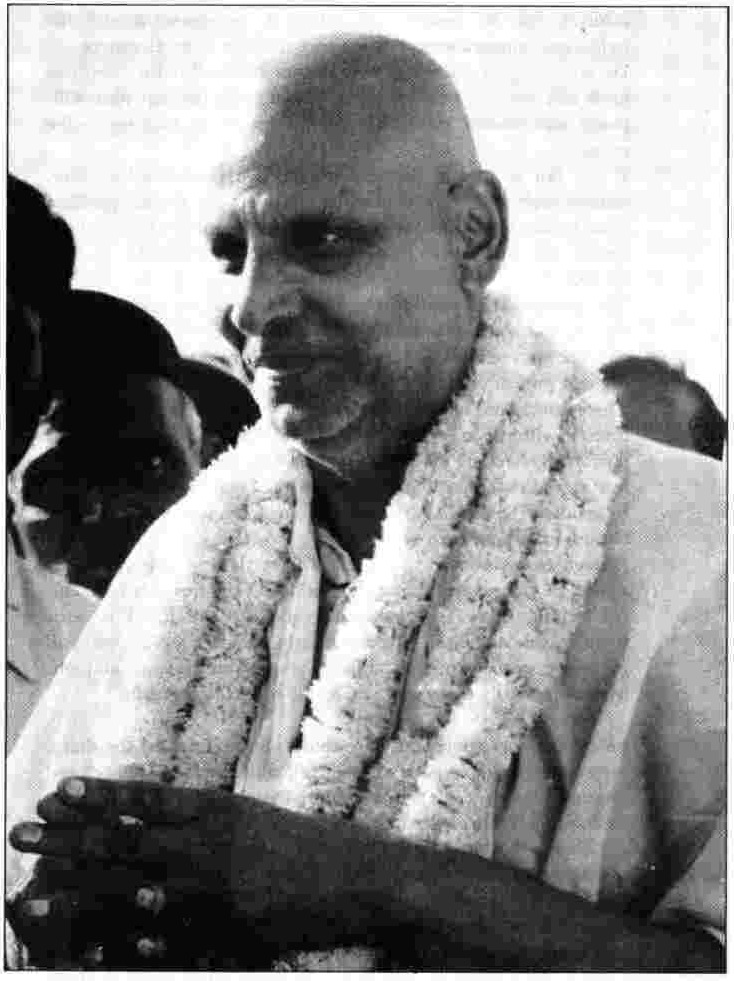
Tranquil, peaceful, happy
Make a few resolves for practice during the New Year. Any of the resolves may be crossed out, added to or altered to suit the individual temperament, convenience or stage of development.
Do not abruptly change your nature or mode of living. You can grow and evolve quickly in the spiritual path, develop your will-power and control the mind and the senses by sticking to the resolves.
If you fail in any of the resolves through lack of self-control, unknowingly or by force of circumstances, you should perform some malas of japa or give up one meal to remind yourself of the resolve and to impress upon the mind the importance of these resolves.
The resolves form should be prepared in duplicate and one copy duly signed and sent to your guru so that you may not be tempted to relax your efforts or ignore or break any resolves under the slightest pretext or lame excuse.
There is no sword sharper than this diary to kill the big thief hiding himself within you — your mind. The diary is superior to your parents. By keeping the diary you can then and there correct your mistakes, do more sadhana (yoga-practice) and evolve rapidly.
In maintaining the diary do not utter any falsehood: you are maintaining it for your own good.
Enough of the troubles you had all these days in satisfying your senses. Be sincere and start doing sadhana from this very moment. A spiritual diary is a whip for goading the mind towards righteousness and God. If you regularly maintain a diary you will get solace, peace of mind and quick progress in the spiritual path. Maintain a daily diary and realise the marvellous results.
The regular correspondents were those who maintained the diary, sent a copy every month, expressed their difficulties and experiences and sought Swamiji’s guidance. Then there were those who followed the path shown by Swamiji in his books and who sought his blessings to overcome obstacles. Then again there were those who supported the mission with their love offerings: often they would get an unsolicited letter from Swamiji. This was an interesting feature in Swamiji’s method of work. He called this ‘creative correspondence’. Even a casual visitor to the ashram, when he returned home, would find a letter from Swamiji awaiting him. This started a series of letters. People received free books and pamphlets from Swamiji. They acknowledged ‘with thanks’. One would consider the transaction as complete: but to Swamiji it had only commenced! The last letter would always be from him. When people knew that he was a saint whom they could easily approach and who took delight in helping them out of their difficulties, they told their friends, and thus the Correspondence Section grew.
Sadhana Weeks
Another method adopted by Swamiji was the holding of ‘Sadhana Weeks’. During the Easter and Christmas holidays he gathered at the ashram earnest seekers after God, who came from all parts of the country to undergo intensive training in the various spiritual practices. An elaborate programme of sadhana — including all items like japa, meditation, likhit japa (mantra writing), yoga asanas, observance of mauna, selfless service, etc. — was drawn up. Lectures by Swamiji himself and other mahatmas and senior aspirants were arranged to give those who attended the Sadhana Week a good theoretical background to sustain the spirit created by the week-long training. They returned from Rishikesh infinitely richer for coming.
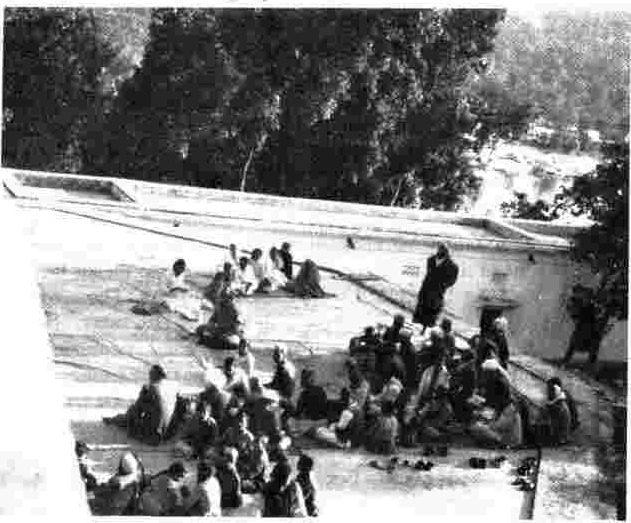
With the Sadhana Week participants
The following ‘Instructions to Members of the Divine Life Sadhana Week’ were published in The Divine Life for the guidance of those who would attend the First Sadhana Week at the ashram, held during the Christmas week in 1939. It gives an idea of Swamiji’s own pattern of the ideal life, and also the ways in which he expected seekers to train themselves:
1. Diet is entirely left to the convenience, habit, nature and constitution of members. There is no hard and fast rule.
2. The following is the prescribed diet for the Sadhana Week:
On the 26th — Bread, rice, dhal, vegetable without salt and milk without sugar.
On the 27th — Milk alone. No rice, dhal or fruits.
On the 28th — Rice, bread, dhal, vegetable, milk without sugar.
On the 31st — Sweets will be given with food.
On all other days ordinary meals with rice, bread, dhal and vegetable, without any restriction.
3. Morning 9 a.m. and night 9 p.m. milk will be given. On the 27th, instead of meals at 12 noon, milk will be given.
4. Food prescribed as above will be supplied by the Ananda Kutir kitchen. The members can make their own arrangements if they so desire and if the prescribed diet does not suit them.
5. Fasting is not strictly enforced, but it is left to the choice of the members.
6. Whatever method the members follow, the Secretary should be informed on the 24th and the particulars should be given in the Spiritual Diary.
7. There will be no necessity for the members to speak. At the prescribed time food and milk can be had from the kitchen.
8. Tea must be avoided completely on all days. Those who are habituated can take tea on the 25th and 31st December.
9. Members should try to sit in padma or siddha asana. In the morning hours during prayers, Pratasmarana stotras of Sri Sankaracharya, Siva stotra and Guru stotra will be repeated in chorus. Members are requested to follow the prayers in harmony, in a melodious voice.
10. In morning japa, prayers, meditation, likhit japa (mantra writing) and svadhyaya (study), the members can sit in one asana. When they change the posture in the middle they should not unnecessarily twist the body, hands and legs, and thereby distract others. Frequent changes of asana should not be made.
11. In all common functions members are requested not to look hither and thither. Posture must be steady and mind concentrated. Others should not be disturbed by unnecessary sound, hard breathing, shaking the hands and legs, sneezing, hiccough and other sounds. All members should try their level best to maintain a calm and quiet atmosphere throughout the morning hours and during manasik (mental) japa, concentration, tratak and meditation.
12. Mental japa is done without moving the lips, without a mala. This is compulsory in all common functions. When japa is done individually in separate places, mental, whispered or loud recitation can be done, with or without a mala.
13. During morning hours if anyone feels sleepy or drowsy he can continue the mental japa or prayers by standing for 10 minutes. While standing or sitting no sound should be produced that will draw the attention of others.
14. For japa the mantra of ishta devata or guru mantra should be recited. For likhit japa, mental japa etc., one mantra should be maintained. Mantra should not be changed.
15. Likhit japa should be written clearly in ink in a separate notebook. Mantras can be written in Sanskrit, English or mother tongue.
16. Lord Krishna’s picture will be kept in the centre of the meditation hall. A ghee lamp also will be burning throughout the morning period. Bhaktas can do tratak on the picture. Others can do tratak on the ghee lamp or OM.
17. Akhanda kirtan is done by repeating the maha mantra. This must be chanted in a uniform manner. Frequent changes of tune must not be made. There should be no break in the middle. Every member will lead for half an hour and all others will follow in chorus.
18. The members will join together on the 31st December and arrange for the cooking of food and service of all the sadhus, mahatmas and the poor. At the end they will take prasad. The members themselves will contribute their mite to the kitchen for this item. According to finance, the required number of sadhus and mahatmas will be invited.
19. All members should write an essay on the practical side of sadhana on the 28th, and try to speak at the evening satsang on the 29th. A copy of the essay can be handed over to the Secretary, Divine Life Society, for publication. The name and address of the members should be clearly written on the first page.
20. Spiritual Diary forms will be supplied to members. This is for guidance only. Detailed particulars should be given in a separate notebook as regards japa, daily routine, concentration and meditation, one page for each item with daily entries. At the end of the notebook they should write the obstacles and difficulties they find in sadhana, and their experiences. After a perusal of the Diary, further instructions will be given by Sri Swami Sivanandaji by post. The Spiritual Diary and mantra notebooks should be handed over to Sri Swami Sivanandaji before the 1st January.
Members will be able to carry on the daily sadhana, without any distraction or inconvenience, with the following things: — (1) A vessel for drinking water, (2) hurricane lantern and torch, (3) watch, (4) a seat of deer-skin or kusa grass, (5) a copy of the Bhagavad Gita, (6) rudraksha mala or tulasi mala, and (7) ordinary bedding with one blanket.
Further instructions given in the March 1947 issue of The Divine Life are highly inspiring:
When you come to attend the Sadhana Week, come with the proper spiritual attitude. Do not come to attend the Sadhana Week as though for a week-end holiday to spend your vacation. Unlike picnics or pleasure trips, this is a different and more serious occasion. You need not be over-serious or gloomy; but the holiday mood is out of place at this time. It will spoil the solemn atmosphere and also prevent your reaping the maximum spiritual benefit out of it.
You dress yourself in your uniform while on official duty. You put on special clothing on special occasions or during ceremonial events. For Sadhana Week do not come dressed as though for a marriage party or an official gathering. Have a simple dress that will be conducive to keep yourself in a religious frame of mind.
At least for that one week, all such things like special attention to toilet, elaborate combing and brushing of hair, trimming moustache, applying hair oil, etc., should be given up by men, and ladies should stop scent, face-powdering, nail-polishing, etc. You should have the sole consciousness that you are a sadhaka and have
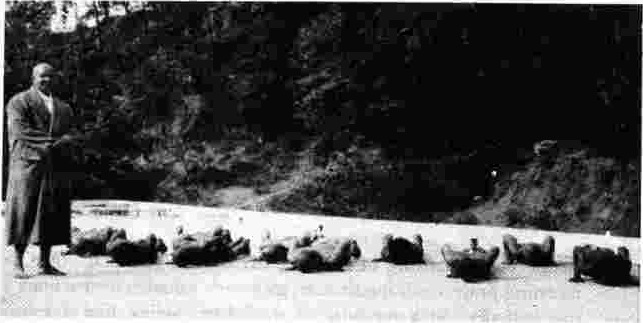
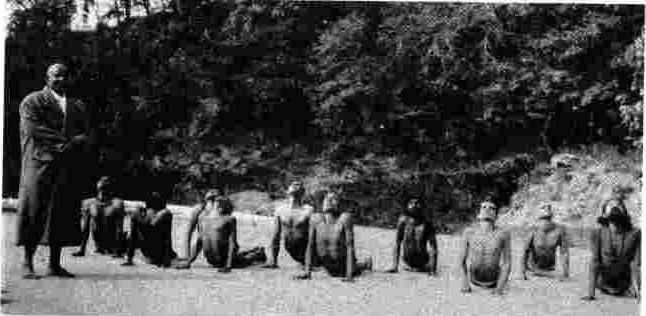
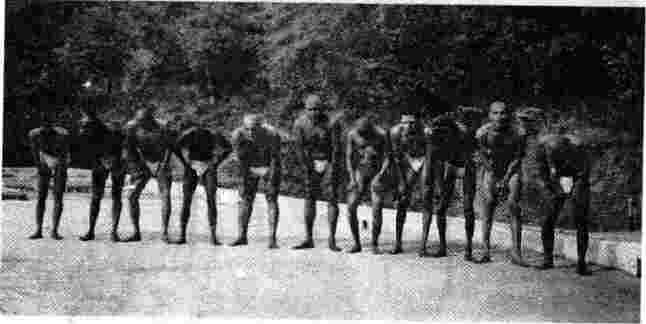
Senior swamis of the ashram demonstrate asanas
come specially to do some solid sadhana.
The instructions also warned that those who (1) take a resolve that they would not smoke, chew tobacco, etc., during the Week, and who break their own resolves, and (2) who are not punctual in attending the classes, would have to pay a fine of one rupee more. Aspirants who knew the soft heart of Swamiji thought that they could ignore this and that Swamiji would ignore it. They were mistaken. The Sadhana Week Report mentions:
In the early morning of the 31st, Sri Swami Maharaj, after the morning prayers and meditation, gave very valuable instructions to the sadhaks. As a measure of discipline, acting like a school teacher, he collected fines from those sadhaks who were slack in attending classes and who were not observing the rules laid down for them. The fines so collected were distributed to the poor that afternoon. Those who did not possess money were asked to hold the right ear with the left hand and the left ear with the right hand, and made to bend several times, elbows touching the ground. This was a new experience to many sadhaks who thought that as usual Sri Swamiji Maharaj would allow their mistakes to pass unnoticed.
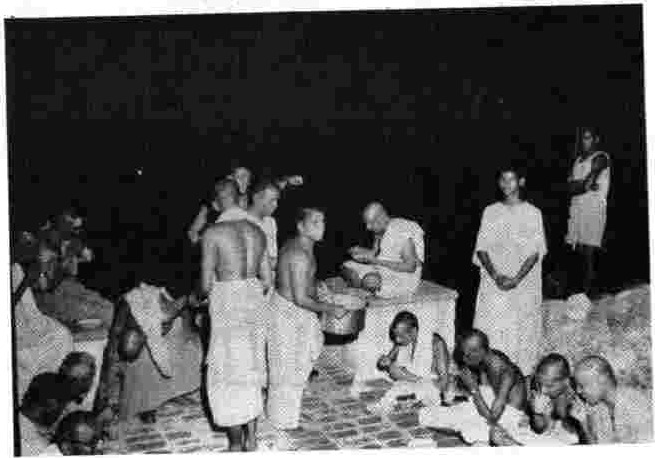
Evening meal by the Ganges at the Summer Training Course
The Sadhana Weeks were always spiritual training camps. There were theoretical lectures, no doubt; but they were only regarded as aids to spiritual practice. Practice was all-important. In the brahmamuhurta there was group meditation. No one was exempt.
During the Sadhana Weeks Swamiji would insist on some of the inmates of the ashram going round and waking up the visitors and taking them to the Bhajan Hall for the meditation class. If a visitor was absent Swamiji questioned the inmates of the ashram and not the visitor himself: the inmate had neglected his duty. Swamiji even gave us elaborate instructions on the ‘art’ of waking up a sleeping person: “Do not shout. It will give an undesirable shock to the nervous system. At first, utter a mild OM. Wait. If he does not wake up, raise the tone a bit. Do not be impatient. When he responds, wait for a few more moments. See that he actually gets up. Sometimes, after answering your summons, he might once again go to sleep. Do not think this a waste of your time: it is wonderful service of the Lord, greater than meditation. You are helping the spiritual evolution of a kindred soul.”
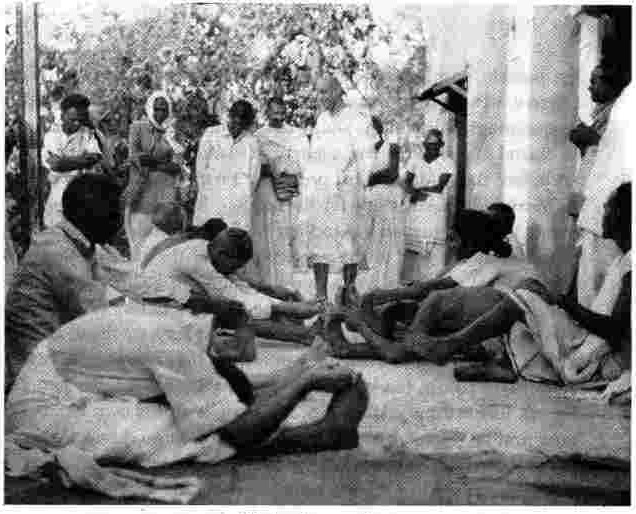
Visitors’ asana class
Meditation would be followed by the yoga asana class.
In all these it was Swamiji’s own presence and active participation that provided the greatest inspiration. He always mingled with the sadhaks as one of them. There would then be study of scriptures; the Gita, Upanishads, Ramayana, Bhagavatam, etc., would be devoutly studied. Japa, likhit japa, etc., were systematically taught: there would be a brief introduction, followed by the actual sadhana, in practice. The competitive spirit was encouraged and utilised by Swamiji to provide the incentive for greater spiritual effort. There would be a yoga asana competition and a mantra writing competition. During the Gita Jayanti celebrations there was also the Gita recitation competition. On occasions an essay writing competition was also introduced. Prizes were awarded: one or two sadhaks were awarded the first prize and the second prize, but Swamiji could not really make such distinctions and, therefore, he would call out the names of all the other competitors too and award them all first prizes. Children got some articles of use: e.g., pens, pencils, etc., and elders got Swamiji’s books with his autographed blessings.
During Sadhana Weeks there would invariably be a regular karma yoga class. The following is an account of such a class held during September, 1945:
Not content with giving instructions, advice and hints, on three different occasions during the month Sri Swamiji conducted a unique programme in the shape of a regular karma yoga class. At the sound of a bell the entire party of visitors and inmates turned out before the main ashram premises. First to be on the spot was Sri Swamiji himself, ready for the task — his dhoti girded up and a towel tied as a turban around his head. Then followed the never-to-be-forgotten sight, to the astonishment of the passing pilgrims and the local residents. With shovel and broom Swamiji began the cleaning up of the roadside and the Ganges bank. One or two visitors of high birth and status hesitated just for a moment, but the sight of Sri Swamiji clearing the gutter with his right hand up to the elbow in the drain, made them forget everything; and they, too, fell to work like ordinary labourers. Clearing with his own hands the dung and the refuse from the road, Swamiji showed how the force of direct personal example was by far the best persuasion to inspire others in the field of selfless service. While he had the basket of dripping wet refuse actually upon his head, his inner feeling flashed out for a moment when he gravely said: “Remember Sarvam khalvidam Brahma (All indeed is God). There is absolutely nothing bad or dirty or unclean in this world. Everything is in your mind. Feel that everything is the Lord. Then the real spirit, vision and attitude of the true karma yogi will come to you. Never regard any work as low or menial. All actions are worship of the all-pervading Supreme Spirit. Action will not bind you. It will give you Self-realisation. Repeat:
Kayena vacha manasendriyair va buddhyatmana va prakriter svabhavat karomi yad yat sakalam parasmai narayanayeti samarpayami. I offer to the Lord everything that I do with my body, mind and soul.”
These karma yoga classes actually made everyone an entirely changed being, filling them with the spirit of service and bestowing a new humility to their natures.
In addition to the Sadhana Week, Swamiji organised the Summer Training Courses for the special benefit of the teachers and students of schools and colleges. This was of course open to others, too.
The syllabus covered all the important items of individual sadhana, the methods for carrying on collective sadhana and systematic spiritual propaganda on broad non-sectarian Divine Life lines.
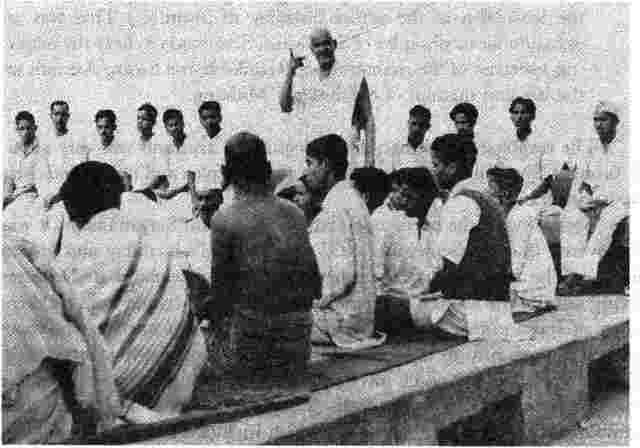
Advice from Swamiji at the Summer Training Course
Birthdays
The society celebrated the birthdays of all the prophets of all religions of the world. Of particular importance to the members, as well as the disciples and devotees of Swamiji, however, has been the Sivananda Jayanthi (birthday). The origin of these celebrations is interesting. In the year 1936 Swamiji had gone on tour. The idea of celebrating his birthday occured to the handful of disciples then living at Ananda Kutir, but they did not know the date of Swamiji’s birth. They had only learnt from Swamiji himself the year, the month and the constellation under which he was born. Among Swamiji’s disciples was an able astrologer — Swami Satyanandaji of Ceylon. They requested him to fix the exact date and, according to an astrological method, he drew up a horoscope. In the meantime, however, Paramanandaji had an idea. “Siva’s birthday we will celebrate on Sivaratri day,” he said, and the birthday in 1935 was actually celebrated on the Maha-Sivaratri day.
This is how Paramanandaji described the first ‘birthday celebrations’ at Ananda Kutir:
Then there were only six or seven inmates at Ananda Kutir. Once Swamiji had been to Sitapur to conduct sankirtan and hold sadhana classes there. I invited some mahatmas of Rishikesh to join us in a satsang. (We called it Swamiji’s Birthday, but I had not the least idea of the actual birthday of Swamiji.) That was an occasion for us disciples of Sri Swami Sivananda to hear the inspiring speeches of the mahatmas of Rishikesh and Swarg Ashram on the life and mission of Sri Swamiji Maharaj.
The response of the disciples and spiritual aspirants was very good. It brought Swamiji nearer the heart of the disciples and intensified their devotion to him.
According to the horoscope cast by Sri Swami Satyanandaji, it was discovered that 8th September 1937 was Swamiji’s birthday and golden jubilee. The authorities of the ashram decided to celebrate it. Devotees living outside the ashram welcomed the idea. Many came from different parts of India to take part in the celebrations. It was to them one more golden opportunity to have Swamiji’s darshan and listen to his words. Those who could not come invoked Swamiji’s blessings from their home towns by celebrating there itself. They all adopted the programme announced by the headquarters — which included common meditation in the early morning (brahmamuhurta), dawn procession round the roads singing the Lord’s name, feeding of sadhus and the poor, printing and distribution of leaflets containing Swamiji’s message and instructions, and a satsang or public meeting in which seekers after Truth had the benefit of the spiritual teachings of scholars, yogis and saints. At the conclusion there was invariably mass prayer for the welfare of the entire mankind. This actually proved to be another God-sent opportunity of enabling the gospel of divine life to spread further.
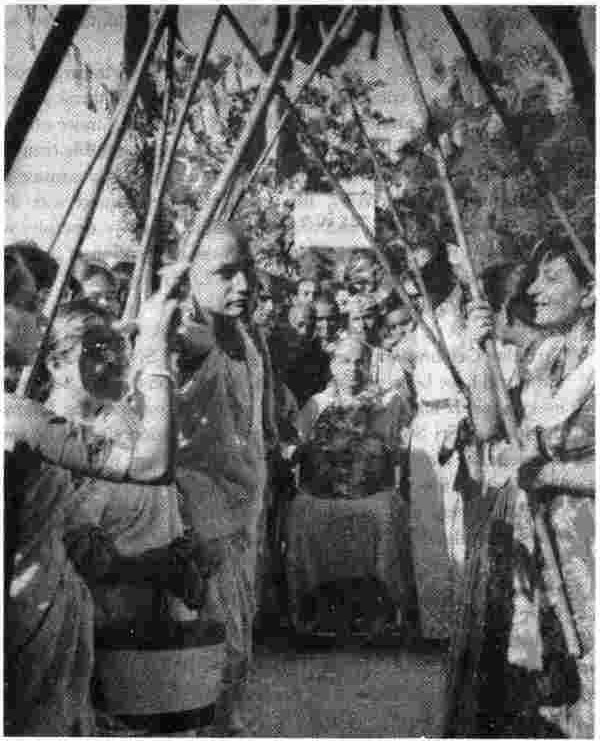
Guard of honour on Swamiji’s birthday
Since then, birthdays of Swamiji have been celebrated with greater and greater enthusiasm at the ashram and all over the world. After Swamiji’s All-India Tour in 1950 particularly, these celebrations assumed the magnitude of a great religious festival. In the big cities of India dynamic centres of the Divine Life Society organise the birthday celebrations on a scale which is in no way less than the headquarters celebrations themselves. They have been able to make up for the physical absence of Swamiji in those centres by invoking his spiritual presence, by sending a powerful beam of their combined thought-current to the lotus feet of Swamiji, and by listening to his glorious life and mission expounded by scholars and saints — often those who were closely acquainted with Swamiji and his message.
Whenever he took up a work which was aimed at bringing good to people, Swamiji was so intensely dynamic that he would think about it and make others think about it day and night. Better and more effective ways constantly suggested themselves to him. For a considerable time that particular section of the ashram would take on a festive appearance and be ever-humming with activity, till that which he wanted was done perfectly well in a methodical and routine manner. His own disciples who have imbibed this spirit manifested it even in the celebration of his birthday. The news item published in The Divine Life magazine of January, 1949, tells the rest of the story:
Birthday Celebration: Devotees of Sri Swami Sivanandaji all over the world have been celebrating his birthday on the 8th September every year. It has been the fervent prayer of some of the foremost disciples of Sri Swamiji that the commemoration should be more frequent, at least once a month, to enable them to carry within their hearts the continuous feast of the birth of Siva-anandam (auspiciousness and bliss). We are glad to report that this took effect from the 8th October, and since then the 8th of every month has been a great day of kirtan, prayer and spiritual sadhana at the ashram.
If it meant someone doing one mala of japa more than usual, a few moments of meditation or a pious act of selfless service, Swamiji himself would encourage the celebration of his birthday — or anyone else’s, for that matter — every day.
His Voice Immortalised
In October 1940 Swamiji visited Calcutta for the recording of his voice on gramophone discs. Sri Swami Kaivalyanandaji (a sannyasin-disciple of Swamiji who had organised the Publication League at Calcutta for the printing and publication of several of Swamiji’s works) had taken a keen interest in arranging with the Hindustan Musical Products to record the inspiring speeches and kirtans of Swamiji on gramophone discs. Swamiji utilised this opportunity of paying a visit to the biggest city in India, to create a spiritual stir there. He addressed several meetings in the city and returned to the ashram on the 13th November, 1940.
Thirteen records were made. Swamiji immensely liked the idea of the dissemination of his message and the names of the Lord in this manner. In a notification published later in The Divine Life he said: “Hear the songs just before going to bed and in the early morning, and you will enjoy supreme peace and highest bliss. This is both study of scriptures and meditation. You will be free from undesirable dreams. Your mind will be filled with purity. You will develop balance of mind, inner spiritual strength and strong will. There will be an inner urge to lead a spiritual life. This is constant satsang for you even in the busy world of noise, strife and turmoil. Live in the spirit of these teachings and attain moksha or emancipation in this very birth.”
Swamiji had another set of ten gramophone records made in 1944 when he went to Bombay.
Swamiji’s All-India Tour opened up yet another avenue for the immortalisation of his voice — magnetic tape recording. The first time his lecture was caught by the magnetic recording device was while Swamiji was at Dharmapuram early in October, 1950. His discourse at the public reception there was recorded and relayed on the very next day, to Swamiji’s own surprise. Once again, during the same tour while he was at Bombay, his discourse on the Bhagavad Gita was tape-recorded. Paramanandaji and Saradanandaji were charmed: it was such a thrill to be able to capture Swamiji’s voice as he spoke, and to listen to it immediately! As soon as Swamiji returned to the ashram in November, 1950, both these swamis went over to Bombay and purchased a tape-recorder for the ashram.
Such was Swamiji’s enthusiastic response to this novelty that he literally dedicated himself to its best use. The recorder arrived when he was convalescing at Dehra Dun hospital, but nothing could prevent him from spending hours at a stretch letting Saradanandaji record all his speeches and songs. (The doctors who were attending upon this extraordinary ‘patient’ were amazed at the energy Swamiji could muster at will.)
The following is one of the speeches he recorded:
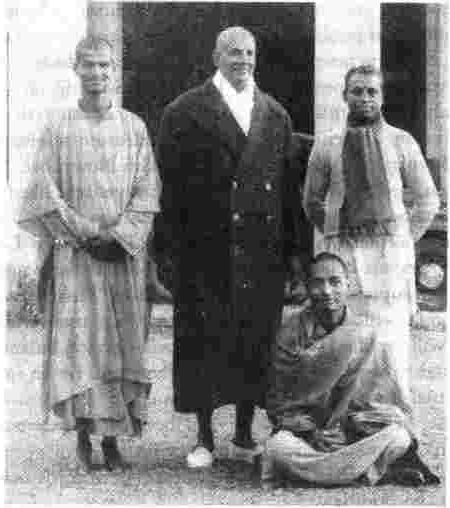
Outside Dehra Dun Hospital
O man! Do not be discouraged when sorrows, difficulties and tribulations manifest in the daily battle of life. Thou art the master of thy destiny. Thou art divine. Live up to it, feel it, realise it. Draw up spiritual strength and courage from within. Learn the ways to tap the source. Dive deep within. Sink down. Plunge into the sacred waters of immortality. You will be refreshed, renovated and vivified.
Understand the laws of the universe. Move tactfully in this world. Learn the secrets of nature. Learn the best ways to control the mind. Conquer the mind. Conquest of the mind is really conquest of nature and the world.
Do not murmur or grumble when troubles and sorrows descend upon you. Difficulties strengthen your will, augment your power of endurance and turn your mind towards God. Face them with a smile. In your weakness lies your real strength. Conquer the difficulties one by one. This is the beginning of a new spiritual life, a life of expansion, glory and divine splendour. Expand, grow. Build up all positive virtues — fortitude, patience and courage. Start a new life.
Have a new angle of vision. Arm yourself with discrimination, cheerfulness, discernment, alacrity and undaunted spirit. A brilliant future is awaiting you. Let the past be buried. You can work miracles. Do not give up hope. You can neutralise the effect of evil influences and the antagonistic dark forces that may come against you. You can nullify destiny — many have done so. Assert, recognise, realise thou art the immortal Self or Atman. Claim thy birthright now.
You have created your destiny through thoughts and actions. You can undo them by right thinking and right action. Wrong thinking is the root cause of human suffering. “I am the immortal Self” —this is right thinking. Work in terms of unity, work unselfishly, work with Atma-bhava (feeling that the self is all). This is right action.
There is no such thing as sin. Sin is only a mistake; it is a mental creation. The baby soul must commit some mistakes during the process of evolution. Mistakes are your best teachers. Think, “I am pure Atman,” and the idea of sin will be blown in the air.
Then Sri Swami Sivananda-Radha of Canada presented Swamiji with a tape-recorder and also took with her to Canada a number of tape-recorded songs and speeches of Swamiji. Her example was followed by a number of others.
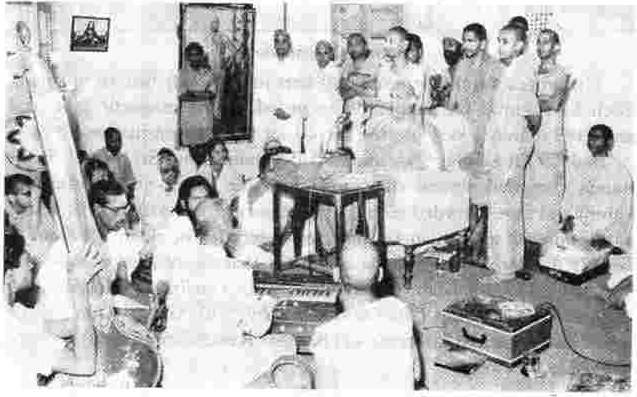
A recording session
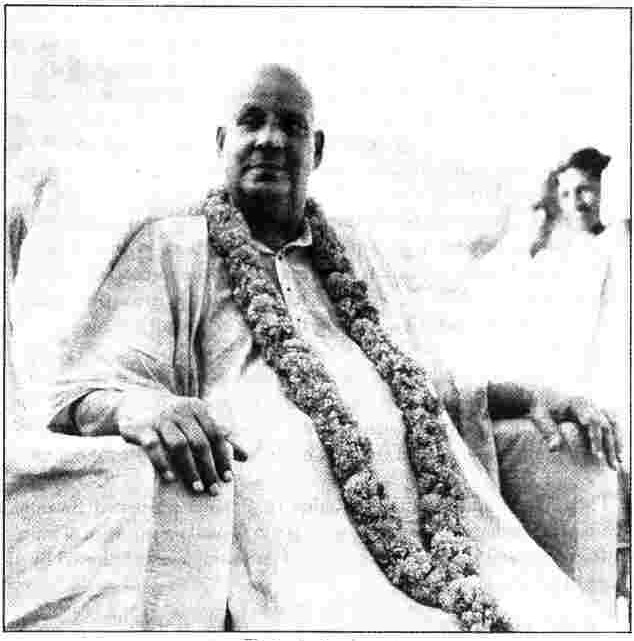
Majestic Sivananda
The proprietor of a firm of publishers in Germany had an inspiring speech by Swamiji on meditation recorded on the magnetic tape and transferred it onto a long-playing record for wide dissemination.
In 1959 Sri Swami Sivananda-Hridayananda and Sri Swami Shantananda compiled several dialogues from the songs and writings of Swamiji and tape-recorded them. The following ‘one act plays’ in which Swamiji himself took the main part were recorded by them: (1) Goal of Life, (2) A Morning with Sivananda, (3) Practice of Bhakti Yoga, (4) Vedanta for Modern Man, (5) Sivananda, the Darling of Children, (6) Bhagavad Gita, (7) Siva Gita (autobiography), (8) Ananda Gita (in the form of questions and answers), (9) Sangita Ramayana and (10) Essence of Bhagavatam (songs).