ॐ साई श्री साई सच्चिदानन्द साई
Om Sai Sri Sai Satchitananda Sai
The Greatest Secret
Parama Rahasya
Prema — love exclusively for God.
Whatever the sādhana, without prema it will not fructify.
We may practise meditation. We may undertake yoga, ātma-vicāra, japa, bhajana or seva. We may study the śāstras with great care, sit for long hours, observe disciplines and faithfully follow a method. But what gives all of this life?
Our Gurudeva has emphasised this point to such an extent that he has engraved it into our hearts.
On many an occasion, our Gurudeva has drawn our attention to a beautiful point made by Śrī Ramaṇa Maharṣi: even to abide in the Self, one needs much love. The Self is ever-present — yet the mind has countless objects toward which it can run. To turn from them again and again, and to remain, there must be something deeper than effort. There must be love.
Bhagavān Śrī Ramaṇa Maharṣi says the same thing at the end of Ātma Vidyā, and says it as an instruction rather than a sentiment. The verse climbs through what the Self is — the eye of the eye, the sky of the mind’s sky — and then, having arrived, it does not stop at seeing.
காணுமே; அருளும் வேணுமே; அன்பு பூணுமே; இன்பு தோணுமே.
kaanumae arulum vaenumae anbu poonumae inbu thoanumae
Annamalai, my Self, shines and will be seen. Grace too is needed. Be clothed in love. Bliss will appear.
அன்பு பூணுமே — aṉbu pūṇumē. Be clothed in love. The word is the one used for putting on a garland or a garment. Not summon it, not manufacture it, not wait until it arrives. Wear it. It is something you put on before you go in.
And what is it that keeps drawing us back? Śrī Ādi Śaṅkarācārya answers with no doctrine at all, only pictures.
अङ्कोलं निजबीजसन्ततिरयस्कान्तोपलं सूचिका साध्वी नैजविभुं लता क्षितिरुहं सिन्धुः सरिद्वल्लभम् । प्राप्नोतीह यथा तथा पशुपतेः पादारविन्दद्वयं चेतोवृत्तिरुपेत्य तिष्ठति सदा सा भक्तिरित्युच्यते ॥ ६१॥
ankolam nijabījasantatirayaskāntopalam sūchikā sādhvī naijavibhum latā kshitiruham sindhuh saridvallabham | prāpnotīha yathā tathā pashupateh pādāravindadvayam chetovrittirupetya tishthati sadā sā bhaktirityuchyate || 61||
The seeds of the aṅkola fall and go back to their tree. The needle springs to the magnet. The faithful wife turns to her husband, the vine to the tree, the river to the sea. When the mind moves like that — when it goes to the two lotus feet of Paśupati and simply stays there, always — that is what is called bhakti.
Not one of those five is making an effort. The seed is not disciplining itself toward the tree. This is what the ācārya of advaita chooses when asked to define devotion: not a striving but a homing — the mind’s own motion, once it has been given something to move toward.
Perhaps even the longing for liberation can be understood this way. Why seek Truth so relentlessly, why refuse to settle for anything less, unless Truth has become dear? Seen deeply enough, even mumukṣutva is love. Love for Truth.
It is worth pausing here with Bhagavān Ramaṇa. Ātma-vicāra did not begin with him; the inquiry into the Self belongs to the ancient current of the Upaniṣads. But Bhagavān became one of its great modern beacons, illuminating Self-inquiry with extraordinary clarity and directness, bringing seeker after seeker back to the source of the ‘I’. And this same Bhagavān poured out a garland of one hundred and eight verses to Aruṇācala.
சேராயெனின் மெய் நீராயுருகிக்கண் ணீராற்றழிவே னருணாசலா
saeraay enin mey neeraay urugi kan neer aatru azhivaen arunaachalaa
If you will not join me, my body will melt into water, and I shall perish in a river of tears, Arunachala.
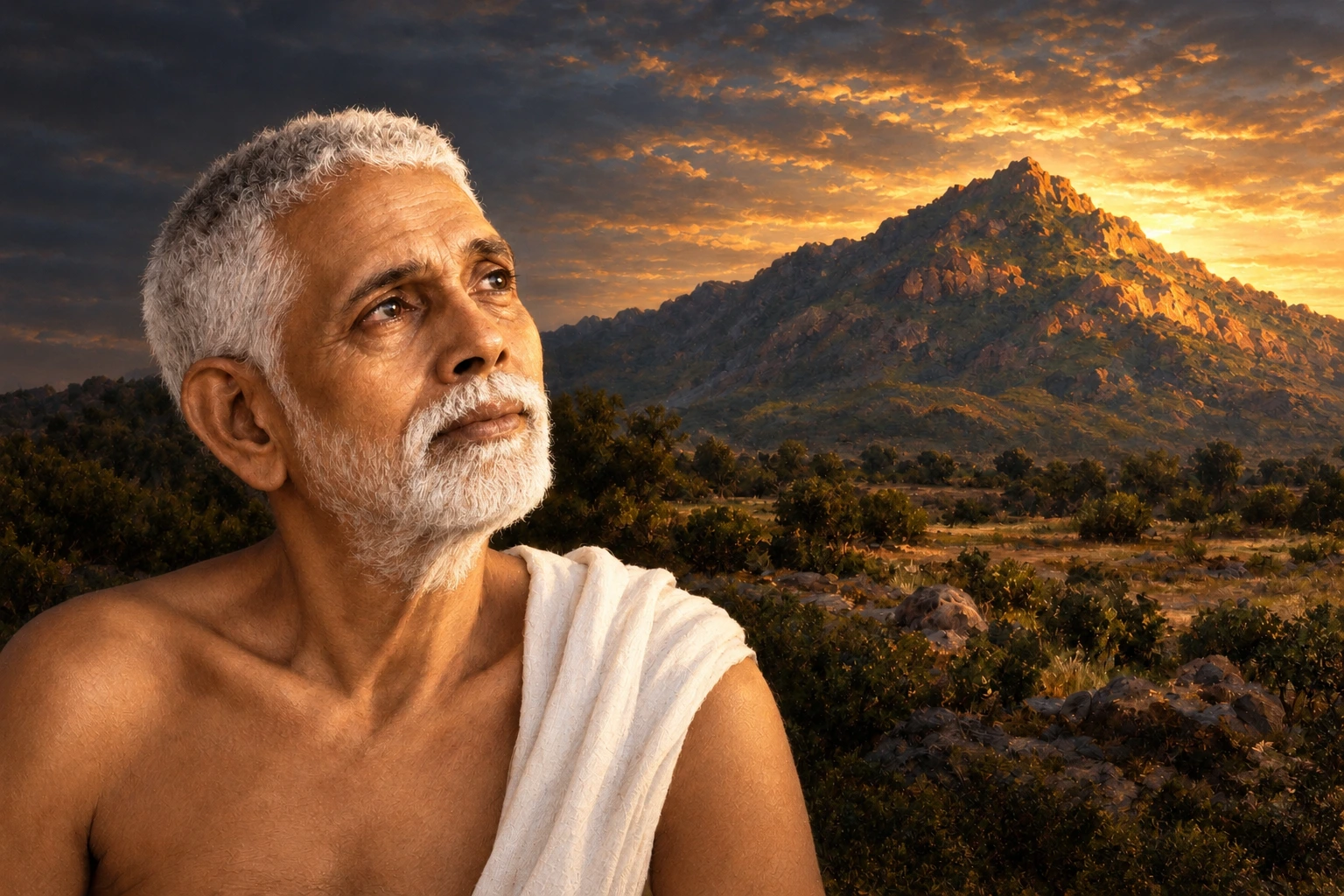
There is no method in that. No posture, no count, no hour set aside. It is a threat made by someone with nothing left to bargain with, and it is one of the most exact descriptions of sādhana anyone has left us. Later in the same garland he asks for something smaller and even more revealing: that the ear which receives the sweet words of lovers whose very bones melt might receive his poor words too. He does not place himself among them. He asks to be let in at the edge of their company.
The one who unerringly brought countless seekers back to Self-inquiry also showed us what it is to be consumed by love.
In the Tirumandiram there is a short section titled simply Śiva and Love, where Tirumūlar closes a distinction most of us never think to question.
அன்புசிவம் இரண் டென்பர் அறிவிலார் அன்பே சிவமாவ தாரும் அறிகிலார் அன்பே சிவமாவ தாரும் அறிந்தபின் அன்பே சிவமாய் அமர்ந்திருந் தாரே.
anbusivam iran denbar arivilaar anbae sivamaava thaarum arigilaar anbae sivamaava thaarum arinthabin anbae sivamaay amarnthirun thaarae.
Those without knowing say that love and Śiva are two. No one knows that love itself is Śiva. Once anyone knows that love itself is Śiva, they remain seated as love itself, as Śiva.
அன்பே சிவம் — aṉbē sivam. Not love leads to Śiva. Not love is a way of reaching Śiva. Love is Śiva. Which changes what prema is doing in a sādhana: it is not the fuel that carries us toward a destination somewhere ahead. It is the destination, arriving early, and letting us walk the rest of the way in its company.
The Upaniṣads are usually read for their statements. But they keep telling stories, and the stories carry something the statements cannot. When the Muṇḍaka describes how a seeker should approach a teacher, it adds one detail that has nothing to do with knowledge.
तद्विज्ञानार्थं स गुरुमेवाभिगच्छेत् समित्पाणिः श्रोत्रियं ब्रह्मनिष्ठम् ॥
tadvignyānārtham sa gurumevābhigachchhet samitpānih shrotriyam brahmanishtham ||
To know that, he should approach a Guru alone, kindling in hand, one who is Śrotriya and Brahma-niṣṭha.
Samit-pāṇiḥ. Fuel in hand. You do not arrive with a question. You arrive with firewood, because there is a fire to be kept and you have come to keep it.
A fire does not keep what is fed to it. It changes it. Tend one long enough, wanting nothing back, and what it finally burns through is not the wood — it is the sense of having arrived at all as someone apart from the flame.
That fire has a name of its own in the Gītā: jñānāgni, the fire of knowledge. It is not a metaphor borrowed for this article. It is what the Guru actually is to the one who has come with firewood.
यथैधांसि समिद्धोऽग्निर्भस्मसात् कुरुतेऽर्जुन ज्ञानाग्निः सर्वकर्माणि भस्मसात् कुरुते तथा
yathaidhāmsi samiddho'gnirbhasmasāt kurute'rjuna gnyānāgnih sarvakarmāni bhasmasāt kurute tathā
As a blazing fire reduces fuel to ashes, Arjuna, so the fire of jñāna reduces all actions to ashes.
What decides whether the wood is truly given to that fire, and not merely set down near it, is the attitude it is carried with. No attitude serves it better than love held one-pointedly: not one motive weighed against others, but the single, undivided kind that keeps a person returning to the same fire because there is nowhere else they would rather be. Approached that way, the fire does what fire does. It does not spare the wood.
The Chāndogya then shows what that looks like when it is carried all the way.
उपकोसलो ह वै कामलायनः सत्यकामे जाबाले ब्रह्मचार्यमुवास तस्य ह द्वादश वार्षाण्यग्नीन्परिचचार स ह स्मान्यानन्तेवासिनः समावर्तयंस्तं ह स्मैव न समावर्तयति ॥ ४.१०.१ ॥
upakosalo ha vai kāmalāyanah satyakāme jābāle brahmachāryamuvāsa tasya ha dvādasha vārshānyagnīnparichachāra sa ha smānyānantevāsinah samāvartayamstam ha smaiva na samāvartayati || 4.10.1 ||
Upakosala Kāmalāyana lived as a student of sacred knowledge with Satyakāma Jābāla. For twelve years he tended his fires. And though the teacher let other pupils return home, he did not let him return.
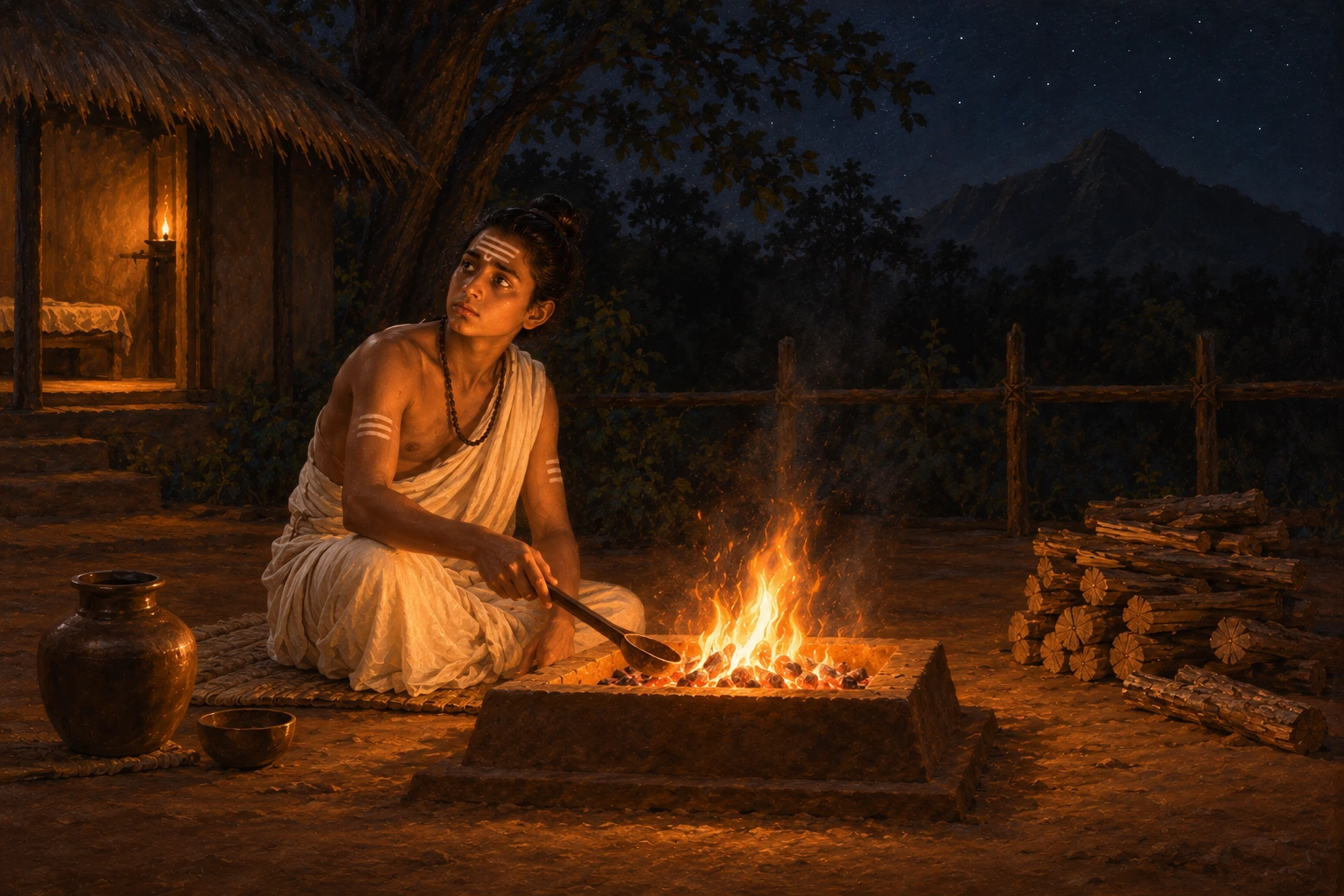
Twelve years. Not of meditation, or inquiry, or study — of tending fires. And at the end of them the other students are sent home taught, and he is not. The teacher’s wife pleads for him. The teacher listens, says nothing, and leaves on a journey without teaching him.
And then the story does something very tender. Upakosala is not angry. He is not owed anything and he knows it. He simply cannot eat.
And it is at exactly that point that the fires he has been tending for twelve years speak among themselves and say: this student has practised austerity and has tended us well — come, let us teach him. And they do. The fires. Not the teacher. The very thing he had been serving, day after day, with no instruction and no sign that it was being noticed, turns and instructs him.
But they will not finish. This is our knowledge and the knowledge of the Self, they tell him — but thy teacher will tell thee the way. And when the teacher comes home, he does not ask what Upakosala has learned. He looks at him.
भगव इति ह प्रतिशुश्राव ब्रह्मविद इव सोम्य ते मुखं भाति को नु त्वानुशशासेति को नु मानुशिष्याद्भो इतीहापेव निह्नुत इमे नूनमीदृशा अन्यादृशा इतीहाग्नीनभ्यूदे किं नु सोम्य किल तेऽवोचन्निति ॥ ४.१४.२ ॥
bhagava iti ha pratishushrāva brahmavida iva somya te mukham bhāti ko nu tvānushashāseti ko nu mānushishyādbho itīhāpeva nihnuta ime nūnamīdrishā anyādrishā itīhāgnīnabhyūde kim nu somya kila te'vochanniti || 4.14.2 ||
"My dear, thy face shines like one who knows Brahman. Who has taught thee?"
Twelve years of firewood, and what the teacher finally reads is his face.
And that sentence had been said to the teacher once. Satyakāma came to his own guru unable to name his father, was taken in on the strength of having told the truth about it — bring the fuel, my dear — and was sent away with four hundred lean cattle and told not to come back under a thousand. He was taught by a bull, by a fire, by a swan and by a bird on the water. When he came home his own teacher looked at him and said the same thing: thou shinest like one who knows Brahman. Who has taught thee?
So he knows what he is looking at, because it was once read on his own face.
It is worth saying plainly what carried Upakosala there, because it was not patience and it was not merit. Everyone else had gone home. He had done the same years and kept the same fires, and he was given no reason why he was the one left behind. His teacher’s wife spoke up for him and his teacher walked out of the house without a word. There is no reading of that which is fair, and Upakosala never once says it isn’t.
He does not argue. He does not go looking for another teacher. He stays and he keeps the fires, and when it finally breaks him it does not break as anger — he simply cannot eat.
What is hurting him is not the unfairness. It is the distance. He cannot bear to be away from him. That is love, and it is love with nothing in it for him.
He was not tending those fires to earn a teaching. If he had been, the twelve years would have been a price he was paying, and the silence would have turned him bitter instead of hungry. He tended them because they were his Guru’s fires, and that was reason enough.
And that love is what taught him, in the end. Not the study, not the years, not being owed anything. The fires he had served all that time with nothing to show for it turned round and taught him, and by the time his teacher came home there was nothing left to examine. It was already on his face.
Upakosala’s sādhana was firewood. It fructified.
The Bhāgavatam tells the same thing from the side of the one who gives. Brahmā has been performing austerity for an unimaginable span, wanting to know how to bring forth a world. The Lord appears — and before He gives anything, He says why He has come.
वरं वरय भद्रं ते वरेशं माभिवाञ्छितम् । ब्रह्मञ्छ्रेयःपरिश्रामः पुंसां मद्दर्शनावधिः
varam varaya bhadram te varesham mābhivānchhitam | brahmanchhreyahparishrāmah pumsām maddarshanāvadhih
Ask a boon, and may it go well with you; ask me, the lord of boons, for what you want. Brahmin, all a man's toil after what is good comes to its end in the sight of me.
All the toil comes to its end in the sight of Him. Not in its own completion, not in a quantity reached: the practice runs until the moment of seeing, and the seeing is what ends it. And in the verse just before, He says something easy to read past — that austerity is His very heart, and He is the self of austerity. The tapas was never a transaction being conducted at a distance. He was inside it the whole time.
Only then does He give the four verses the tradition has held ever since as the seed of the whole Bhāgavatam — and the line that announces them names what is being handed over.
श्रीभगवानुवाच । ज्ञानं परमगुह्यं मे यद्विज्ञानसमन्वितम् । सरहस्यं तदङ्गं च गृहाण गदितं मया
shrībhagavānuvācha | gnyānam paramaguhyam me yadvignyānasamanvitam | sarahasyam tadangam cha grihāna gaditam mayā
Bhagavan said: Take from me, as I speak it, the knowing of me that is the deepest secret, joined with the seeing that goes with it, together with what is hidden in it and all that belongs to it.
Jñānaṁ parama-guhyaṁ me. The knowing of Me that is the deepest secret. Then vijñāna, the seeing that goes with it — and then the two words that carry the weight: sa-rahasyam, with its mystery, and tad-aṅgam, and what belongs to it. The rahasya is prema-bhakti. The aṅga is the sādhana through which it is approached. So what the Lord offers Brahmā is not one thing but an order: there is knowledge, there is realisation, there is the secret, which is love — and there is the practice by which one comes near it.
The practice is named as the limb. The love is named as the secret.
And when Brahmā speaks of his own relation to the Lord, he does not call himself a servant or a student. He says he has been made a friend to a friend.
The Bhāgavatam then stops explaining prema and shows it instead. Uddhava is Śrī Kṛṣṇa’s closest confidant — learned, composed, deeply trusted — and he is sent to Vraja carrying a message, to console some unlettered cowherd women who cannot bear being parted from Śrī Kṛṣṇa.
He arrives expecting to console them. What he finds are women standing where ṛṣis, after lifetimes of tapas, are still labouring to arrive. They have no learning and no standing.
What carried them is love and nothing else — undivided, asking for nothing, unable to bear a moment of separation from Śrī Kṛṣṇa.
And the message he had carried all that way was not a comfort of the ordinary kind. Śrī Kṛṣṇa had sent them word that there had never been a separation at all.
भवतीनां वियोगो मे न हि सर्वात्मना क्वचित्
bhavatīnām viyogo me na hi sarvātmanā kvachit
There is no parting of you from me anywhere at all, since I am the self of everything.
He had come from Śrī Kṛṣṇa’s own side for a few days. He stayed for months — and the Bhāgavatam says those months passed for the people of Vraja like a single moment, because they were spent in talk of him. Uddhava was at home among them. At the end, he bowed to them, and sang.
आसामहो चरणरेणुजुषामहं स्यां वृन्दावने किमपि गुल्मलतौषधीनाम् । या दुस्त्यजं स्वजनमार्यपथं च हित्वा भेजुर्मुकुन्दपदवीं श्रुतिभिर्विमृग्याम्
āsāmaho charanarenujushāmaham syām vrindāvane kimapi gulmalataushadhīnām | yā dustyajam svajanamāryapatham cha hitvā bhejurmukundapadavīm shrutibhirvimrigyām
Let me be something in Vrndavana, some bush or creeper or herb, that has the dust of the feet of these women, who let go their own people and the way of the noble, so hard to let go, and took the road of Mukunda, which the Vedas go searching for.
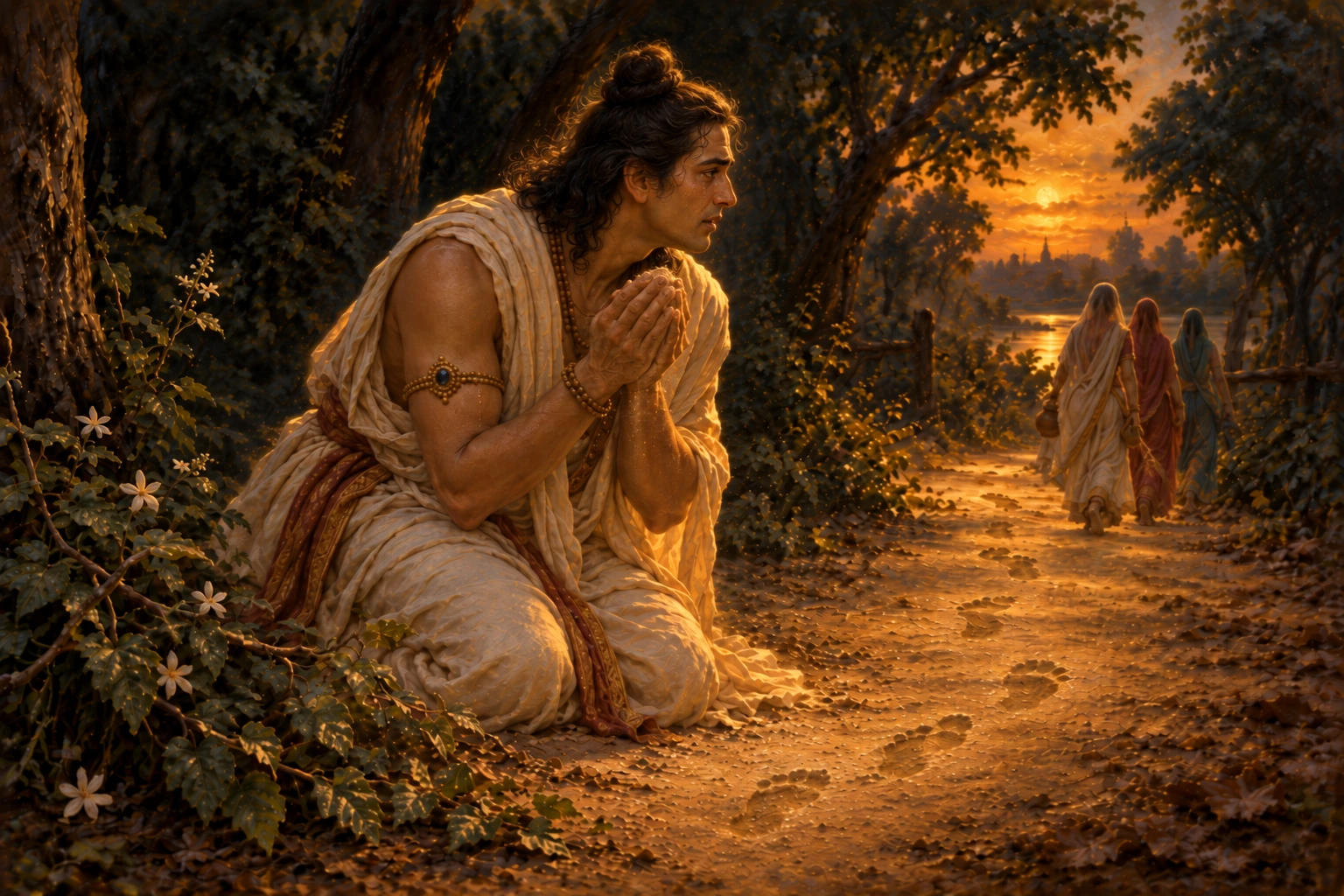
The road the Vedas go searching for, these women simply took.
The śruti is still looking. The gopīs are already there. Uddhava does not ask to be given their knowledge; he asks to be a shrub in the place where they walked.
Devarṣi Nārada, who watched all of this from closer than anyone, wrote it down in sentences short enough to be memorised.
सा त्वस्मिन् परमप्रेमरूपा ॥ 2 ॥
sā tvasmin paramapremarūpā || 2 ||
It is, in relation to Him, the form of supreme love.
The second sūtra of the book, and the word he reaches for is parama-prema. Not faith. Not worship. Not discipline. Supreme love — and that is the definition, the thing itself rather than a description of how it feels.
Nineteen sūtras on he is asked what that looks like, and he does not reach for a sage.
यथा व्रजगोपिकानाम् ॥ 21 ॥
yathā vrajagopikānām || 21 ||
As in the case of the cowherd women of Vraja.
Four sūtras after that he says what a cautious editor might have softened, and does not soften it.
सा तु कर्मज्ञानयोगेभ्योऽप्यधिकतरा ॥ 25 ॥
sā tu karmagnyānayogebhyo'pyadhikatarā || 25 ||
It is greater even than the paths of action, knowledge, and yoga.
Karma, jñāna, yoga — the three great roads, named and set aside in one breath. And a few sūtras on he explains why, in a way that settles what prema is for: devotion is itself the fruit. It does not earn something later. It is the thing that was being earned. He gives it a quality no practice has, too — increasing every moment, unbroken, subtler than the subtle. Every method we know has a ceiling and a session. This has neither.
The Gītā ends on the same word. Eighteen chapters of sāṅkhya and yoga, of karma and dhyāna and renunciation — the whole architecture of practice — and then Śrī Kṛṣṇa says he has one thing left to say, and reaches for the superlative he used with Brahmā: not parama-guhya this time but sarva-guhyatama, the most secret of all.
सर्वगुह्यतमं भूयः शृणु मे परमं वचः इष्टोऽसि मे दृढमिति ततो वक्ष्यामि ते हितम्
sarvaguhyatamam bhūyah shrinu me paramam vachah ishto'si me dridhamiti tato vakshyāmi te hitam
Hear again My supreme word, the deepest secret of all. You are deeply dear to Me; therefore I shall tell you what is for your good.
The second line is the reason, not an aside. Iṣṭo’si me dṛḍham — you are dearly loved by Me; therefore I shall tell you what is for your good.
And what the secret turns out to be is not a doctrine at all. It is four short instructions, and every one of them is relational.
मन्मना भव मद्भक्तो मद्याजी मां नमस्कुरु मामेवैष्यसि सत्यं ते प्रतिजाने प्रियोऽसि मे
manmanā bhava madbhakto madyājī mām namaskuru māmevaishyasi satyam te pratijāne priyo'si me
Let your mind be in Me; be My bhakta; worship Me; bow to Me. You shall come to Me alone. I promise you truly, for you are dear to Me.
Let your mind be in Me. Be My bhakta. Worship Me. Bow to Me. And then the promise — sealed with the same reason the passage opened with: priyo’si me, you are dear to Me. The most secret teaching in the Gītā sits between two declarations of affection, and they are what hold it up.
The highest teaching is what love does when it can no longer keep anything back.
And notice what those four instructions actually are. They are a practice, given by the Guru, to someone he loves. Which is the possibility love opens in any sādhana.
Then meditation is no longer merely my meditation. Japa is no longer a technique being performed to obtain a result. Seva is no longer a task. Inquiry is no longer a mechanical spiritual exercise. A different feeling enters:
The Guru has given this upadeśa. Let it become my life-breath, because there is nothing more important in my life than my Guru. Let my entire life become an offering to my Guru, and let sādhana and every spiritual practice become a means of expressing that love.
The outward sādhana may remain exactly the same. Everything inwardly has changed.
Bhagavān Ramaṇa puts precisely this into the next two verses of the Upadeśa Undiyār. He has just finished listing worship, recitation and meditation, in ascending order — and then he does not add a fourth practice to the list. He removes an assumption from underneath all three.
அனியபா வத்தி னவனக மாகு மனனிய பாவமே யுந்தீபற வனைத்தினு முத்தம முந்தீபற
aniya paavaththin avan agam aagum ananiya paavamae untheebara anaiththinum uththamam untheebara
Rather than Anya-bhāva, meditating on God as other than oneself, Ananya-bhāva, the meditation in which He is I, is certainly the best of all.
All of it so far had quietly assumed one thing: that He is over there and you are here. Drop that. Not the practice. The assumption.
Our Gurudeva says that prema is the greatest solvent. It dissolves resistance, attachment, me and mine — and, most wonderfully, even the one under the delusion that they are doing the sādhana.
This is where prema reveals a secret deeper still. At first there is still an ‘I’ doing and offering. Then love deepens. The offering becomes more important than the one making it; the Beloved more important than the one who loves; the Guru’s upadeśa more important than the preferences of the one practising it.
Somewhere along the way, almost unnoticed, the doer begins to lose its solidity. The very prema that gave life to the sādhana begins to dissolve the one who claimed to be doing it.
This is not a devotional flourish. It is the next verse of the Undiyār.
பாவ பலத்தினாற் பாவனா தீதசற் பாவத் திருத்தலே யுந்தீபற பரபத்தி தத்துவ முந்தீபற
paava palaththinaal paavanaa atheetha sath paavaththu iruththalae untheebara parabhakthi thaththuvam untheebara
By the strength of such meditation, being in Sat-bhāva, the state of being, which transcends all Bhāvanā, all thinking and imagining, that alone is the true nature of Parā-bhakti, supreme devotion.
An attitude is still something you are holding. What it ripens into is not held at all — it is simply being what is, with nobody left to have a view about it. And that, says Bhagavān Ramaṇa, is what the highest devotion actually is.
Not the strongest feeling. The end of the one who was feeling it.
The Gītā’s very next line does the same thing, and does it faster.
सर्वधर्मान् परित्यज्य मामेकं शरणं व्रज अहं त्वा सर्वपापेभ्यो मोक्षयिष्यामि मा शुचः
sarvadharmān parityajya māmekam sharanam vraja aham tvā sarvapāpebhyo mokshayishyāmi mā shuchah
Abandoning all dharmas, take refuge in Me alone. I shall free you from all sin; do not grieve.
Sarva-dharmān parityajya. Let go of all of them — every concept, every opinion, every personal agenda, every idea you have been carrying, every other priority. And then the other half of the line. Mām ekaṁ śaraṇaṁ vraja. Take refuge in Me alone. Do not grieve.
So the last instruction of the Bhagavad Gītā is not to stop holding on. It is to let go of everything else and hold to Śrī Kṛṣṇa alone — and nothing but love can hold. That is why it is said to someone who has just been told twice that he is loved.
And who had loved him long before any of it began. Not from a distance and not on ceremony — Arjuna kept him close, the one he turned to first, with nothing held back on either side.
Śrī Kṛṣṇa says so himself, fourteen chapters earlier, and makes it the reason the teaching was given at all.
स एवायं मया तेऽद्य योगः प्रोक्तः पुरातनः भक्तोऽसि मे सखा चेति रहस्यं ह्येतदुत्तमम्
sa evāyam mayā te'dya yogah proktah purātanah bhakto'si me sakhā cheti rahasyam hyetaduttamam
That same ancient yoga I have taught you today, because you are My devotee and friend; this is indeed the highest secret.
Devotee and friend — and therefore the highest secret. But they had been together all their lives and none of this had ever been said. What was new that morning was not the love and not the friendship. It was that Arjuna asked. Eighteen chapters earlier he had put down his bow and taken the lower seat for the first time — śiṣyas te’haṁ, I am your disciple — and asked to be told what was truly good for him. The supreme secret is the answer to that question, and Śrī Kṛṣṇa says as much when he gives it: therefore I shall tell you what is for your good.
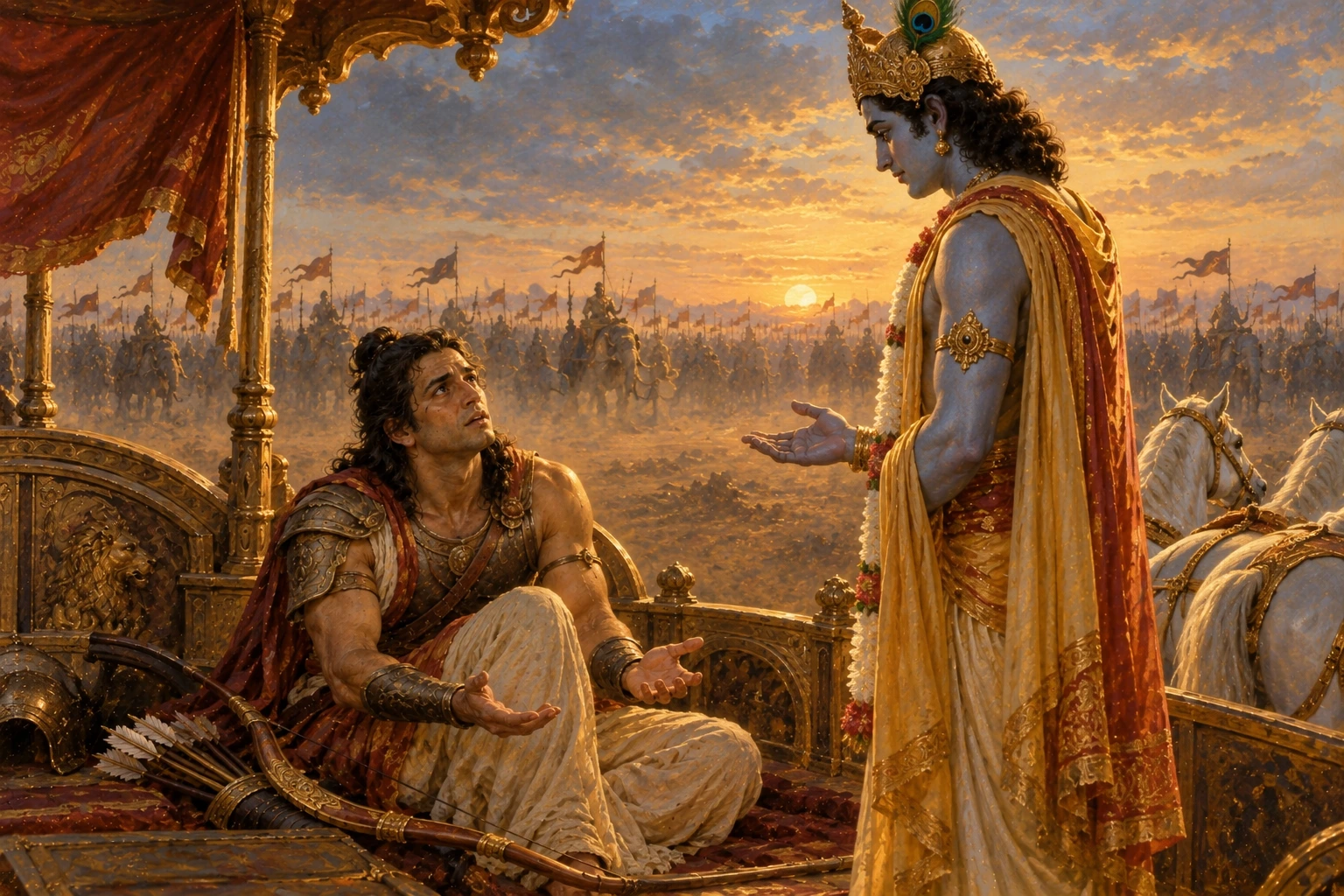
And he did not answer at the surface. Arjuna asked what to do about a battle. Śrī Kṛṣṇa did not answer the question; he answered the one asking it.
Bhagavān Śrī Ramaṇa Maharṣi answered the same way. He rarely answered the question that was put to him. He asked who was asking.
And there is a resonance here worth lingering over.
Mām ekaṁ śaraṇaṁ vraja. Take refuge in Me alone. That last word, vraja, is an imperative — go, proceed, come. It is the last thing Śrī Kṛṣṇa asks of anyone. It is also a name: Vraja is the cowherd country, the fold the herds are brought home to. And it is the word Devarṣi Nārada reached for when he was asked what supreme love looks like — yathā vraja-gopikānām.
Mām ekaṁ. Me alone. The women of Vraja have already shown what that looks like when it stops being an instruction and becomes a life.
No second refuge. No other priority. No competing beloved. No calculation of what will be gained.
Uddhava came to teach them and stayed to ask for the dust of their feet. The road the Vedas go searching for, the women of Vraja had already taken.
So the last word of the Bhagavad Gītā, after eighteen chapters of sāṅkhya and yoga and renunciation, is come — and it is also their name.
Vraja.
And the first thing this article quoted said what to wear on the way. From the other end of the country and the other end of a life, at the close of Ātma Vidyā: அன்பு பூணுமே — aṉbu pūṇumē.
Be clothed in love.
If that sounds like the meeting of two roads, Śrī Ādi Śaṅkarācārya had already written it as one. In the Vivekacūḍāmaṇi he ranks the means to liberation, puts devotion at the head of them — and then defines the word.
मोक्षकारणसामग्र्यां भक्तिरेव गरीयसी । स्वस्वरूपानुसन्धानं भक्तिरित्यभिधीयते ॥ ३२ ॥
mokshakāranasāmagryām bhaktir eva garīyasī | svasvarūpānusandhānam bhaktir ity abhidhīyate || 32 ||
Of everything that leads to liberation, devotion matters most. And here devotion means this: keeping your attention fixed, again and again, on your own true nature.
Svasvarūpa-anusandhānam. The seeking-out of one’s own true nature. That is his definition of bhakti — which is also, word for word, what ātma-vicāra is. Bhagavān Ramaṇa arrives there by taking the otherness out from under worship until devotion turns out to have been inquiry; the Ācārya arrives by naming devotion the greatest of all means and then saying it is inquiry. Para-bhakti and jñāna are not two roads that happen to reach the same town. Followed far enough, each turns out to have been the other all along — which is what Tirumūlar said in four lines, and what the gopīs did without saying anything at all.
And the Devī Gītā names the word this whole article is about — in the Goddess’s own voice, while she is saying what the Self is.
अत एव च नित्यत्वं प्रोक्तं सच्छास्त्रकोविदैः । आनन्दरूपता चास्याः परप्रेमास्पदत्वतः ॥ 2-17 ॥
ata eva cha nityatvam proktam sachchhāstrakovidaih | ānandarūpatā chāsyāh parapremāspadatvatah || 2-17 ||
Therefore those who know the true śāstra declare it eternal. Its nature is Bliss because the Self is the final and unsurpassed object of love.
Para-prema-āspada. The seat of supreme love. It is the same compound Devarṣi Nārada reaches for — he says bhakti is parama-prema toward Him; she says the Self is what supreme love is for. And then she gives a reason that is not a doctrine at all, but something anyone can check in themselves.
मा न भूवं हि भूयासमिति प्रेमात्मनि स्थितम् । सर्वस्यान्यस्य मिथ्यात्वादसङ्गत्वं स्फुटं मम ॥ 2-18 ॥
mā na bhūvam hi bhūyāsamiti premātmani sthitam | sarvasyānyasya mithyātvādasangatvam sphutam mama || 2-18 ||
The impulse ‘May I never cease to be; may I continue to be’ reveals this love of the Self. Since everything other than the Self is dependent appearance, My essential nature is plainly unattached.
Mā na bhūvaṁ, bhūyāsam. May I never cease to be; may I go on being. That wish is in everyone, it asks for nothing in return, and it has no object but oneself. The love is already there and already pointed at the Self, long before anyone thinks to look for it.
Bhagavān Śrī Sathya Sāī Bābā writes in the Sathya Sāī Vāhinī:
To love such an all-knowing, all-powerful principle of the Ātma — the state of the highest truth — to love it alone is to worship him. The Ātma alone is man's one and only beloved. To regard It as dearer than everything that exists in this world and the next — to hold this view is to worship him — this alone is the Veda's teaching. What the Vedas propounded is not some dreadful mass of harsh rules, nor is it a prison built of cause and effect. Rather, they propound that there is One, the Lord of all these laws, who abides and shines in every atom of physical substances and physical forces, and that by his command alone the five elements each perform their own tasks. This alone is the doctrine of Prema propounded in the Vedas.
He begins with the lotus leaf, and then allows the lesser motive without scolding it.
Just as the lotus-leaf, though it arises in water, is never wetted by that water, so must man live in this world — that is the highest truth. To love God while expecting a reward, whether in this world or the next, is good enough in itself; but since there is nothing dearer than God, to love him alone with a desireless Prema is the highest form of loving — that too is the inner meaning of this teaching. That is to say, to feel that I hold Prema only for the sake of loving God — this way of thinking is the Bharatiya conception of the highest truth.
And he gives it a story. Dharmarāja has lost an empire and is living in a Himālayan cave with Draupadi, grief-stricken, who asks how such a calamity could fall on the one who never left the path of dharma. He does not answer the question directly.
"Draupadi! Do not grieve. Look at these Himalayan mountains — with what sublime splendour, what greatness of beauty they shine! I take boundless delight in them. They give me nothing at all — but their sublimity,
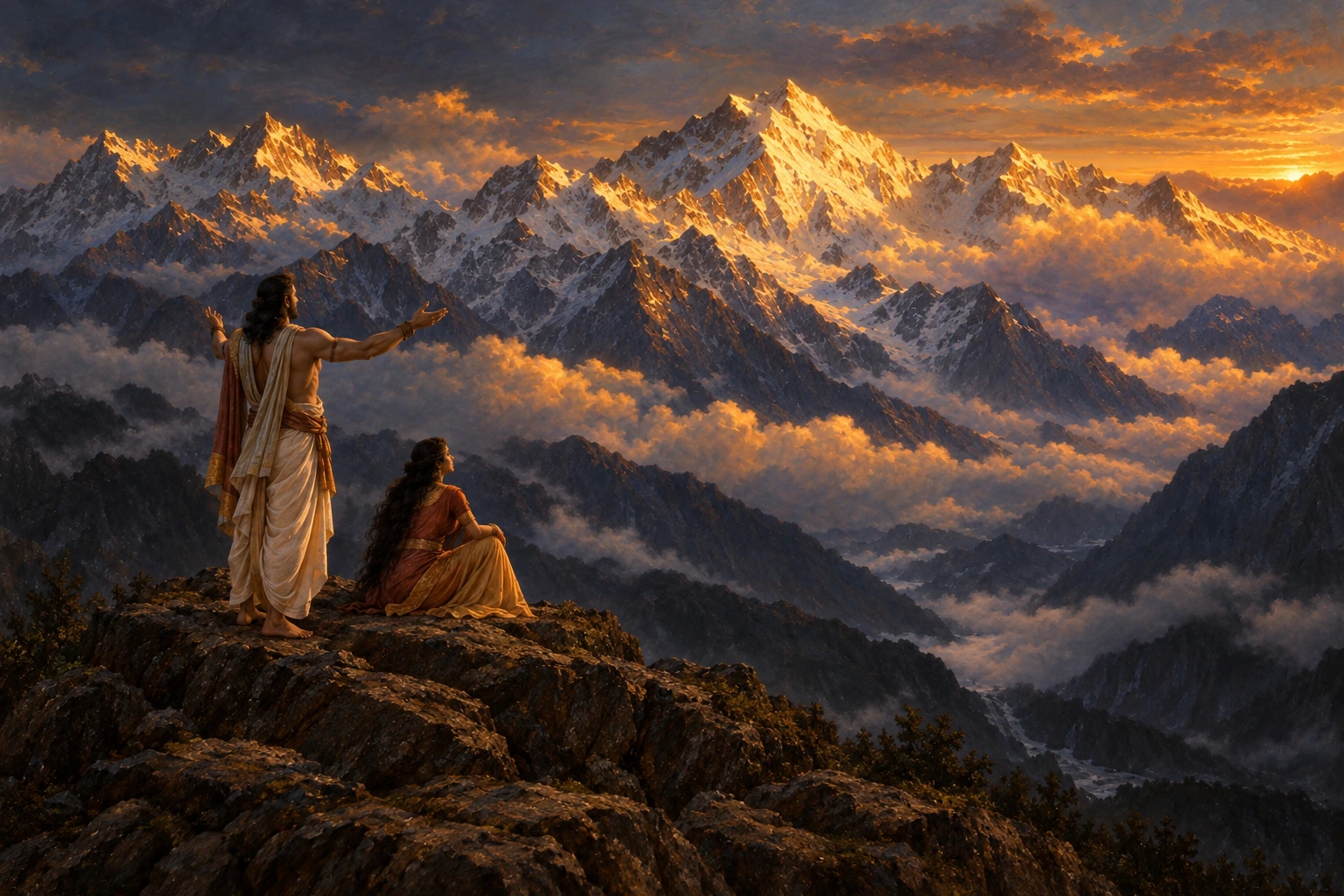
They give me nothing at all. That is the whole of it. And he is not finished — he turns from the mountains to the one they stand for, and answers Draupadi’s question at last, though not in the terms she asked it.
and beauty — to love these is my very nature. It is for this reason that I love and dwell here. That very embodiment of beauty is Paramātma. Hence, it is in loving Paramātma that this highest goal lies," he said. The one thing truly worth loving is Paramātma alone — this truth is what Bharatiya paramartha proclaims. This indeed is man's own nature. It is for this very reason that I love him. I want nothing from him, and ask for nothing whatsoever. Wherever it pleases him to place me, let him place me there. For my Prema, Prema itself is the highest goal. My Prema is not a commodity to be traded, O Draupadi!' — so Dharmaja answered. Dharmaja understood that Prema is a divine thing, and taught Draupadi that this Prema is the natural attribute existing at the very plane of the Ātma.
For my Prema, Prema itself is the highest goal.
Which turns this whole article’s question round. Not what my sādhana will get me: prema was never a means to anything else. It is its own goal.
When love is the goal, what was mechanical becomes intimate. What required constant self-discipline begins to be carried by love. And slowly sādhana escapes the little portion of the day that had been allocated to it.
It becomes like breathing. Like a heartbeat. We do not schedule the heart to beat for thirty minutes in the morning and then permit it to stop.
In the same way, when sādhana is nourished by prema, the distinction between practice and life begins to soften. Cooking can become sādhana. Working, and caring for someone, and silence, and speech, and difficulty, and seva. Even an ordinary moment of remembering. Because the secret was never merely what we were doing. It was for whom, and with what love, it was being done.
Upakosala did not have a practice. He had firewood, and twelve years, and someone he could not bear to leave.
Then the Guru’s upadeśa is no longer something remembered only when we sit for practice. It becomes life-breath. Sādhana is no longer confined to a portion of the day; life itself becomes the offering. And through prema, even the one who imagined that it was their life and their sādhana begins, quietly, to dissolve.
உன்னிடத்தி லொப்புவித்த வுள்ளத்தா லெப்பொழுது முன்னைக்கண் டெல்லாமு முன்னுருவா—யன்னியமி லன்புசெயு மன்னோ னருணாச லாவெல்கு மின்புருவா முன்னிலாழ்ந் தே.
unnidaththil oppuviththa ullaththaal eppozhuthum unnai kandu ellaamum un uruvaay anniyam il anbu seyum annoan arunaachalaa velkum inbu uruvaam unnil aazhnthae
A man whose heart is handed over to you sees you always and sees everything as your form. Loving without otherness, he triumphs, O Arunachala: he sinks deep into you, who are the very form of bliss.
அன்னியம் இல் அன்பு — anniyam il aṉbu. Love with no other in it. Which is where all of this has been pointing from the beginning, and why our Gurudeva keeps returning us to it.
One last thing, and it is not an argument. It is a sage’s heart, revealed.
Bhagavān Śrī Ramaṇa Maharṣi is the one this article began with — who reduced the whole path to a single question, who sat for decades in ātma-niṣṭhā, abidance in the Self, and who by any reckoning had nothing left to want. Among his nine gems to Aruṇācala, there is a verse that still asks for something anyway.
அண்ணா மலையா யடியேனை யாண்ட வன்றே யாவியுடற் கொண்டா யெனக்கோர் குறையுண்டோ குறையுங் குணமு நீயல்லா லெண்ணே னிவற்றை யென்னுயிரே யெண்ண மெதுவோ வதுசெய்வாய் கண்ணே யுன்றன் கழலிணையிற் காதற் பெருக்கே தருவாயே.
annaamalaiyaay adiyaenai aanda andrae aavi udal kondaay enakku oar kurai undoa kuraiyum kunamum neeyallaal ennaen ivatrai ennuyirae ennam ethuvoa athu seyvaay kannae undran kazhalinaiyil kaathal perukkae tharuvaayae
Annamalai, on the very day you took this servant as your own, you took my life and body. What lack can there be for me now? Faults and virtues: apart from you, I give them no thought. O my life, whatever you intend, do that. O dearest, give me only this, a flood of love for your two feet.
Read the middle of it slowly. On the very day you took this servant as your own, you took my life and body. What lack can there be for me now? Nothing is held back and nothing is being negotiated; even fault and virtue have stopped being his to weigh. And then whatever you intend, do that — not do what is best for me, which would keep the judgement in his own hands. He does not know what the intention is, and he does not ask.
So by the seventh line there is a sage with nothing to want, nothing to weigh, and nothing to ask for. And he asks for one thing.
காதற் பெருக்கே தருவாயே — kādhal perukkē tharuvāyē. Give me only the flood of love at your feet.
Tatpada is simply one place where a drop has spilt from an overflowing cup.
He opened a treasury and we are looting and raiding it joyfully.
And the treasure, the true inheritance, is prema — the Self, God.
This prema is the very elixir with which our Gurudeva — who is Love itself — has filled and transformed our hearts, until life itself has become Nityotsavam, Hṛdayotsavam, Premotsavam: an eternal celebration, a celebration of the Heart, a celebration of Love.
We end with a passage our Gurudeva holds as his favourite among the words of his Guru. It names the love this whole article has been about: the love that sees God in everything, and has no other in it.
The heart of the devotee flows with love of the Lord through constant remembrance and recitation of His name. Out of this stream of love, devotion emerges. One who is nourished by the nectar of Bhakti will have no desire for anything else. To be unaffected by joy or sorrow, gain or loss, praise or blame, to remain steadfast and unwavering in faith, is the hall-mark of true devotion. Affection, attachment, desire are natural qualities in man. When these qualities are directed towards God and when one is continuously engaged in good deeds, these qualities acquire purity and sacredness. Then a man becomes not only a great soul but can become divine.
The devotee is ever conscious that the universe is a manifestation of the Divine and is permeated by the Divine. His life is based on the recognition of the immanence of God in everything. This state of mind is called “Prema Advaitam” (unity in Love.) Through this love the devotee experiences his oneness with the Divine. Enjoying the bliss of this experience, the devotee does not even desire Moksha (Liberation from birth and death). Unremitting love of the Lord is everything for him. Such devotion is known as “Ananya Bhakti” (Devotion to God alone, where no other exists.)